Small Towns That Rot From the Inside
Puke Bitch
MOVIE REVIEWS
Puke Bitch
 -
- 


Genre: Horror, Thriller, Episodic
Year Released: 2025, 2026
Runtime: 37m
Director(s): Sam Tricomo
Writer(s): Sam Tricomo
Cast: Kimberly Cruchon Brooks, Jaclyn Iskow, Brandon Engel, Olivia Kiefer, Kelley Holcomb, Jalen Wilson Nelem, Zakiyyah BG
Where to Watch: shown at the 2026 Slamdance Film Festival
RAVING REVIEW: Is unexpected shock still effective when it’s tied to something real? PUKE BITCH declares its desires immediately as something uninterested in politeness. This isn’t an experience designed to ease viewers into its world or offer safety handrails. It drops you into an environment already steeped in neglect, cruelty, and unresolved trauma, then dares you to stay long enough to understand how that damage spreads. The result is a viewing experience that’s deliberately abrasive, heavy, and far more disciplined than its title might suggest.
The story centers on siblings Dove and Larry, whose bond is forged less through affection than shared survival. Their home life is defined by hostility and ridicule, with authority figures offering no real protection, only pressure. Sam Tricomo’s writing treats adolescence not as a transitional phase but as a prolonged exposure to instability in which curiosity and cruelty coexist without clear moral boundaries. Nothing about these characters is softened for audience comfort, and that honesty becomes one of the defining strengths.
Kimberly Cruchon Brooks delivers a performance that feels internal and unsettling rather than overtly expressive. Dove’s fascination with death isn’t framed as shock value or a gimmick. It’s quiet, observational, and disturbingly patient. The camera often persists just long enough to make that curiosity feel intimate, not voyeuristic. Brooks understands that the most unsettling aspect of Dove isn’t what she does, but how she absorbs it.
Brandon Engel’s portrayal of Larry operates on a different axis of damage. His desire for validation, especially from religious authority, feels transactional rather than spiritual. The series presents faith not as comfort, but as another system of control and attention, one that rewards obedience while ignoring harm. Engel balances bravado and insecurity without tipping into caricature, making Larry’s choices feel inevitable rather than impulsive.
Jaclyn Iskow’s presence as Janet introduces a slow-burn threat that wisely refuses to over-explain itself. It lets implication do the work, trusting the audience to recognize when fascination crosses into something far more dangerous. This patience is crucial. PUKE BITCH doesn’t rush to prove it’s horror. It allows dread to accumulate naturally through repetition, silence, and proximity.
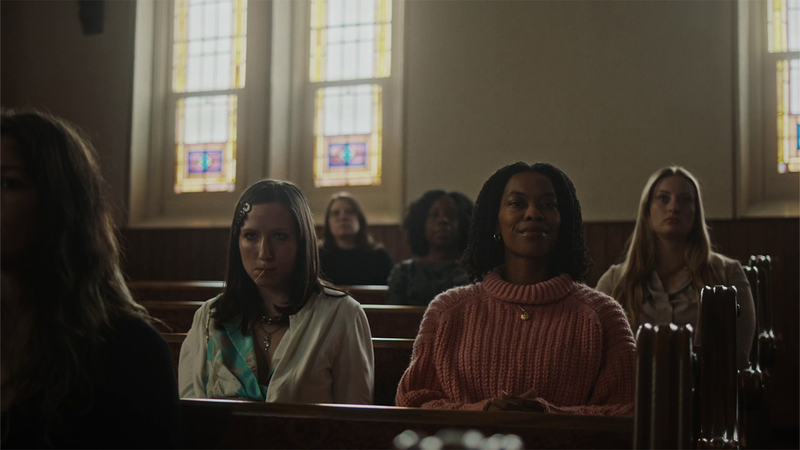
Leaning into bleakness without stylizing it into something alluring. The environments feel stripped down, ordinary, and suffocating. There’s no romantic decay here, only the banality of spaces where harm goes unnoticed because it’s routine. Reynard Lee’s cinematography favors stillness and distance, often placing characters at the edges of frames, reinforcing their emotional isolation.
Sound design and score are used sparingly, which makes their appearances more effective. The filmmakers often rely on ambient noise or near-silence, forcing viewers to sit with discomfort rather than be guided by musical cues. When the score does surface, it underscores unease rather than dictating emotion. This restraint keeps the episode grounded, even as its subject matter grows more disturbing.
What sets PUKE BITCH apart from other episodic horror is its refusal to chase momentum for its own sake. At thirty-seven minutes, it could have easily padded the runtime with exposition or shock. Instead, it commits to character observation. That choice won’t work for everyone; some people will insist on constant chaos, but it’s exactly what gives the series its identity. The horror here isn’t about what’s revealed, it’s about what’s normalized.
If there’s a risk, it’s that the experience demands patience and emotional endurance. PUKE BITCH doesn’t offer easy purification or clear morality angles. Some viewers may mistake that for indulgence, but it reads more as intention. This is a story about environments that fail children long before monsters enter the picture. By the moment the runtime reaches its closing moments, the damage is already done, and the horror feels earned rather than imposed.
PUKE BITCH succeeds by committing to its perspective. It doesn’t hedge, it doesn’t dilute its themes, and it doesn’t apologize for its discomfort. That confidence places it firmly among some of the year's strongest episodic offerings, especially for viewers willing to engage with psychological horror that’s deeply uncomfortable. PUKE BITCH isn’t here to be liked in the traditional ways. It’s here to be felt, and it understands exactly how long to hold your focus.
Please visit https://linktr.ee/overlyhonestr for more reviews.
You can follow me on Letterboxd, Instagram, Twitter, and YouTube. My social media accounts can also be found on most platforms by searching for 'Overly Honest Reviews'.
I’m always happy to hear from my readers; please don't hesitate to say hello or send me any questions about movies.
DISCLAIMER:
At Overly Honest Movie Reviews, we value honesty and transparency. Occasionally, we receive complimentary items for review, including DVDs, Blu-rays, CDs, Vinyl Records, Books, and more. We assure you that these arrangements do not influence our reviews, as we are committed to providing unbiased and sincere evaluations. We aim to help you make informed entertainment choices regardless of our relationship with distributors or producers.
Amazon Affiliate Links:
Additionally, this site contains Amazon affiliate links. If you purchase through these links, we may receive a commission. This affiliate arrangement does not affect our commitment to honest reviews and helps support our site. We appreciate your trust and support as you navigate these links.
