Fear Becomes a Form of Survival
The Haunting of Pennhurst
MOVIE REVIEW
The Haunting of Pennhurst
 -
- 
Genre: Documentary, Horror
Year Released: 2026
Runtime: 1h 21m
Director(s): Mike Attie, Nathan R. Stenberg, Katarina Poljak
Where to Watch: shown at the 2026 Tribeca Festival
RAVING REVIEW: THE HAUNTING OF PENNHURST starts like a ghost story, but the longer it goes, the clearer it becomes that the film isn’t interested in ghosts at all. It’s interested in systems. Institutions. Memory. The ways societies bury cruelty beneath euphemisms like “care” and “treatment” until the language itself almost starts to sound haunted. By the time the documentary settles in, the abandoned Pennhurst State School & Hospital stops feeling like a horror setting and begins to resemble an accusation.
That accusation carries so much impact because the film never treats Pennhurst’s history as history or as a long-forgotten past. The directors constantly connect past and present through the people working inside the Pennhurst Asylum haunted attraction, many of whom live with disabilities or conditions similar to those once institutionalized at the facility itself. On paper, that sounds almost too loaded to explore at the depths needed. A lesser documentary could’ve collapsed into exploitation or just outrage within minutes. Instead, THE HAUNTING OF PENNHURST becomes something more complicated and emotionally loaded.
What makes the documentary so effective is its refusal to turn anyone into a symbol. The performers inside the haunt aren’t framed as tragic figures reclaiming trauma through some narrative of empowerment. They’re workers, artists, horror fans, performers, friends, people searching for community, and people trying to survive the world they’re in. Sometimes those realities clash against the disturbing history surrounding them. The film allows those contradictions to exist without rushing to resolve them all.
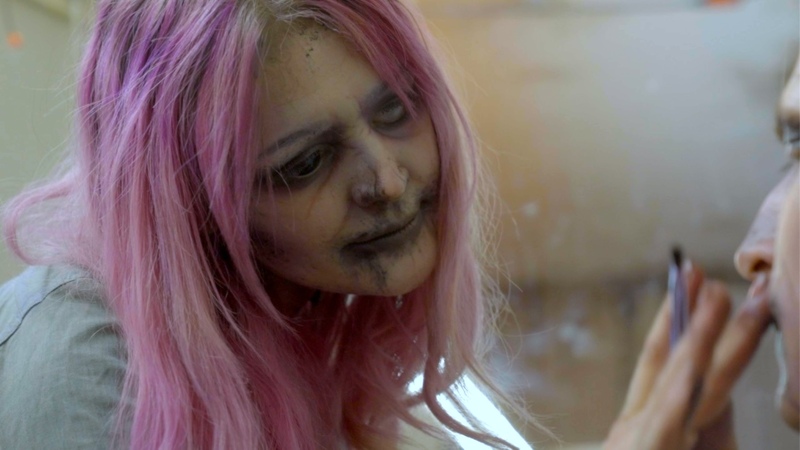
Directors Nathan R. Stenberg, Mike Attie, and Katarina Poljak also understand that horror can be undeniably powerful when used carefully. Rather than borrowing horror aesthetics, the documentary absorbs them into its visuals. Fog-filled hallways, twisted makeup, flashing lights, costumes, archival footage, and empty institutional spaces begin bleeding together until the line between attraction and history becomes intentionally unstable. The result feels less like a conventional documentary and more like a lingering panic attack.
There’s an effectively intense tension running throughout the film. The haunted attraction encourages audiences to stare, recoil, laugh, and seek thrills from exaggerated horrors and grotesque imagery. Meanwhile, the documentary forces viewers to confront the reality that disabled bodies were once treated as spectacles, burdens, or disposable problems hidden away from public view. THE HAUNTING OF PENNHURST keeps circling that uncomfortable reality without turning the performers themselves into objects of pity.
Autumn Werner emerges as one of the film’s emotional anchors because of the way she discusses performance and identity. The documentary repeatedly returns to the idea that “haunting” allows performers to manipulate the audience’s fear rather than merely be subjected to judgment themselves. That power shift becomes central to the film’s strength. Horror ceases to function purely as entertainment and begins to take on the form of authorship.
The archival material is devastating without being sensationalized. The directors avoid treating Pennhurst’s documented abuse only as shocking, designed to provoke reactions. Instead, the footage and documents accumulate slowly, building a portrait of institutional neglect so normalized that it became routine. The horror comes less from isolated atrocities than from the scale of indifference surrounding them.
I was blown away at how effectively the film balances rage with empathy. THE HAUNTING OF PENNHURST could’ve easily become a condemnation of the haunted attraction itself. At times, the documentary absolutely questions the ethics of monetizing a site connected to such profound suffering. But it also recognizes that the performers working there have complicated relationships with the space. Some find belonging there. Some find confidence. Some find catharsis. The documentary trusts audiences enough to sit inside those conflicting truths rather than simplifying them.
What separates THE HAUNTING OF PENNHURST from many socially conscious documentaries is that it never sounds like it’s lecturing from a safe distance. The filmmakers implicate audiences, too. Horror fans. Spectators. People are drawn to history while remaining emotionally detached from the suffering beneath it. The film repeatedly asks why society feels more comfortable turning trauma into entertainment than confronting the systems that created it in the first place.
There’s also an underlying anger throughout the documentary that gives it focus. Not performative outrage, but exhaustion. Exhaustion from erasure, institutional violence, and the way disabled communities continue being discussed more often than actually heard. THE HAUNTING OF PENNHURST gains much of its emotion from centering voices that history tried to hide alongside the institution itself.
THE HAUNTING OF PENNHURST ultimately becomes more than a documentary about a haunted attraction or a historical institution. It’s about the uneasy relationship between entertainment, memory, exploitation, and survival. The film understands that some places never stop being haunted, not because spirits remain trapped there, but because the consequences of what happened inside still shape the people living around them.
Please visit https://linktr.ee/overlyhonestr for more reviews.
You can follow me on Letterboxd, Instagram, Twitter, and YouTube. My social media accounts can also be found on most platforms by searching for 'Overly Honest Reviews'.
I’m always happy to hear from my readers; please don't hesitate to say hello or send me any questions about movies.
[photo courtesy of NAKED EDGE FILMS]
DISCLAIMER:
At Overly Honest Movie Reviews, we value honesty and transparency. Occasionally, we receive complimentary items for review, including DVDs, Blu-rays, CDs, Vinyl Records, Books, and more. We assure you that these arrangements do not influence our reviews, as we are committed to providing unbiased and sincere evaluations. We aim to help you make informed entertainment choices regardless of our relationship with distributors or producers.
Amazon Affiliate Links:
Additionally, this site contains Amazon affiliate links. If you purchase through these links, we may receive a commission. This affiliate arrangement does not affect our commitment to honest reviews and helps support our site. We appreciate your trust and support as you navigate these links.
