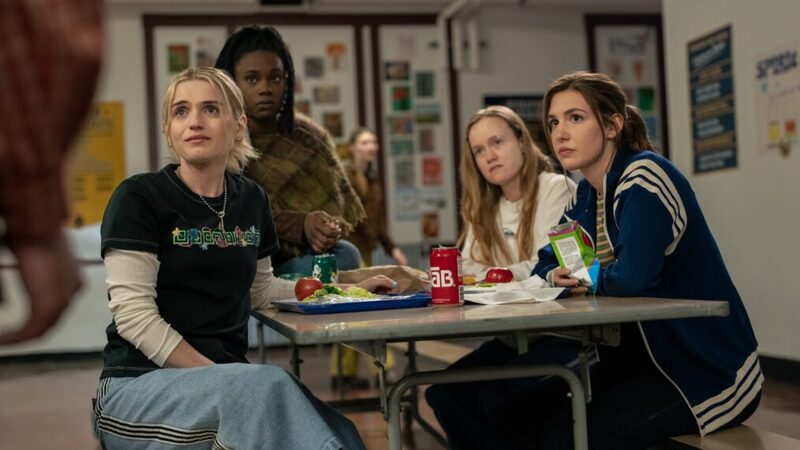
Survival Was Only the Beginning
Yellowjackets: Season 4
TV SERIES REVIEW
Yellowjackets: Season 4
 -


Genre: Psychological Horror, Mystery, Thriller, Drama
Year Released: 2026
Episodes: 10 x 1h episodes, with 8 for review
Creators / Showrunners: Ashley Lyle, Bart Nickerson
Writers: writing team led by Ashley Lyle and Bart Nickerson
Cast: Melanie Lynskey, Christina Ricci, Tawny Cypress, Sophie Nélisse, Jasmin Savoy Brown, Sophie Thatcher, Samantha Hanratty, Courtney Eaton, Liv Hewson, Hilary Swank, Warren Kole, Kevin Alves, Sarah Desjardins, Nia Sondaya, Jenna Burgess
Where to Watch: premieres on Paramount+ Premium, beginning November 20, 2026
RAVING REVIEW: After years of cannibalism, questionable decisions, complicated relationships, and enough unresolved trauma to keep several therapists employed for the rest of their lives, YELLOWJACKETS is approaching its conclusion. I love this wonderfully disturbing series; after binging the first three seasons in a few weeks, it’s so exciting to watch a story this ambitious bringing so many storylines together. Has every episode been perfect? Absolutely not. Have some characters made decisions that left me wondering how they survived this long? Without question. But the fourth and final season reminds us why this series became such an obsession in the first place. It's dark, sometimes absurd, deeply uncomfortable, and willing to explore the emotional damage that doesn't disappear just because someone survives the experience that caused it.
Created by Ashley Lyle and Bart Nickerson, YELLOWJACKETS began with a premise compelling enough to sustain the series. A high school girls' soccer team crashes in the Canadian wilderness, leaving its survivors to endure circumstances that gradually strip away their understanding of civilization. Rather than confining the story to their struggle for survival, the creators introduce a second timeline that follows the surviving members decades later. We know that some of them make it home, but the real mystery involves what happened before their rescue and how those experiences shaped the adults they became. This approach gives the series a distinct feel, allowing the consequences of the past to exist alongside what caused it all.
The fourth season carries major expectations. When a television series builds its reputation around mysteries, relationships, and the promise of answers, audiences understandably want it all to mean something. YELLOWJACKETS has never been interested in providing the easy way out. That almost joyful expectation of leaving people uncomfortable has been both one of its greatest strengths and a frequent source of frustration (for some). The final season brings that all into focus. Rather than introducing closure as something that will make everyone happy, the series continues to treat its characters as people whose experiences have left them damaged. This approach is honestly the only way it makes sense for a story that shows survival and recovery are two very different things.
One of the things I appreciate most about this final stretch is the attention it gives to bringing some of the storylines to nearly perfect conclusions. With so many characters and mysteries accumulated over the years, there was always a risk that the series would become more interested in adding than addressing the ones audiences had spent years following. The eight episodes I got to review gave me a much greater appreciation for the groundwork laid throughout the series. They don't erase every issue I've had along the way, but they reinforce why I remained invested. There's real satisfaction in recognizing that stories which occupied so much of the show are being treated as important parts of its conclusion. My favorite aspect is that I don’t think they’re going to answer everything, and that’s really the best decision they could have made.
Not everything needs a perfectly packaged explanation. One of the more divisive aspects of YELLOWJACKETS has always been its relationship with the supernatural. The series has repeatedly encouraged audiences to question whether the wilderness influences the survivors or whether their beliefs stem from trauma and desperation. It's an intriguing contradiction because both say something about the characters. If something supernatural exists, their understanding of reality has been compromised. If it doesn't, their decisions become even more unsettling. The show spent years exploring the space between those interpretations, and its ambiguity remains essential to its identity.
The wilderness timeline has always felt different because we already know that at least some of the characters eventually get “home”. That doesn't make their experiences any easier to watch. Instead, it changes what we're looking at. We're not waiting to discover who survives. We're watching people become versions of themselves that they never could have imagined before boarding that plane. Their relationships evolve under pressure, and the morality they once understood becomes difficult to maintain. By the fourth season, the approach of rescue carries implications beyond the relief of escaping isolation. Returning to civilization means confronting a world that doesn't understand what they've experienced or what they've done.
Sophie Nélisse, Jasmin Savoy Brown, Sophie Thatcher, Samantha Hanratty, Courtney Eaton, and Liv Hewson have helped make that timeline an essential component of the series. These aren't just younger versions of characters whose futures are being established. Their performances helped us understand the events and circumstances that shaped the adults we meet. Maintaining that connection across two different casts is enormous, especially when the younger characters face situations that fundamentally alter their personalities. The series benefited from performers who could give those changes the credibility they needed without reducing them to innocence lost.
The adult timeline faced greater scrutiny over the years from the die-hard fanbase, especially as its increasing outrageousness pushed the limits. I understand that criticism, and there have certainly been moments when the characters' behavior seemed designed to create chaos for its own sake. The contrast between those timelines is central to what YELLOWJACKETS is. The girls may have escaped the wilderness, but they carried so much into lives that were supposed to represent a return to normalcy. Their dysfunction is frustrating by design, even if some of the storytelling decisions haven't always been equally convincing.
Melanie Lynskey's Shauna remains one of the series' most fascinating examples. Adult Shauna has never been easy to defend, and the show has repeatedly challenged audiences to reconsider how much sympathy they're willing to extend to someone who can be that destructive. Sophie Nélisse's portrayal of the younger Shauna provides an important connection to the experiences that shaped her. Neither version exists independently of the other. That's what makes the dual-timeline structure so valuable. We understand the characters through a combination of who they were, who they became, and the distance between those two.
Christina Ricci and Samantha Hanratty have also made Misty one of the most memorable characters in the entire series (I’m a sucker for the broken insanity). Misty's mix of insecurity, intelligence, and confidence has delivered an enormous amount of uncomfortable humor, often at moments when things are anything but funny. She reminds us that YELLOWJACKETS has never been content to exist as a relentlessly grim survival story. The show's humor is often inappropriate, sometimes ridiculous, and frequently connected to behavior that would be horrifying outside the context of these characters. Honestly, I’ve always been able to forgive Misty more than anyone else; while she knows better, I can feel what it was like to be the outsider.
Tawny Cypress and Jasmin Savoy Brown add so much as Taissa, whose experiences blur the line between decision-making and forces she struggles to understand. The character has been essential to the show's exploration of identity, particularly the fear of losing control over your own behavior. YELLOWJACKETS returns to questions about how well people understand themselves, and Taissa makes those questions especially uncomfortable. The series doesn't limit psychological damage to visible symptoms or straightforward emotional responses. It's concerned with how people construct explanations for their behavior, including the ones they need to believe to keep living with themselves.
The final season benefits from the history established through characters such as Lottie, Van, Natalie, and the larger supporting ensemble. One challenge for a series with this many interconnected relationships is finding space for everyone without turning the story into a collection of conclusions and answers. Some characters receive more attention than others, and the audience's investment won't necessarily be distributed evenly. I appreciate that the show has never treated its ensemble as interchangeable survivors. Their individual approaches to guilt, belief, loyalty, and self-preservation have created disagreements that continue to matter long after the original circumstances have changed. I think what makes the series stronger is that it has a “core cast,” but that doesn’t mean it focuses only on them, and season four proves why that works so well.
The first season introduced a compelling mix of mystery and character exploration, encouraging audiences to build theories around every detail. As the series continued, expectations expanded alongside the mythology. Every unanswered question became another opportunity for speculation, and every new development faced scrutiny over whether it justified the attention audiences had given it. That's a difficult bar for any television series, particularly one that deliberately encourages uncertainty.
Something I’ve always admired is the show's refusal to show its characters as inspirational examples of survival. These women aren't necessarily better people because they endured something terrible. In many cases, their experiences have made them difficult to understand and far less capable of maintaining healthy relationships. That's an uncomfortable approach, especially in a culture that frequently expects trauma stories to end with growth and healing. YELLOWJACKETS has never promised that suffering makes someone wiser. Sometimes it leaves people angry. Sometimes they become manipulative or desperate to control what reminds them of their helplessness. The series recognizes that surviving doesn't automatically mean understanding.
This all becomes increasingly important as the story approaches the point where the younger survivors return to the world they once knew. Rescue has always been an inevitable part of the series, but knowing that it happens doesn't tell you what it means for the people involved. The idea of going home carries an expectation of relief. YELLOWJACKETS has spent its entire existence challenging that expectation through the lives of the adult survivors.
For me, the fourth season's greatest strength is that it makes the years spent following these characters feel connected. A long-running mystery can become exhausting when the accumulation of questions outweighs the reasons anyone cared. YELLOWJACKETS approached that territory at different points. Yet the final season gives the existing storylines renewed importance without requiring the series to abandon its darker personality. The progression toward resolution is satisfying because the characters remain complicated. Their histories haven't been simplified to serve the ending, and the show keeps reminding us that some consequences can't be undone.
It's difficult to discuss a season like this without revealing things that deserve to remain a surprise, particularly when so much of its appeal depends on understanding how established stories develop. The temptation is to point toward individual moments as evidence of why everything works, but doing so would undermine the experience for anyone who has spent years waiting to discover what happens. What I can say is that the eight episodes made available for review have reinforced my appreciation for the series as a whole. The characters have been through hell and back, and this final chapter understands the importance of giving their experiences the attention they deserve.
Two episodes remain, including the series finale. I can't judge the full ending or claim that every remaining question gets answered (I hope they don’t). That's an important distinction when discussing a series whose reputation has been built around the anticipation of its conclusion. My enthusiasm comes from what these eight episodes accomplish, not from assumptions about how the final two will resolve. They establish a direction for the farewell, and they've given me plenty of reasons to feel optimistic about where the story is heading. After spending so much time with these characters, I appreciate that.
It’s never been easy to love everyone in YELLOWJACKETS. Characters can be selfish, reckless, cruel, and horrid at recognizing the consequences of their actions. Yet those imperfections have also made the story far more interesting than a conventional tale about overcoming adversity. The fourth season embraces that and brings these women to this point, letting the approach of an ending carry genuine emotion. After all the arguments about which season (three) was strongest and whether individual mysteries were worth the investment, I'm reminded of how much I've enjoyed spending time with this deeply damaged collection of people. They're terrible at making good decisions, and I'm going to miss them!
For a show that began with a group of teenagers desperate to survive long enough to return home, YELLOWJACKETS spent years demonstrating that getting what you want doesn't necessarily mean escaping what happened to you. The final season brings that idea full circle while rewarding the investment audiences have made in its characters and their complicated histories. It's not a flawless journey, and I wouldn't pretend otherwise. There's something about seeing a series with such an unusual approach reach its conclusion without forgetting what made it work in the first place. Eight episodes into its farewell, YELLOWJACKETS has given me a bloody good reason to remain invested. Whatever happens in the final two episodes, I'm grateful this strange, disturbing series has had the chance to bring its story to a proper close.
Please visit https://linktr.ee/overlyhonestr for more reviews.
Follow me on Letterboxd, Instagram, Twitter, and YouTube. You can also find my social media accounts on most platforms by searching for 'Overly Honest Reviews'.
I’m always happy to hear from my readers; please don't hesitate to say hello or send me any movie questions.
[photo courtesy of PARAMOUNT+, CREATIVE ENGINE ENTERTAINMENT, ENTERTAINMENT ONE, LIONSGATE TELEVISION/NBC, PARAMOUNT TELEVISION STUDIOS, EONE TELEVISION]
DISCLAIMER:
At Overly Honest Movie Reviews, we value honesty and transparency. Occasionally, we receive complimentary items for review, including DVDs, Blu-rays, CDs, Vinyl Records, Books, and more. We assure you these arrangements do not influence our reviews, as we are committed to unbiased, sincere evaluations. We aim to help you make informed entertainment choices regardless of our relationship with distributors or producers.
Amazon Affiliate Links:
This site also contains Amazon affiliate links. If you purchase through these links, we may receive a commission. This affiliate arrangement does not affect our commitment to honest reviews and helps support our site. We appreciate your trust and support as you navigate these links.
