Two Women the System Never Planned For
Ponies
MOVIE REVIEW
Ponies
 -
- 

Genre: Espionage Thriller, Drama
Year Released: 2026
Runtime: 8 episodes x ~60m
Creator(s): Susanna Fogel, David Iserson
Director(s): Susanna Fogel, Viet Nguyen, Ally Pankiw
Writer(s): Susanna Fogel, David Iserson, Rosa Handelman, Carolyn Cicalese, Jordan Riggs
Cast: Emilia Clarke, Haley Lu Richardson, Adrian Lester, Artjom Gilz, Nicholas Podany, Petro Ninovskyi, Vic Michaelis
Where to Watch: premieres on Peacock January 15, 2026
RAVING REVIEW: What does power look like when the world has already decided you don’t have any? PONIES begins with that question embedded deep in its DNA, not as a slogan or thesis, but as its core message. Set in 1977 Moscow, the series doesn’t treat espionage as a fantasy of dominance or bravado. Instead, it frames spycraft as an act of endurance, adaptation, and emotional intelligence, told through two women who were never meant to matter to that world and therefore become dangerous precisely because of it.
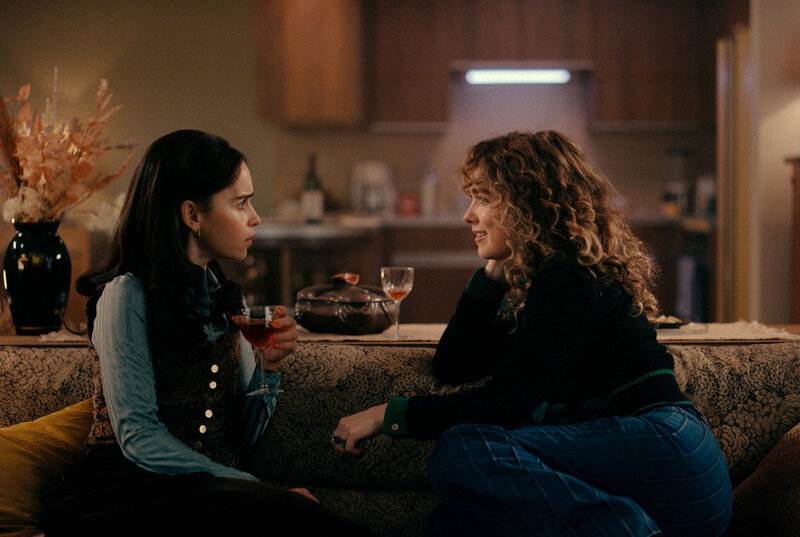
The show’s greatest strength is its vision and perspective. PONIES knows exactly whose story it’s telling and why. Bea and Twila aren’t outsiders accidentally wandering into espionage; they’re women systematically underestimated by their time, their institutions, and their peers. The series understands that invisibility can be weaponized, and it builds its tension not around physical dexterity, but around misdirection, psychological pressure, and the art of being ignored until it’s too late.
That perspective isn’t accidental. According to the creators, PONIES was born out of a fascination with Cold War failures rather than successes, specifically the CIA’s inability to recruit women in Moscow during this period. Rather than rewriting history to give Bea and Twila implausible proficiency, the series commits to something far more interesting: letting them be ordinary, observant, and grounded as they learn what power actually looks like inside the system.
Emilia Clarke delivers a career-defining performance as Bea, a woman trained to excel. Clarke plays with this idea of anxiety not as fragility, but as hyper-awareness. Every look, pause, and recalibration feels intentional, the result of someone constantly measuring the room because she’s learned that mistakes are punished harder when you’re expected to stay in your lane. As the season progresses, Bea’s transformation isn’t about becoming fearless; it’s about learning that her intellect, instincts, and emotional discipline are already her greatest forms of strength.
Haley Lu Richardson’s Twila is the perfect counterweight. Loud, impulsive, and unapologetically abrasive, Twila initially offers chaos and a lot of it. Richardson makes the crucial choice to let that swagger feel defensive rather than performative. Beneath it all is grief, shame, and survival, worn like armor. The show allows Twila to be difficult without punishing her for it. Her fearlessness isn’t romanticized; it’s contextualized as someone daring the world to reject her so she doesn’t have to feel abandoned again.
The chemistry between Clarke and Richardson is the beating heart of the series. PONIES understands that partnership doesn’t need romance to be the primary focus. Their bond becomes the moral center, a relationship defined by mutual recognition rather than obligation. In a genre that often isolates its heroes, PONIES insists on connection as a form of resistance. These women don’t become stronger by standing alone; they survive because they choose each other.
The Cold War setting is more than aesthetic, although it nails that visual with perfection. PONIES uses the era to explore contradictions, especially the cultural dissonance around feminism, ambition, and visibility. The show resists revisionism. Women are told it’s their moment, yet boxed into narrow roles. Progress exists, but it’s slow, compromised, and uneven. That tension mirrors the espionage itself: everything is in transition, nothing is stable, and alliances are never permanent.
The show’s visual style is also deeply intentional. Shot in a 3:2 aspect ratio to echo 1970s television rather than modern widescreen format. Production design and costuming draw directly from period Russian interiors, where clashing wallpaper and bright colors became subtle acts of self-definition. That same philosophy carries into the music, which blends period-accurate radio with a character-driven score that keeps the series lively even when the stakes turn deadly.
The production design leans into the colors, patterns, and textures of the day, rejecting the grayscale minimalism often associated with Cold War thrillers. The choice pays off. The world feels alive, expressive, and slightly surreal, reinforcing the idea that individuality persists even in systems designed to suppress it.
The season manages to show surprising restraint. The plot moves forward without sacrificing character integrity. Espionage here is slow, procedural, and often frustrating by design. Information must be earned, not extracted. Mistakes linger. Consequences ripple. The series refuses to turn its leads into experts, which grounds the danger in plausibility rather than fantasy. This series trusts the audience to pay attention, to sit with tension, and to read between the lines. For those willing to meet it on that level, the payoff is substantial. For others, the restraint may feel too demanding. That’s not a flaw but a declaration of intent.
By the time the season reaches its final stretch, PONIES has fully articulated its identity. It’s a spy thriller that treats emotional intelligence as a tactical advantage. It’s a feminist story that doesn’t flatten its politics into slogans. It’s a period piece that feels alive rather than embalmed. Most importantly, it’s a series that understands how power actually works: quietly, unevenly, and often in places no one is looking.
PONIES stands as one of the most confident espionage series on television in recent years. It doesn’t just flip the genre’s expectations; it interrogates why those expectations existed in the first place. The result is thrilling, smart, emotionally grounded television that knows exactly what it’s doing and never apologizes for it.
Please visit https://linktr.ee/overlyhonestr for more reviews.
You can follow me on Letterboxd, Instagram, Twitter, and YouTube. My social media accounts can also be found on most platforms by searching for 'Overly Honest Reviews'.
I’m always happy to hear from my readers; please don't hesitate to say hello or send me any questions about movies.
[photo courtesy of PEACOCK, ALL THE TIME ALL, DAVID ISERSON ENTERPRISES, PACESETTER PRODUCTIONS, UNIVERSAL TELEVISION]
DISCLAIMER:
At Overly Honest Movie Reviews, we value honesty and transparency. Occasionally, we receive complimentary items for review, including DVDs, Blu-rays, CDs, Vinyl Records, Books, and more. We assure you that these arrangements do not influence our reviews, as we are committed to providing unbiased and sincere evaluations. We aim to help you make informed entertainment choices regardless of our relationship with distributors or producers.
Amazon Affiliate Links:
Additionally, this site contains Amazon affiliate links. If you purchase through these links, we may receive a commission. This affiliate arrangement does not affect our commitment to honest reviews and helps support our site. We appreciate your trust and support in navigating these links.
