Mourning in a Room That Won’t Listen
Them That's Not
MOVIE REVIEWS
Them That's Not
 -
- 

Genre: Drama, Short
Year Released: 2025, 2026
Runtime: 18m
Director(s): Mekhai Lee
Writer(s): Mekhai Lee
Cast: Angel Theory, Biko Eisen-Martin, Carrie Compere, Erika Hamilton, Blake McLennan, Mykee Selkin
Where to Watch: shown at the 2026 South by Southwest (SXSW) Film & TV Festival
RAVING REVIEW: THEM THAT’S NOT starts inside a family gathering that feels familiar and immediately alienating. A moment like this should be communal and connective, a time when shared loss pulls people closer. Instead, writer/director Mekhai Lee frames it as a space thick with unspoken distance, emotional misalignment, and the calm violence of being unseen. The film’s power doesn’t come from dramatic confrontation but from the ache of coexistence, the way grief can feel isolating even when you’re surrounded by people who share your blood.
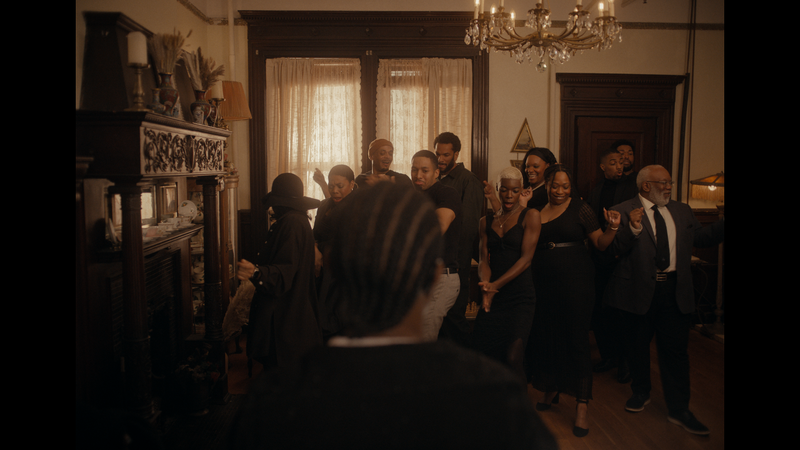
Andrea “Drea” Stoney, played with a focused clarity by Angel Theory, is a Deaf, queer poet navigating her grandmother’s passing in a family that largely doesn’t speak ASL. That fact alone establishes the film’s emotional axis. Communication exists, but connection doesn’t. Conversations happen around her, not with her. Mourning becomes something she witnesses rather than is allowed to participate in. The film never exaggerates this disconnect, and it doesn’t need to. The isolation is built into the blocking, the framing, and the pulses of the gathering itself.
The arrival of Drea’s estranged father, Samuel, temporarily released from prison to mourn his mother, shifts the emotion without resolving it. Biko Eisen-Martin plays Samuel with restraint and weariness, avoiding the temptation to soften the character to compromise. His presence isn’t redemptive, and the film never pretends it is. Instead, it becomes another layer of tension, a reminder that time lost doesn’t pause just because grief demands a truce.
What THEM THAT’S NOT does exceptionally well is refuse shortcuts. There’s no grand emotional breakthrough, no sweeping forgiveness, no manufactured moment of healing. The film understands that, when it comes at all, reconciliation is often fragile and incomplete. Drea and Samuel’s interactions are tentative, shaped as much by what’s missing as what’s present. The film allows that discomfort to sit unresolved, which makes their moments of connection feel honest rather than cathartic.
Angel Theory’s performance is the emotional focus of the film. Her presence, her use of ASL, and her stillness within crowded frames speak volumes without a word being spoken. The film doesn’t treat her Deafness as a thematic device. It’s simply the reality through which everything else is filtered. That perspective shapes the audience’s experience in subtle but effective ways, especially in scenes where sound drops out or becomes secondary to movement and expression. These moments aren’t embellishments; they’re experiential, pulling you into Drea’s position rather than asking you to observe it from a distance.
The film is composed with care and intention. Group scenes emphasize separation even when characters share the same room. Drea is often positioned at the edge of the frame or partially obscured, reinforcing her exclusion without calling attention to it. Lighting remains warm but restrained, mirroring the contradiction at the heart of the event, a gathering meant to comfort that instead deepens certain wounds. The cinematography supports the story without drawing focus away from performance and emotion.
THEM THAT’S NOT, emotional impact is deeply tied to personal experience. Viewers familiar with Deaf culture, family estrangement, or the tensions of mourning rituals may find the film devastating. Others may experience it as powerful without fully understanding it ot being overwhelmed in the same way. That isn’t a flaw so much as an inherent quality of a film that prioritizes specificity over universality. It knows exactly who it’s speaking for, and it never expands its voice to accommodate everyone else.
The film’s short runtime is used efficiently, and certain relationships and family dynamics hint at histories we only get a glimpse of. While that restraint keeps the film focused, it also leaves you wanting just a bit more time inside this world, not for answers, but for texture. The film’s discipline ensures it never feels incomplete.
THEM THAT’S NOT is a deeply empathetic short that understands grief as something shaped by access, language, and history. It doesn’t offer comfort in the traditional sense. Instead, it offers recognition. For those who have felt invisible at family gatherings, unheard in moments meant for togetherness, or stranded between obligation and self-preservation, the film lands with force that will stick with you for a long time.
It’s not a film that demands tears, but it earns them. And more importantly, it respects them.
Please visit https://linktr.ee/overlyhonestr for more reviews.
You can follow me on Letterboxd, Instagram, Twitter, and YouTube. My social media accounts can also be found on most platforms by searching for 'Overly Honest Reviews'.
I’m always happy to hear from my readers; please don't hesitate to say hello or send me any questions about movies.
DISCLAIMER:
At Overly Honest Movie Reviews, we value honesty and transparency. Occasionally, we receive complimentary items for review, including DVDs, Blu-rays, CDs, Vinyl Records, Books, and more. We assure you that these arrangements do not influence our reviews, as we are committed to providing unbiased and sincere evaluations. We aim to help you make informed entertainment choices regardless of our relationship with distributors or producers.
Amazon Affiliate Links:
Additionally, this site contains Amazon affiliate links. If you purchase through these links, we may receive a commission. This affiliate arrangement does not affect our commitment to honest reviews and helps support our site. We appreciate your trust and support as you navigate these links.
