Stillness That Speaks Loudest
Dua Ji
MOVIE REVIEWS
Dua Ji
 -
- 


Genre: Drama, Short
Year Released: 2026
Runtime: 18m
Director(s): Yu-Han Tsai
Writer(s): Yu-Han Tsai
Cast: Kuei-Mei Yang, Chia-Kuei Chen, Yu-Ping Wang, Jie-Fei Huang, Yu-Lan Shao, Hsueh-Mei Huang
Where to Watch: shown at the 2026 South by Southwest (SXSW) Film & TV Festival
RAVING REVIEW: There’s a particular kind of pressure that comes from being asked to perform grief the way others expect. DUA JI understands that pressure, and it never lets the audience forget how tightly it’s bound to gender, family, and inherited obligation. Set during the funeral of A-Hsien’s mother in rural Taiwan, the film isn’t interested in catharsis or confrontation in any conventional sense. Instead, it focuses on the strain of endurance, the exhaustion of compliance, and the quiet calculations that come with knowing exactly what’s expected of you, even when your heart is somewhere else.
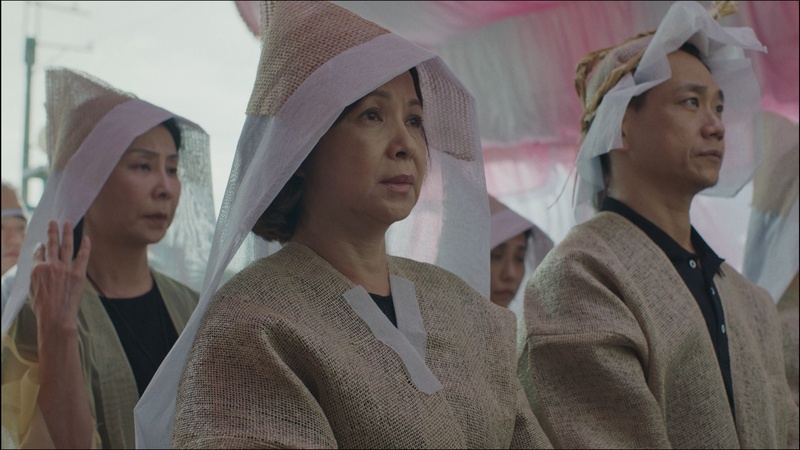
A-Hsien, portrayed with restraint by Kuei-Mei Yang, is the eldest daughter in a family shaped by patriarchal tradition. The funeral rituals that develop around her aren’t framed as cruelty or villainy. They’re normalized, procedural, and deeply embedded in norms. That’s what makes them so suffocating. The film draws directly from director Yu-Han Tsai’s own family history, particularly the experience of witnessing Taoist funeral rites centered around male lineage despite a household shaped by generations of women. That personal foundation gives DUA JI its emotional clarity. Nothing here feels generalized for symbolism’s sake. Every gesture, every pause, every enforced role feels purposeful.
The film refuses the urge to underline its themes. The patriarchal structure isn’t explained, challenged, or critiqued. It simply exists, immovable and unquestioned, and the audience is asked to sit with the discomfort of that reality. The pressure placed on A-Hsien isn’t dramatic in a traditional sense, but it’s relentless. She’s expected to lead, to comply, to embody respectability, and to suppress any emotion that might disrupt the ceremony’s order. Grief becomes something managed rather than felt, filtered through ritual instead of allowed to breathe.
Kuei-Mei Yang’s performance is central to the film’s effectiveness. Her work here is defined by control rather than expression. A look held too long, a breath restrained, posture that never relaxes. It’s a performance that trusts the audience to notice what isn’t being said, and that trust pays off. There’s a deep sense of history behind her stillness, the implication of a lifetime spent navigating similar expectations long before this funeral ever began. The supporting cast reinforces that atmosphere, functioning less as individual characters and more as extensions of the social structure pressing in on her from all sides.
The cinematography favors patience and observation, allowing scenes to evolve without the urgency of forceful editing. The camera doesn’t intrude; it sits back and watches. Editing choices emphasize duration and restraint, reinforcing the idea that this is not a momentary burden but an inherited one. The score is used sparingly, never attempting to manufacture emotion, which keeps the focus squarely on the tension between grief and obligation. Every aspect of the film’s construction supports its thematic intent.
Where DUA JI may divide viewers is in its commitment to subtlety. The film’s resistance is almost entirely internal. There’s no clear moment of rupture, no decisive act that releases the pressure it so carefully built. For some, that will feel appropriate. For others, it may feel like emotional restraint. The film asks you to accept that not all resistance looks like defiance, and not all endings provide relief. That’s a valid choice, but it also limits the film’s emotional reach. The final moments leave you contemplative rather than transformed, thoughtful rather than shaken.
At 18 minutes, the film is tightly constructed. There are moments where a slightly deeper push into A-Hsien’s world could have elevated the experience from observant to devastating. The restraint is admirable, but it also creates a sense of distance that keeps the film from fully overwhelming you. That balance between control and impact is where DUA JI ultimately lands for better or worse, and the fact that you can imagine more speaks volumes.
There’s no denying the film’s clarity of purpose and emotion. It understands exactly what it wants to explore and never loses focus. Its depiction of grief isn’t sentimental or performative, but structured, monitored, and shaped by systems larger than any one individual. That perspective feels both specific and universally resonant. Anyone who’s ever felt trapped by expectation during a moment of personal loss will recognize the emotional landscape immediately.
DUA JI doesn’t demand attention through drama. It earns it through discipline, intention, and trust in its audience. It’s a powerful short that lingers more in thought than in feeling, and while that may limit its immediate emotional impact, it also ensures that its themes continue to echo long after the screen goes dark.
Please visit https://linktr.ee/overlyhonestr for more reviews.
You can follow me on Letterboxd, Instagram, Twitter, and YouTube. My social media accounts can also be found on most platforms by searching for 'Overly Honest Reviews'.
I’m always happy to hear from my readers; please don't hesitate to say hello or send me any questions about movies.
DISCLAIMER:
At Overly Honest Movie Reviews, we value honesty and transparency. Occasionally, we receive complimentary items for review, including DVDs, Blu-rays, CDs, Vinyl Records, Books, and more. We assure you that these arrangements do not influence our reviews, as we are committed to providing unbiased and sincere evaluations. We aim to help you make informed entertainment choices regardless of our relationship with distributors or producers.
Amazon Affiliate Links:
Additionally, this site contains Amazon affiliate links. If you purchase through these links, we may receive a commission. This affiliate arrangement does not affect our commitment to honest reviews and helps support our site. We appreciate your trust and support as you navigate these links.
