A Story of Resistance Caught Between Two Visions
Desert Warrior
MOVIE REVIEW
Desert Warrior
 -
- 

Genre: Action, Adventure, Drama, History
Year Released: 2026
Runtime: 1h 54m
Director(s): Rupert Wyatt
Writer(s): Rupert Wyatt, Erica Beeney, David Self, Gary Ross
Cast: Anthony Mackie, Aiysha Hart, Ben Kingsley, Sharlto Copley, Ghassan Massoud
Where to Watch: only in theaters April 24, 2026
RAVING REVIEW: DESERT WARRIOR works best when it’s operating on instinct instead of obligation. The early stretch focuses on clarity, a sense of direction that feels driven by character rather than expectation. A young woman refusing to be bargained like currency isn’t just a plot trigger; it’s a disruption, and the film briefly understands how powerful that disruption can be.
Aiysha Hart carries that initial vitality with conviction. Her version of Hind isn’t played as an untouchable symbol right away, and that restraint matters. There’s hesitation, calculation, and a quiet defiance that suggests someone still figuring out how far she’s willing to go. Those moments are where the film feels most alive, when leadership isn’t assumed but earned in real time. Sadly, that focus doesn’t last.
As the story develops, the film starts assigning importance to Hind without doing the work to back it up. Decisions happen, alliances shift, and the narrative expects those turns to land with weight, but the logic behind them stays just out of reach. It’s not that her arc disappears; it’s that it stops evolving. She becomes an idea the film keeps referring to rather than a person we’re actively following.
Anthony Mackie’s character ends up caught in a similar limbo. Without a doubt, there’s something deeply compelling about how he’s introduced, operating with his own agenda, never aligned with anyone else. That independence gives him an edge that the film could’ve used more consistently. Instead, he drifts in and out, sometimes positioned as essential, other times feeling like an afterthought. The inconsistency makes it harder to lock into his role, even when the performance itself is doing the work.
The shift in scale is where the film really starts to fracture. What begins as a focused and contained story gradually broadens into a conflict rooted in politics and unification. That transition should feel like a natural escalation, but here it feels more like a reset. The urgency that defined the earlier sections gets diluted, replaced by a structure that prioritizes scope over connection. Even so, the film knows how to present that scope.
There’s a physical weight to the environment that never feels unnatural. The desert isn’t just a backdrop; it dictates movement, strategy, and survival. When the film leans into that, especially during its larger scenes, there’s a tangible sense of effort behind what’s on screen. The action doesn’t rely on excess to make an impression. It’s grounded, direct, and at times authentically effective because of that restraint. Those sequences highlight what the film could’ve been if everything else had aligned with that same level of clarity.
Ben Kingsley makes the most of limited screen time, bringing a commanding presence without the script overexplaining his presence. He establishes stakes quickly, even if the film doesn’t revisit them with the same consistency. Sharlto Copley pushes in the opposite direction, adding volatility that occasionally borders on being too much, but at least it disrupts the film’s more controlled stretches. That unpredictability works in bursts, even if it isn’t always measured.
The larger issue isn’t any one performance or storyline; it’s the film’s uncertainty about how to frame its own identity. There’s a visible effort to balance historical weight with global accessibility, and that never feels settled. Language choices, casting decisions, and shifts all contribute to a version of the story that feels slightly removed from its own foundation. It’s not enough to break the film; it creates a distance that keeps it from accomplishing what it's looking to.
At the same time, it’s hard to ignore what the production represents. A film of this scale, shot in Saudi Arabia with this level of investment, signals a shift in what kinds of stories are being positioned for international audiences. That context doesn’t fix the film's struggles, but it does add something to the film's existence beyond its story.
The final act comes close to resolving the tension that runs through the rest of the film. The narrative tightens, the scale supports the story rather than competing with it, and the pieces begin to connect in a way that feels intentional. It’s not a complete turnaround, but it’s enough to show what the film was reaching for all along. That’s what makes the rest of it frustrating.
DESERT WARRIOR isn’t lacking in direction because it doesn’t have any ideas; it’s because it has too many, and they aren’t working together. When it simplifies itself, it’s effective. When it expands, it loses control. The film keeps circling a stronger version of itself without ever settling into it. There’s a compelling story here, and at times, you can see it clearly. It just never holds onto that version long enough to make it work as one.
@desertwarriormovie
Please visit https://linktr.ee/overlyhonestr for more reviews.
You can follow me on Letterboxd, Instagram, Twitter, and YouTube. My social media accounts can also be found on most platforms by searching for 'Overly Honest Reviews'.
I’m always happy to hear from my readers; please don't hesitate to say hello or send me any questions about movies.
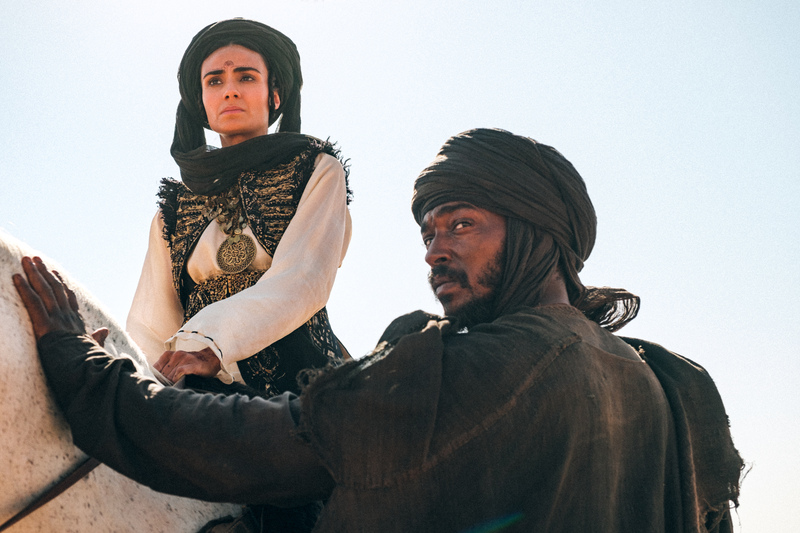
[photo courtesy of VERTICAL ENTERTAINMENT]
DISCLAIMER:
At Overly Honest Movie Reviews, we value honesty and transparency. Occasionally, we receive complimentary items for review, including DVDs, Blu-rays, CDs, Vinyl Records, Books, and more. We assure you that these arrangements do not influence our reviews, as we are committed to providing unbiased and sincere evaluations. We aim to help you make informed entertainment choices regardless of our relationship with distributors or producers.
Amazon Affiliate Links:
Additionally, this site contains Amazon affiliate links. If you purchase through these links, we may receive a commission. This affiliate arrangement does not affect our commitment to honest reviews and helps support our site. We appreciate your trust and support as you navigate these links.
