A Journey Defined by Distance and Consequence
Che Guevara: The Last Companions (Les Survivants du Che)
MOVIE REVIEW
Che Guevara: The Last Companions (Les Survivants du Che)
 -
- 

Genre: Documentary, Historical, War
Year Released: 2026
Runtime: 1h 34m
Director(s): Christophe Dimitri Réveille
Where to Watch: shown at the 2026 Cannes Film Festival
RAVING REVIEW: What happens after the story everyone already knows ends? That’s the question sitting at the center of CHE GUEVARA: THE LAST COMPANIONS, and it’s one the film approaches with a clear understanding that the answer won’t be what you’ve set yourself to expect. The revolution has already been immortalized, simplified, and repurposed across decades. What remains here are the fragments left behind, carried by the people who had to keep moving when the symbol they followed fell.
Christophe Dimitri Réveille doesn’t try to compete with the mythology surrounding Che Guevara. Instead, he moves around it, focusing on the aftermath rather than the moment of impact. The film is less concerned with who Che was and more interested in what it meant to survive him. That shift in perspective defines everything that follows. It reframes the narrative from ideology to endurance.
The core of the documentary rests in its interviews, particularly with the last surviving comrades who experienced that 2,400-kilometer escape across Bolivia. Their recollections don’t feel curated for dramatic effect. There’s a weariness in how they speak, a sense that the passage of time hasn’t necessarily refined everything. If anything, it’s made the memories more complicated. The film leans into that complexity rather than trying to streamline it into a clear message.
What stands out early is how the documentary resists turning these figures into heroes. There’s respect in how they’re presented, but not reverence. That distinction matters. The film allows space for contradiction, for moments where belief and doubt coexist without resolution. It doesn’t force these individuals into a singular pathway of loyalty or sacrifice. Instead, it lets their experiences remain fragmented, which feels more honest.
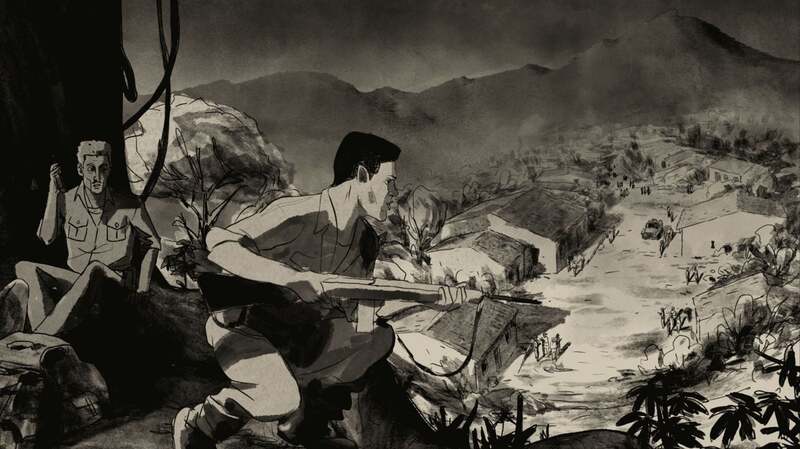
The use of archival footage is handled with restraint. Rather than overwhelming the narrative with historical imagery, the film uses these elements as points of connection, brief reminders of the larger context without diverting the focus from the personal accounts. The animation sequences serve a similar function, filling in gaps where documentation doesn’t exist, but they never feel like an attempt to embellish. They’re there to bridge memory and history, not replace either one.
There’s a careful balance in how the film navigates the broader political context. It acknowledges the Cold War backdrop and the geopolitical forces at play, but it doesn’t get lost in them. Those elements exist as part of the environment shaping these individuals’ experiences, not as the primary subject. That decision keeps the film laser-focused, even as it touches on larger historical currents.
Where the documentary finds its strongest footing is in its sense of distance, both physical and emotional. The journey across Bolivia is presented not just as a feat of survival but as a process of unraveling. The further these fighters move from the revolution, the more uncertain their realities become. That uncertainty carries through the interviews, where the passage of sixty years hasn’t fully resolved what that journey meant.
The pacing reflects that approach. It moves steadily, allowing space for reflection, but there are stretches where the narrative feels as if it could have pushed further and gone deeper. There’s a power in how the film handles its subject. It’s not trying to redefine Che Guevara or dismantle his legacy. It’s doing something specific, narrowing the focus to those who lived in the shadow of that legacy and asking what it cost them to carry it forward. That perspective doesn’t offer all of the conclusions. It doesn’t attempt to reconcile the contradictions. It simply presents them.
There’s a sense that the distance traveled, both in miles and in years, hasn’t led to a clear destination. The journey continues in memory, shaped by the same uncertainties that defined it in real time. That lack of resolution feels intentional. It reflects the reality that not every story tied to a major historical figure can be neatly contained within the narrative that made them famous.
CHE GUEVARA: THE LAST COMPANIONS works best when it trusts that ambiguity. When it allows its subjects to exist without forcing their experiences into a singular interpretation, it finds something that feels grounded and genuine. It’s less effective when it leans too heavily on the idea that their presence alone is enough to carry the weight of the story.
What lingers is the sense of scale, not in terms of the revolution itself, but in the distance between what was believed and what was lived. The film doesn’t try to close that gap. It leaves it open, asking the audience to consider how much of history is shaped by the stories that survive, and how much is lost in the space between them. With all of this said, I feel like it's more important than ever to learn about revolutionaries of the past, so don’t stop here. If you’re unfamiliar with Guevara and the history he left behind, make sure to watch/read more about him.
Please visit https://linktr.ee/overlyhonestr for more reviews.
You can follow me on Letterboxd, Instagram, Twitter, and YouTube. My social media accounts can also be found on most platforms by searching for 'Overly Honest Reviews'.
I’m always happy to hear from my readers; please don't hesitate to say hello or send me any questions about movies.
[photo courtesy of LUCKY NUMBER, THE PR FACTORY]
DISCLAIMER:
At Overly Honest Movie Reviews, we value honesty and transparency. Occasionally, we receive complimentary items for review, including DVDs, Blu-rays, CDs, Vinyl Records, Books, and more. We assure you that these arrangements do not influence our reviews, as we are committed to providing unbiased and sincere evaluations. We aim to help you make informed entertainment choices regardless of our relationship with distributors or producers.
Amazon Affiliate Links:
Additionally, this site contains Amazon affiliate links. If you purchase through these links, we may receive a commission. This affiliate arrangement does not affect our commitment to honest reviews and helps support our site. We appreciate your trust and support as you navigate these links.
