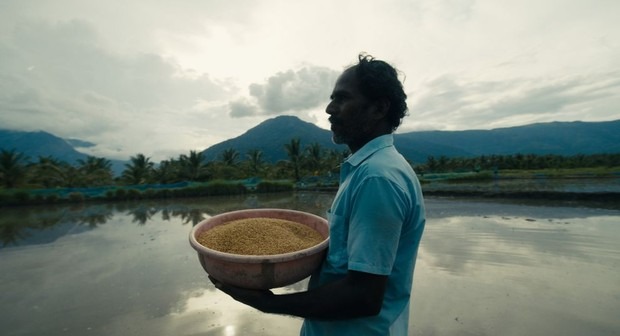
Farming As Resistance, Restoration, and Renewal
Groundswell
MOVIE REVIEW
Groundswell
 -
- 

Genre: Documentary
Year Released: 2026
Runtime: 1h 34m
Director(s): Josh Tickell, Rebecca Harrell Tickell
Where to Watch: shown at the 2026 Cannes Film Festival
RAVING REVIEW: There’s a point where documentaries about climate change start to blur together. Endless warnings, collapsing ecosystems, political doublespeak, footage of natural disasters cut together with swelling music and exhausted narration about how humanity is running out of time. The message matters, but the format has dulled its impact. That’s what makes GROUNDSWELL stand apart almost immediately. It isn’t built around despair. It’s built around proof. That distinction changes the film's tone entirely.
Rather than spending ninety minutes explaining why the planet is in trouble, Josh Tickell and Rebecca Harrell Tickell approach the subject from the opposite direction. GROUNDSWELL assumes the audience already understands that something is wrong. The real focus becomes whether meaningful change is still possible, and more importantly, whether people are already doing it successfully without waiting for governments or corporations to suddenly grow a conscience.
The documentary travels across multiple continents examining regenerative agriculture, not as an abstract theory or trendy buzzword, but as an active practice already producing measurable results. Farmers restoring depleted soil. Indigenous communities are protecting ecosystems through generational knowledge. Scientists tracking carbon retention beneath healthy land. Ranchers are reversing erosion while improving crop yields. The film repeatedly emphasizes that soil health, climate health, food quality, and biodiversity are interconnected systems rather than isolated problems.
What helps GROUNDSWELL work is that it doesn’t feel like a lecture assembled in a boardroom. There’s a quality to the presentation. The filmmakers clearly care about the subject, but they also understand that audiences shut down when documentaries become too apocalyptic. Even when the material gets heavy, and it often does, the film keeps redirecting itself toward momentum instead of hopelessness. That becomes one of its biggest strengths.
Many climate-focused documentaries unintentionally leave viewers emotionally stranded. They overwhelm audiences with statistics and catastrophic projections, then roll credits before anyone has time to process the exhaustion. GROUNDSWELL takes a different route. It acknowledges the scale of environmental collapse while also arguing that restoration is already happening in real time. The optimism doesn’t come from fantasy. It comes from observable results.
Something is compelling about watching individuals describe ecological recovery not in theoretical terms, but through tangible before-and-after realities. Dead soil is becoming fertile again. Water returning to damaged ecosystems. Wildlife is reappearing in places where biodiversity had collapsed. Those moments ground the documentary in physical evidence rather than abstract advocacy.
Because the documentary spans multiple countries, environmental crises, agricultural methods, and scientific discussions, certain sections feel somewhat compressed, as if they are straining for more breathing room. The film introduces genuinely fascinating ideas about carbon sequestration, food systems, and ecological restoration, but there are moments when it moves on just as the discussion becomes intriguing. You can feel the tension between wanting to remain accessible while also tackling an enormous amount of information. Some transitions arrive abruptly, and a few segments feel more like condensed presentations than fully developed explorations. The documentary is clearly trying to cover a global movement rather than a single story, but that scale can sometimes prevent a deeper emotional attachment to specific individuals or communities.
Ironically, one of the film’s smaller recurring issues comes from its own optimism. While GROUNDSWELL does acknowledge systemic resistance and environmental damage, it sometimes frames regenerative agriculture as though widespread adoption is primarily a matter of awareness rather than economics, politics, and entrenched corporate interests. The previous installment, COMMON GROUND, leaned harder into institutional pushback, and there are moments here where some of that sharper confrontation feels softened.
The documentary remains effective because it never loses sight of its central focus. GROUNDSWELL isn’t claiming regenerative agriculture is a magical overnight fix for every environmental crisis humanity faces. It’s arguing that restoration is possible when people stop treating ecosystems as disposable resources. The film emphasizes interconnectedness between land, food, water, climate, and public health, and that broader perspective gives the documentary real impact.
The inclusion of Prince William in the closing section could have easily come across as performative or self-congratulatory, but the film uses the moment more symbolically than politically. The focus stays on stewardship and generational responsibility rather than celebrity endorsement. It works because the documentary understands that its power comes from ordinary people creating measurable change at ground level, not from famous faces briefly entering the frame. What ultimately carries GROUNDSWELL is sincerity. Not manufactured inspiration. Not manipulative tragedy.
You can feel that the filmmakers believe restoration is achievable. Whether viewers agree with every argument being made or not, that conviction gives the documentary a sense of purpose that many issue-driven films lack. It’s informative without becoming sterile. Emotional without collapsing into sentimentality. Hopeful without pretending everything is fine. That combination gives the film a surprisingly refreshing energy.
In a media landscape saturated with narratives of environmental collapse, GROUNDSWELL chooses to focus on repair. Not easy, not instant, but active repair is already happening across the world. The documentary understands that fear alone eventually stops motivating people. At some point, audiences need to believe action can still matter. GROUNDSWELL makes that case persuasively enough to leave an impression long after it ends.
That optimism also becomes somewhat of a limitation. For all the genuinely compelling ideas GROUNDSWELL introduces about regenerative agriculture and environmental restoration, the film rarely delves deeply enough into the larger systems that surround those problems. It presents its solutions with such straightforward certainty that the documentary occasionally feels less like an investigation and more like something you’d watch in high school bio. There’s value in making complex environmental issues easier to understand, but the simplification sometimes comes at the expense of nuance. Questions surrounding corporate responsibility, political resistance, economic structures, and the realities of large-scale implementation aren’t explored enough. The result is a documentary filled with worthwhile conversations and encouraging examples, yet one that ultimately remains somewhat one-note in how it frames both the crisis and the path forward.
Please visit https://linktr.ee/overlyhonestr for more reviews.
You can follow me on Letterboxd, Instagram, Twitter, and YouTube. My social media accounts can also be found on most platforms by searching for 'Overly Honest Reviews'.
I’m always happy to hear from my readers; please don't hesitate to say hello or send me any questions about movies.
[photo courtesy of PRIME VIDEO, BIG PICTURE RANCH]
DISCLAIMER:
At Overly Honest Movie Reviews, we value honesty and transparency. Occasionally, we receive complimentary items for review, including DVDs, Blu-rays, CDs, Vinyl Records, Books, and more. We assure you that these arrangements do not influence our reviews, as we are committed to providing unbiased and sincere evaluations. We aim to help you make informed entertainment choices regardless of our relationship with distributors or producers.
Amazon Affiliate Links:
Additionally, this site contains Amazon affiliate links. If you purchase through these links, we may receive a commission. This affiliate arrangement does not affect our commitment to honest reviews and helps support our site. We appreciate your trust and support as you navigate these links.
