The Long Walk Through Enemy Fire
Lucky Strike
MOVIE REVIEW
Lucky Strike
 -
- 


Genre: War, Drama, Action, History
Year Released: 2026
Runtime: 1h 42m
Director: Rod Davis Lurie
Writer(s): Rod Davis Lurie, Marc Frydman
Cast: Scott Eastwood, Colin Hanks, Aunjanue Ellis-Taylor, Taylor John Smith, Lorne MacFadyen
Where to Watch: nationwide in theaters on June 26, 2026
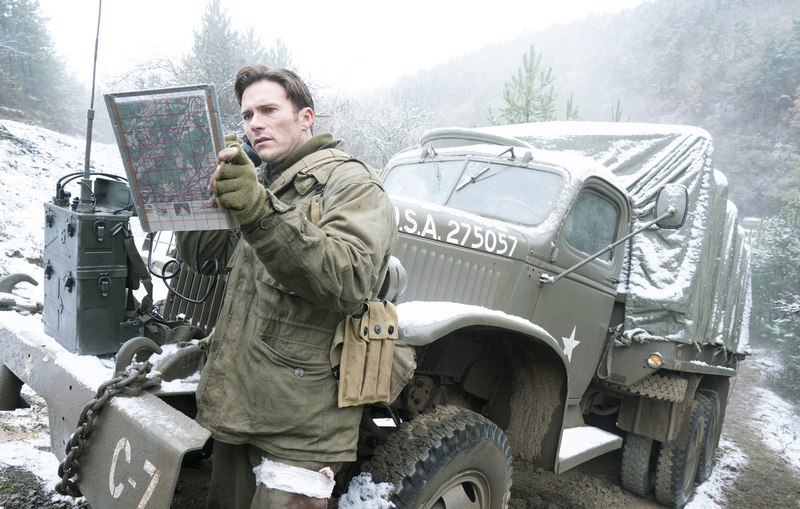
RAVING REVIEW: LUCKY STRIKE builds tension around a battlefield that feels almost quaint by modern standards, then treats that like a lifeline, a weapon, and a prayer all at once. A wounded American soldier is trapped behind German lines during the Battle of the Bulge, separated from his unit, surrounded by enemy movement, and dependent on a Motorola SCR-300 radio to survive long enough to make it home. That kind of premise can turn into the idea that survival comes down to cold air, bad odds, and the thin hope that someone on the other end of the signal is still listening.
Director/co-writer Rod Davis Lurie is a natural fit for that kind of material. Lurie’s military background has mattered most in the small behavioral details rather than in grand gestures, and LUCKY STRIKE works because of this. The film isn’t selling World War II as a cinematic version of noble sacrifice. It’s treating the Ardennes as a place where fear, exhaustion, terrain, and technology all collide. The Battle of the Bulge has been covered often enough that another film about it needs a focused reason to exist, and LUCKY STRIKE finds that by narrowing the war to one man’s attempt to stay alive behind the line.
War movies can become inflated when they try to represent every front, every commander, every speech, and every moment. LUCKY STRIKE is more interested in a pressure-cooker approach, turning a massive historical offensive into a close-quarters survival story. The Germans’ final major offensive in Western Europe already carries enormous historical importance, but the film’s best perspective isn’t its scale. It’s the way a soldier can be swallowed by that size and reduced to instinct. A radio becomes more than equipment. It becomes the difference between order and chaos, between strategy and panic, between being a soldier with a mission and being a wounded man trying not to die in the snow.
Scott Eastwood’s casting makes sense for this kind of stripped-down war thriller. His screen presence has always worked best when a role asks for physical credibility. In a story like this, that restraint is useful. A trapped soldier behind enemy lines doesn’t need to narrate every feeling to the audience. He needs to listen, observe, improvise, and keep moving. A one-person survival story can’t coast on just familiarity. It needs a performance that lets us read fear, calculation, pain, and resolve without turning the character into a walking recruitment poster.
The supporting cast in LUCKY STRIKE may have more on its mind than one man crawling through enemy territory. Colin Hanks and Taylor John Smith lend a military presence to the story, while Aunjanue Ellis-Taylor’s involvement raises the dramatic ceiling. Ellis-Taylor can convey emotion even with limited screen time. The danger with this kind of story is that everyone outside the main focus can become a function, a voice on a radio, a worried face, a strategic obstacle, or a reminder of home.
Modern audiences are used to instant communication, satellite tracking, and action heroes with endless backup. A World War II radio changes the type of suspense. It’s heavy, flawed, and vulnerable to range, terrain, weather, and enemy interception. That makes every transmission dramatic in a way that doesn’t have to be forced. A signal can mean rescue, exposure, misinformation, or death. The device creates suspense because communication itself becomes unstable. The soldier isn’t just hiding from German forces. He’s trying to make sense of a battlefield he can only partly hear.
That’s where LUCKY STRIKE separates itself from more routine war pictures. The most affecting combat films often understand that confusion is part of the horror. Soldiers rarely get the complete map. They get fragments. A sound in the trees. A garbled command. A movement in the distance. A radio message that may or may not arrive in time. Lurie, leaning into that uncertainty, delivers a lean, anxious version of the Battle of the Bulge that feels personal without diminishing the event's importance. The war remains immense, but the movie’s emotional point of entry is small enough to hold in your hand.
LUCKY STRIKE is at its strongest as an idea when it remembers that survival in war is rarely about a single kind of courage. There’s the obvious kind, the one attached to fire, injury, and physical endurance. There’s also the quieter kind, the ability to keep thinking when terror is trying to make every decision lead to panic. A soldier with a radio behind enemy lines has to become part fighter, part scout, part spy, and part ghost. That mix gives the film a compelling shape, especially with the Ardennes as a backdrop and Lurie returning to the kind of military material that brought out some of his best filmmaking instincts.
That strong conceptual hook only carries the film so far. LUCKY STRIKE often explains the danger better than it makes us feel it, leaving stretches that should feel nerve-tight instead feeling strangely routine. Eastwood’s restrained approach fits the role on paper, though the performance sometimes becomes so contained that the fear, grief, and desperation stay at a distance. The supporting cast also feels underused, with characters who hint at a larger world but rarely get enough room to deepen the story. For all its respect for the material, the film too often lands as competent rather than gripping, turning a survival scenario with real dramatic potential into something more serviceable than memorable.
The result is a serious, contained WWII thriller rather than a sweeping battlefield epic. LUCKY STRIKE doesn’t need to compete with the largest depictions of the Battle of the Bulge. It has a stronger chance by making the audience feel the intimacy of being one man cut off from everyone else, carrying a radio through hostile ground, hoping the next voice he hears isn’t the one that gets him killed.
Please visit https://linktr.ee/overlyhonestr for more reviews.
You can follow me on Letterboxd, Instagram, Twitter, and YouTube. My social media accounts can also be found on most platforms by searching for 'Overly Honest Reviews'.
I’m always happy to hear from my readers; please don't hesitate to say hello or send me any questions about movies.
[photo courtesy of ROADSIDE ATTRACTIONS, SABAN FILMS]
DISCLAIMER:
At Overly Honest Movie Reviews, we value honesty and transparency. Occasionally, we receive complimentary items for review, including DVDs, Blu-rays, CDs, Vinyl Records, Books, and more. We assure you that these arrangements do not influence our reviews, as we are committed to providing unbiased and sincere evaluations. We aim to help you make informed entertainment choices regardless of our relationship with distributors or producers.
Amazon Affiliate Links:
Additionally, this site contains Amazon affiliate links. If you purchase through these links, we may receive a commission. This affiliate arrangement does not affect our commitment to honest reviews and helps support our site. We appreciate your trust and support as you navigate these links.
