Every Riddle Leaves Another Scar
Batman: Caped Crusader Season 2
TV SERIES REVIEW
Batman: Caped Crusader Season 2
TV-14 - 

Genre: Animation, Action, Adventure, Crime, Noir
Year Released: 2026
Runtime: 10 x 25m episodes
Creator(s): Bruce Timm
Cast: Hamish Linklater, Jason Watkins, Eric Morgan Stuart, Krystal Joy Brown, John DiMaggio, Gary Anthony Williams, Jamie Chung
Where to Watch: season two premieres July 31, 2026, on Prime Video
RAVING REVIEW: Gotham doesn’t become safer when Batman “begins.” It becomes stranger, as ordinary corruption gives way to criminals who understand that a memorable identity can be as powerful as a gun. BATMAN: CAPED CRUSADER enters its second season with the city adapting to its masked vigilante, while Bruce Wayne remains several steps behind everyone else in understanding what Batman is doing to him.
Season one had to establish an entire variation of the mythology. It introduced a 1940s-inspired Gotham, removed much of Batman’s advanced technology, and surrounded him with police, attorneys, gangsters, and unstable personalities who were often just as important as the man beneath the cowl. The second season doesn’t have to spend as much time explaining that world. It can let Batman do his thing. That shift gives the season a stronger identity. Bruce isn’t just chasing his revised rogues gallery through dark buildings; he’s learning how Gotham’s problems connect and how often supposedly respectable institutions protect the people causing them. Crimes leave patterns behind, witnesses lie for a variety of reasons, and solving a case doesn’t necessarily repair the damage. Batman may catch someone, only to discover that the city has already prepared a replacement.
Hamish Linklater sounds more settled in the role without making Bruce sound comfortable. His Batman remains measured and intimidating, while his public persona carries the faint stiffness of someone performing normal human behavior from memory. Linklater doesn’t rely on a dramatic separation between the two voices. Bruce Wayne and Batman sound connected because neither identity is especially natural to him.
His relationship with Alfred offers a more revealing measure of his progress. Bruce spent much of the first season treating the man who raised him as an employee, addressing him as Pennyworth and keeping any gratitude buried beneath instructions. The distance hasn’t disappeared, although season two allows more recognition that Batman can’t operate without the person waiting for him at home. There’s one especially powerful moment that really changes the dynamic between the two.
Jason Watkins brings warmth to Alfred without turning him into a gentle grandfather figure who accepts every reckless decision. He understands Bruce’s pain and has also lived long enough to recognize when that pain has become an excuse. Their exchanges carry years of affection that Bruce rarely knows how to acknowledge.
The arrival of Edward Nygma is a natural fit for a series that has always promised the World’s Greatest Detective rather than another heavily armed superhero. The Riddler forces Batman to slow down, interpret motives, and recognize the arrogance behind the clues. A puzzle means more here than arranging some dials until a door opens. It becomes a contest between two men who need everyone else to understand how intelligent they are. That similarity gives their conflict some weight. Nygma makes a performance out of being the cleverest person in the room, while Bruce has built an entire second life around proving that he can anticipate every twist and turn. Batman’s restraint separates them, though the distance between obsession and responsibility can become uncomfortably small.
The Joker presents a different challenge for the series. Decades of movies, games, and comics have made him nearly unavoidable, and another interpretation risks overwhelming a version of Gotham that has succeeded through its larger ensemble. CAPED CRUSADER understands the danger of allowing a famous villain to consume everything around him. His presence is handled as a disruption rather than an obligation. The character belongs in this harsher, older Gotham, where theatrical cruelty can feel like an extension of the city’s existing violence rather than an entirely different genre making a guest appearance. The performance avoids making him entertaining at the expense of the people he terrorizes. His humor offers no relief because every laugh carries the possibility that someone else is about to suffer.
Not every addition receives the same amount of breathing room. Ten episodes sound like a lot until the season begins, balancing returning characters, new criminals, police corruption, Bruce’s personal development, and the wider changes taking place across Gotham. Several figures make an immediate impression, only to disappear before their stories have moved much beyond the qualities that introduced them.
Roxy Rocket brings welcome change and recklessness to a world often dominated by shadowy offices and conversations. Carrie Kelly introduces another complication, placing a younger determination near a Batman who can barely manage his own emotions and life. Both characters open interesting possibilities, though their presence can occasionally feel more like a promise for the future than a complete part of this season.
I would vote for longer episodes to allow a deeper dive into these “new” characters. That limitation extends to a few episodic villains whose designs and concepts deserve more than a single confrontation. The series remains skilled at giving each criminal a distinct psychological or social function, but its short runtime can diminish the impact of the aftermath. Gotham moves on quickly, even when an episode has introduced something that should alter its residents for longer than a closing scene.
Barbara Gordon, Jim Gordon, and Renee Montoya prevent the show from shrinking into a weekly exchange between Batman and his adversary of the week. Their work within Gotham’s legal and police systems gives the season consequences that Batman can’t punch his way through. Barbara’s belief in due process becomes particularly valuable in a city where nearly every institution has been compromised.
Krystal Joy Brown gives Barbara conviction without removing her frustration. She can admire Batman’s results while recognizing the danger of one person deciding who deserves punishment. Eric Morgan Stuart’s Jim Gordon carries the exhaustion of an honest officer trying to lead people who may be corrupt, frightened, or simply accustomed to failure. Their disagreements keep the series from pretending that Batman’s existence solves the moral questions created by his methods.
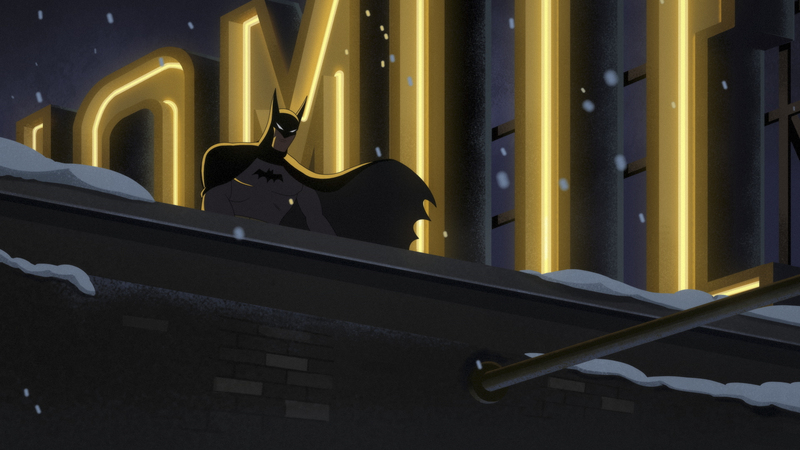
The animation remains very consistent with the 90s animated series, which works for and a little against the series. Gotham’s architecture, shadows, vintage vehicles, and interiors create a recognizable world before anyone speaks. Batman can dominate an image by remaining nearly motionless, and the show understands how much menace can come from leaving part of his body concealed. That visual style has a downside. Certain fights lack the fluidity or physical impact suggested by the surrounding artwork, especially when the story shifts from investigation to an action sequence. These aren’t disastrous shortcomings, though they become more apparent as the direction builds toward a confrontation that the animation can’t match in force. I loved the 90s series, but as this is basically an Elseworlds take on Batman, I would have liked ot have seen a variation on the animation, even if I love the style.
Frederik Wiedmann’s music helps carry some of the weight that the visuals occasionally leave behind. The score respects the period influence without imitating every note associated with earlier Batman productions. It gives Gotham an old-fashioned menace while allowing moments of fear, pursuit, and sorrow to retain their own identities.
Season two doesn’t abandon the episodic mysteries that defined the first year, although it creates a stronger sense that each case is shaping Batman’s reputation. Criminals study him. Police officers adjust their tactics around him. Ordinary residents begin to decide whether he represents protection or another threat, given that he has enough money and power to avoid accountability. The larger, all-encompassing arc helps make the binge of the season work on a larger scale.
Bruce is changing as well, even when he refuses to acknowledge it. The man who once treated people as tools has begun recognizing the cost of remaining unreachable (although not always; sometimes it's still a learning process). He hasn’t become easygoing or especially healthy for his own mental well-being, nor should he; that would erase too much of why Batman exists in the first place. Progress in this version of Batman arrives through tiny concessions. Listening a little longer, admitting that someone else has a point, or understanding that fear can’t build the kind of trust Gotham needs.
BATMAN: CAPED CRUSADER doesn’t need to replace the animated Batman stories that came before it. Its value comes from finding a part of the mythology that remains underused. An inexperienced detective operating in a city where costumes are becoming more common, alliances remain fragile, and every victory teaches the wrong person something. The season occasionally tries to fit too many promising characters into too little space, but that doesn’t keep it from reaching the highest level of animated Batman storytelling. Batman began this story believing he could frighten the city into order. Season two leaves him facing another possibility. Gotham may already be learning from him, and not everyone taking notes intends to become a hero.
Please visit https://linktr.ee/overlyhonestr for more reviews.
You can follow me on Letterboxd, Instagram, Twitter, and YouTube. You can also find my social media accounts on most platforms by searching for 'Overly Honest Reviews'.
I’m always happy to hear from my readers; please don't hesitate to say hello or send me any questions about movies.
[photo courtesy of PRIME VIDEO, WARNER BROS. ANIMATION]
DISCLAIMER:
At Overly Honest Movie Reviews, we value honesty and transparency. Occasionally, we receive complimentary items for review, including DVDs, Blu-rays, CDs, Vinyl Records, Books, and more. We assure you that these arrangements do not influence our reviews, as we are committed to providing unbiased and sincere evaluations. We aim to help you make informed entertainment choices regardless of our relationship with distributors or producers.
Amazon Affiliate Links:
Additionally, this site contains Amazon affiliate links. If you purchase through these links, we may receive a commission. This affiliate arrangement does not affect our commitment to honest reviews and helps support our site. We appreciate your trust and support as you navigate these links.
