Inheritance Comes With a Body Count
Death Has No Master (La muerte no tiene dueño)
MOVIE REVIEWS
Death Has No Master (La muerte no tiene dueño)
 -
- 

Genre: Drama, Psychological Thriller, Horror
Year Released: 2026
Runtime: 1h 46m
Director: Jorge Thielen Armand
Writer(s): Jorge Thielen Armand
Cast: Asia Argento, Dogreika Tovar, Yermain Sequera, Jorge Thielen Hedderich, Arturo Rodríguez
Where to Watch: shown at Fantastic Fest 2026
RAVING REVIEW: Caro returns to Venezuela after her father dies; the family property needs to be sold, and she’s traveled from Italy to deal with it. She discovers that Sonia, a former employee, is living in the house with her young son, Maiko, and has allowed other people to live throughout the estate.
At first, Caro tries to handle the situation with some degree of patience. She moves into her parents' old bedroom, explains that she intends to sell, and assumes everyone will eventually leave once everything becomes clear. Sonia has absolutely no intention of doing that, and DEATH HAS NO MASTER grows out of the increasingly hostile space between a woman who believes ownership settles the argument and another who has lived there long enough to believe the answer is more complicated.
Writer/director Jorge Thielen Armand doesn't rush that conflict. Instead, he lets resentment develop through conversations, looks, and the uncomfortable reality of people sharing a house while waiting for somebody else to surrender. It gives the movie tension long before anything violent happens, because neither woman seems remotely willing to reconsider what she believes she's entitled to.
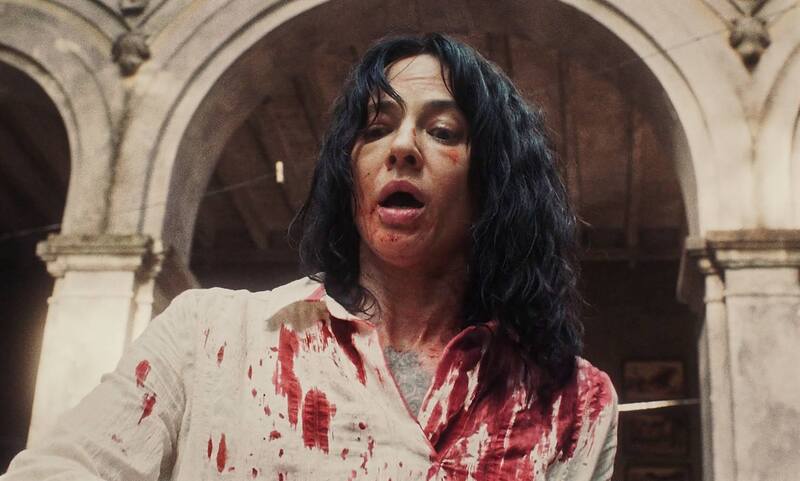
Asia Argento plays Caro without much effort to win us over. She's impatient, condescending, angry, and increasingly offended that nobody seems particularly interested in recognizing the authority she assumes comes with being the owner. Argento is so effective because she doesn't turn Caro into an exaggeration; at times, her frustration is completely understandable, even as her behavior makes it harder to sympathize with her.
Dogreika Tovar's Sonia is quieter but no less stubborn. She has her own history with the property and with Caro's family, and Tovar lets that weight sit behind nearly everything Sonia says. She's not written as some generic victim either, which helps keep their conflict from becoming just a battle between the “obviously good” person and the “obviously horrible” one.
The issue of ownership becomes more unpleasant the longer the movie lingers on it. Caro has the paperwork and the inheritance, but the estate itself comes from a history that makes those legal claims feel considerably less important. Sonia may not have the deed, but she’s spent years calling the place Caro left behind a home, creating a collision between what the law says and what history makes a lot harder to defend.
Armand is clearly interested in colonialism, class, privilege, and who gets to decide when a piece of land belongs to someone. Caro is returning to collect value from a property tied to a history she barely seems interested in confronting. At the same time, Sonia and the surrounding community represent people living with the consequences of those systems rather than simply inheriting from them.
Some of the film's most impactful moments come from watching Caro realize that almost nobody around her sees the situation the way she does. The police don't rush to remove Sonia, neighbors aren't interested in supporting Caro, and every attempt to impose control makes her feel increasingly isolated.
The house itself becomes more unsettling as that isolation grows. It's old, deteriorating, and surrounded by vegetation that seems healthier than anything humans have built there. Luis Armando Arteaga's cinematography makes the property feel less like an asset waiting to be sold and more like something everyone is occupying regardless of what any document says.
There are times when DEATH HAS NO MASTER gets surprisingly close to horror without becoming a conventional horror movie. Memories, dreams, and reality begin rubbing against one another, while Caro's growing anxiety makes it harder to know how literally some moments should be taken. Armand doesn't seem especially interested in explaining every unsettling image, and that uncertainty is one of the movie's better choices.
Some of the symbolism gets heavier than it needs to be. The crumbling estate, inherited wealth, physical decay, and arguments over possession all serve the same ideas, and Armand occasionally pushes them hard enough that the movie loses some of the ambiguity it creates elsewhere. There's plenty to think about here without everything needing to underline the same point.
The shift into direct violence changes the movie again. Everything that was held back suddenly becomes much harder to contain, and the simmering resentment finally turns physical. Those scenes are effective in their ugliness, but I found them less interesting than the uncertainty that came before them. Part of that is because the movie spends so much time building toward an unbearable collision that almost any release risks feeling smaller than the buildup. Once blood enters the equation, the conflict becomes more literal and therefore somewhat less unsettling. The movie still makes the same arguments, but it no longer asks us to sit with them in quite the same way.
Argento remains committed throughout that. Caro becomes increasingly desperate as the situation slips beyond anything she can control, and Argento is willing to let her become more unpleasant rather than searching for a moment of redemption. Even when Caro understands more about the history surrounding her, that doesn't suddenly erase the choices that brought her there.
Tovar is more restrained in her role, but Sonia's anger carries just as much. She doesn't need to match Caro's volume because her refusal to move already says plenty. Their performances work together because the movie never requires either woman to become reasonable to resolve the story suddenly.
DEATH HAS NO MASTER has an interesting take when it comes to colonialism and economic inequality. Individuals can do ugly things, regardless of which side of the argument they're on. Armand is more convincing when he lets those contradictions remain than when the imagery starts telling us exactly what everything represents. There’s also something about how fiercely everyone fights over a place that is falling apart. The estate is valuable because people say it is, because documents say it is, and because generations of ownership have given it meaning. Meanwhile, nature keeps pushing through the cracks as though none of those claims matter.
DEATH HAS NO MASTER leaves me more impressed by its construction than completely satisfied by where it goes. Armand creates an oppressive atmosphere, Argento and Tovar give the conflict real bite, and the movie says plenty about how ownership can become indistinguishable from inherited power. Those strengths are substantial enough to keep it interesting even when the story begins repeating itself.
I just wish the final stretch matched the discomfort of everything leading to it. The quieter parts understand how dangerous resentment can become before anyone acts on it, while the violence makes that danger more obvious but not necessarily more powerful. It's an ambitious, carefully made thriller that occasionally over explains itself after spending so much time being effective in silence.
The best things the film explores are also the simplest. Caro arrives believing she's inherited a house, but what she actually inherits is a conflict that began long before she returned and won't be settled by proving her name is on a piece of paper. DEATH HAS NO MASTER understands that land can carry memory, resentment, and history in ways ownership never accounts for, even if the movie doesn't always trust that long enough to leave it alone.
Please visit https://linktr.ee/overlyhonestr for more reviews.
You can follow me on Letterboxd, Instagram, Twitter, and YouTube. You can also find my social media accounts on most platforms by searching for 'Overly Honest Reviews'.
I’m always happy to hear from my readers; please don't hesitate to say hello or send me any questions about movies.
[photo courtesy of LA FAENA, VOLOS FILMS, FAITS DIVERS MEDIA, DEAL PRODUCTIONS, TRES CINEMATOGRAFÍA, CAPITOLIO, FORERUNNER FILMS, THE GODMOTHER]
DISCLAIMER:
At Overly Honest Movie Reviews, we value honesty and transparency. Occasionally, we receive complimentary items for review, including DVDs, Blu-rays, CDs, Vinyl Records, Books, and more. We assure you that these arrangements do not influence our reviews, as we are committed to unbiased, sincere evaluations. We aim to help you make informed entertainment choices regardless of our relationship with distributors or producers.
Amazon Affiliate Links:
This site also contains Amazon affiliate links. If you purchase through these links, we may receive a commission. This affiliate arrangement does not affect our commitment to honest reviews and helps support our site. We appreciate your trust and support as you navigate these links.
