A Fairytale With Splinters and Sexual Politics
Wicker
MOVIE REVIEW
Wicker
 -


Genre: Fantasy, Comedy, Romance
Year: 2026
Runtime: 1h 45m
Directors: Alex Huston Fischer, Eleanor Wilson
Writers: Alex Huston Fischer, Eleanor Wilson; based on the short story The Wicker Husband by Ursula Wills-Jones
Cast: Olivia Colman, Alexander Skarsgård, Elizabeth Debicki, Peter Dinklage, Richard E. Grant, Nabhaan Rizwan, Marli Siu
Where to Watch: in theaters October 23, 2026
RAVING REVIEW: I tried to get THE WIZARD OF OZ out of my head while watching WICKER, but it kept finding its way back in. Maybe it's the fairytale world, the theatrical personalities, or simply seeing Alexander Skarsgård walk around as a man made entirely from wicker (straw?). Whatever the reason, the comparison stuck, even though the two films share little beyond their willingness to make the impossible feel ordinary. Writers/directors Alex Huston Fischer and Eleanor Wilson have created a peculiar adult fairytale about a lonely woman, her handmade husband, and a village that can't handle seeing someone find happiness outside the rules. Adapted from Ursula Wills-Jones' short story THE WICKER HUSBAND, it's an imaginative, frequently funny, and occasionally frustrating film that puts considerable effort into creating a world unlike anything we're accustomed to seeing.
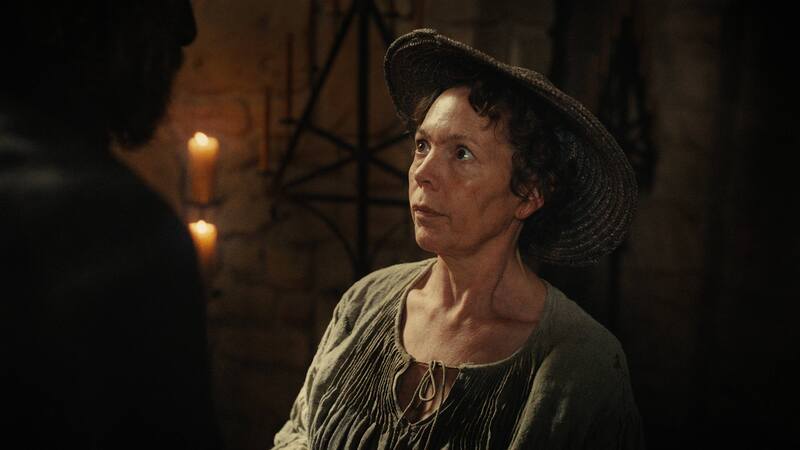
Olivia Colman plays a woman living on the outskirts of a small village where everyone seems to have an opinion about her appearance and lack of a husband. She earns her living catching fish, doesn't particularly care about impressing anyone, and refuses to act the way a woman is apparently supposed to. The villagers treat her independence as an embarrassment, making her the subject of jokes and ridicule. Eventually, she's had enough. Rather than find a man among the people who have spent years treating her so poorly, she approaches the local Basketmaker (Peter Dinklage) and commissions a husband, stitched together from wicker. It's an absurd request, but the Basketmaker accepts the challenge, and the result is far more extraordinary than anyone expected.
Alexander Skarsgård plays the Wicker Husband, a towering figure whose unusual appearance quickly becomes the least remarkable thing about him. He's attentive, affectionate, considerate, and seemingly interested in nothing beyond making his wife happy. He also has abilities that make the couple's relationship a source of considerable curiosity in the village. In a community accustomed to husbands who expect their wives to serve them, a man devoting himself to his partner creates an uncomfortable situation. Suddenly, the women question what they've accepted in their own marriages. At the same time, the men struggle to understand why their wives have become so interested in someone who isn't even technically human.
The comedy comes from the villagers treating the fisherwoman's happiness as if it were somehow offensive, simply because she's found a partner who treats her well. Their outrage says more about their own relationships than hers, and the film makes that hypocrisy a recurring source of amusement. Elizabeth Debicki is especially entertaining as a socially prominent villager whose fascination with the Wicker Husband develops alongside her resentment toward the fisherwoman. Her character represents someone who enjoys enforcing rules until someone else's happiness reveals how restrictive those rules have become. The jealousy isn't especially subtle, but Debicki understands the nature of the material and gives the character enough personality to remain entertaining.
The film's treatment of marriage is far less traditional than its fairytale setting suggests. In this village, men are largely identified by their occupations, while women are expected to define themselves through their relationships with men. Marriage isn't simply a personal decision; it's an arrangement that sets expectations for authority, obedience, and respectability. The fisherwoman challenges those assumptions without giving speeches or trying to organize a rebellion. She just wants to live on her own terms, which ends up threatening the community more than any act of defiance. Her unconventional husband exposes how many people accept unhappy arrangements because they've never considered alternatives.
WICKER's appeal comes from the extraordinary amount of care devoted to its appearance. Production designer Renátó Cseh and cinematographer Lol Crawley establish a village that feels removed from any specific period, with buildings, costumes, and objects that give the setting a strange but recognizable personality. The clothing is particularly effective in distinguishing the villagers and reinforcing their positions. The world looks like it belongs in an illustrated storybook, though the sexual humor and occasionally crude conversations make it clear it isn't intended for children. The contrast between the surroundings and the ridiculous behavior of the people living there is one of the film's more enjoyable qualities.
Skarsgård's transformation deserves particular attention. Rather than relying purely on CGI, the filmmakers worked with Wētā Workshop and costume designer Joe Dunckley to create a practical suit that allows the actor to perform beneath the elaborate construction. The result is remarkable. The woven surfaces and unusual proportions give him a convincing presence. His movements contribute to the illusion, especially when he interacts with people who seem almost disappointingly human beside him. Building such an elaborate practical costume gives the production a distinctive quality CGI alone couldn't provide. It's the kind of craftsmanship that gives an already unusual production considerably more personality.
Colman's performance provides the emotional connection that prevents the story from becoming nothing but an extended joke. Her fisherwoman is crude, occasionally unpleasant, and comfortable expressing herself in ways the other villagers find unacceptable. Colman embraces those qualities without attempting to make her character charming. More importantly, she understands that someone can be independent and still want affection. Fisherwoman has spent so much of her life defending herself against other people's judgments that allowing someone to care for her becomes its own challenge. That adds a complication beyond the strangeness of marrying a man made from wicker.
The Wicker Husband is designed to be an ideal partner, which makes him an effective contrast to the village's existing husbands. That also limits how interesting he can really be as an individual. Skarsgård brings warmth and a physical presence to the role, yet the character's unwavering devotion leaves relatively little room for the complications that ordinarily make romantic relationships compelling. Sure, the fisherwoman has insecurities, frustrations, and personal desires that change as their relationship develops. At the same time, her husband often seems to solve those problems rather than face his own difficulties. The film introduces an interesting distinction between being an ideal partner and being an equal, but its limited exploration of the Wicker Husband's individuality leaves that idea frustratingly underdeveloped.
Peter Dinklage makes an impression as the Basketmaker, whose matter-of-fact acceptance of the fisherwoman's extraordinary request helps establish the film's unusual sense of logic. He treats creating a living wicker husband as an extension of his profession, exactly the sort of ridiculousness that gives the story much of its charm. Richard E. Grant also adds to the village's collection of eccentric personalities, though some supporting characters feel more like amusing additions to the setting than fully developed. Their exaggerated behavior suits the material, but the ensemble occasionally gets so busy demonstrating the village's collective foolishness that it pushes aside the relationship we're supposed to care about.
It's difficult not to appreciate a film willing to be this strange without apologizing for itself. WICKER doesn't try to disguise its concept or make its unusual romance conventional. Fischer and Wilson commit to the visual design, the humor, and the idea that a handmade husband might expose the problems everyone else has been pretending not to notice. The results aren't always as funny or satisfying as they should be. Colman and Skarsgård make the central relationship appealing enough to carry the story through its less successful moments.
I never completely shook that association with THE WIZARD OF OZ, although WICKER eventually establishes an identity that belongs entirely to itself. Its elaborate costumes, exaggerated personalities, practical effects, and unconventional storytelling give it a distinct personality. At its best, the film is funny and surprisingly affectionate toward a woman who has spent her life being told she doesn't deserve happiness. The screenplay never quite matches the imagination behind the production, but Colman's performance, Skarsgård's unusual physical presence, and the film's wonderfully peculiar sense of humor make WICKER worth experiencing. Its handmade leading man might be the strangest husband imaginable, but he also delivers some of the film's most human moments.
Please visit https://linktr.ee/overlyhonestr for more reviews.
Follow me on Letterboxd, Instagram, Twitter, and YouTube. You can also find my social media accounts on most platforms by searching for 'Overly Honest Reviews'.
I’m always happy to hear from my readers; please don't hesitate to say hello or send me any movie questions.
[photo courtesy of BLACK BEAR]
DISCLAIMER:
At Overly Honest Movie Reviews, we value honesty and transparency. Occasionally, we receive complimentary items for review, including DVDs, Blu-rays, CDs, Vinyl Records, Books, and more. We assure you these arrangements do not influence our reviews, as we are committed to unbiased, sincere evaluations. We aim to help you make informed entertainment choices regardless of our relationship with distributors or producers.
Amazon Affiliate Links:
This site also contains Amazon affiliate links. If you purchase through these links, we may receive a commission. This affiliate arrangement does not affect our commitment to honest reviews and helps support our site. We appreciate your trust and support as you navigate these links.
