Who Gets to Define Harm?
Fjord
MOVIE REVIEW
Fjord
 -


Genre: Drama
Year Released: 2026
Runtime: 2h 26m
Director(s): Cristian Mungiu
Writer(s): Cristian Mungiu
Cast: Sebastian Stan, Renate Reinsve, Lisa Carlehed, Ellen Dorrit Petersen, Lisa Loven Kongsli, Henrikke Lund Olsen, Vanessa Ceban, Jonathan Ciprian Breazu, Christian Rubeck, Markus Tønseth
Where to Watch: in select theaters now. Find a showing near you here: www.films.neonrated.com
RAVING REVIEW: Cristian Mungiu has an extraordinary ability to make you question people you were confident you understood just moments ago. With FJORD, he twists that idea into uncomfortable territory, challenging our understanding of family, faith, tolerance, and the institutions we trust to protect us. I found myself repeatedly reconsidering where I was and what I was thinking, sometimes sympathizing with people whose beliefs I disagreed with, and other times questioning those who seemed to be doing everything right. That's what makes this film so exceptional. Mungiu isn't interested in making the audience feel complacent with its convictions, and I don't think I would've appreciated FJORD as much if he had. This extraordinary piece of filmmaking respects its audience enough to let us wrestle with the implications rather than forcing us to defend a position.
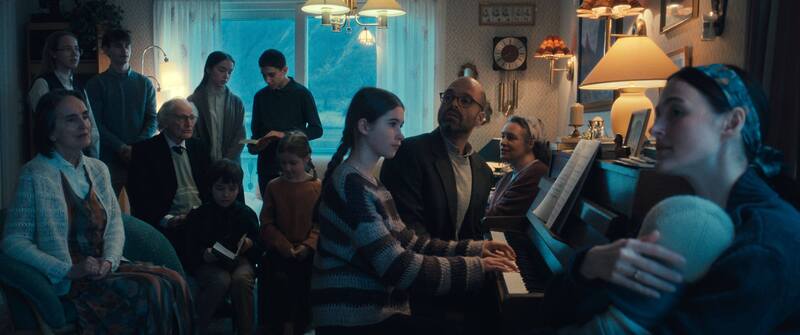
Sebastian Stan plays Mihai Gheorghiu, a Romanian father who relocates to a remote Norwegian community with his Norwegian wife, Lisbet (Renate Reinsve), and their five children. Following the deaths of Mihai's parents, this change offers an opportunity to rebuild their lives closer to Lisbet's family, surrounded by gorgeous scenery and what appears to be a welcoming community. Their conservative Christian beliefs guide every aspect of their household, from the kids' education to expectations surrounding obedience, relationships, and what is and isn’t acceptable behavior. For Mihai and Lisbet, these aren't arbitrary constraints; they're essential to raising their children according to their faith.
Their neighbors, the Halbergs, seem like the kind of people you'd hope to meet when you move to somewhere new. The families become friendly, their children develop relationships, and the differences between their households are initially treated as something they’ll work around, rather than a reason for confrontation. As those differences become more evident, particularly in religious expectations and parenting, the community's warmth begins to feel far less straightforward.
When bruises are discovered on the Gheorghius' daughter, Elia (Vanessa Ceban), it raises concerns about the children's welfare and brings the authorities into the family's private life. What follows forces everyone to consider where parental rights end, where government responsibility begins, and whether cultural differences are understood or unfairly used as evidence against someone. The allegations themselves are serious, and Mungiu never suggests that religious conviction should excuse harmful behavior. He questions whether an institution designed to protect children can become so confident of its own righteousness that it stops recognizing the individuals caught in its processes.
What impressed me most about FJORD is how Mungiu examines the conflict without asking us to sympathize with the family's extreme conservatism. Mihai's religious convictions aren't harmless personal preferences, especially when they shape his children's freedom, relationships, and understanding of the world. Those beliefs deserve scrutiny, and protecting children from harmful practices is an essential responsibility, not persecution. That responsibility also demands fairness, accountability, and the ability to distinguish legitimate concerns from cultural prejudice. Mungiu doesn't ask us to excuse either side because we agree with its intentions. Instead, he examines what happens when people become so convinced of their own moral authority that they stop questioning how their decisions affect others.
Stan is exceptional as Mihai, giving a performance that feels almost deliberately removed from the man underneath the role. He excels at playing hard roles that run counter to the good-guy dynamic. His stubbornness, frustration, and emotional restraint make the character so very convincing. Mihai isn't particularly interested in being pleasant to anyone whose values contradict his own, and Stan never relaxes that side of himself to win our sympathy. There's an uncomfortable authenticity to watching someone who believes wholeheartedly in his responsibilities as a father struggle with the possibility that those responsibilities might be taken away from him. Even when his confidence becomes exasperating, his fear remains understandable.
Reinsve deserves just as much recognition for a performance that requires a different kind of balancing act. Lisbet belongs to both worlds in ways Mihai doesn't, making her relationship with their new surroundings interesting. She's Norwegian, understands the culture, and has community connections. Yet her family's convictions increasingly put her at odds with the expectations of the society she comes from. Reinsve conveys so much through small shifts in expression and behavior, especially as Lisbet tries to reconcile her responsibilities as a mother with circumstances slipping beyond her control. Together, she and Stan make the Gheorghius feel like a real couple rather than two actors reacting differently to a difficult situation.
The screenplay also draws on an important real-world foundation. Mungiu researched child welfare disputes involving immigrant families in Scandinavian countries, drawing particular inspiration from a widely publicized Norwegian case involving a Romanian-Norwegian family and the removal of their children. Rather than presenting a straightforward dramatization meant to settle that controversy, he uses the case to examine competing understandings of responsibility, religious liberty, and intervention.
The film makes excellent use of its Norwegian setting without turning the countryside into an elaborate set. Cinematographer Tudor Vladimir Panduru captures the extraordinary scale of the surrounding landscape, with mountains, water, and communities creating an environment that appears almost impossibly peaceful. The contrast with the Gheorghius' increasingly difficult situation is striking. Mungiu also favors compositions that let conversations and interactions unfold without aggressive editing directing our attention. We're given time to examine the people sharing a space, notice their reactions, and consider how much of their behavior comes from concern rather than assumptions.
I appreciate that the representatives of the Norwegian system aren't just presented as cartoon-like villains who enjoy taking control over vulnerable families. The distinction between prejudice, responsibility, and procedure matters, even when those elements are hard to separate. Someone can believe they're preventing harm while contributing to an entirely different kind of suffering. Acknowledging one shouldn't require pretending the other doesn't exist.
Winning the 2026 Palme d'Or makes FJORD Mungiu's second Cannes win, and it feels fitting for a filmmaker whose work trusts audiences to engage with difficult subjects. This film doesn't ask viewers to abandon their convictions or embrace religious conservatism. It asks whether those convictions remain fair when applied to people whose lives, cultures, and choices differ from our own. I found myself doubting my reactions throughout, sometimes sympathizing with someone whose behavior had frustrated me and occasionally questioning the motivations of people whose intentions initially seemed entirely reasonable.
FJORD is uncomfortable because the questions it raises don't fade away once you've decided who you agree with. Protecting children is essential, religious freedom has limits, and prejudice doesn't become acceptable because it's expressed through a voice that you don’t agree with. All three statements can be true at the same time, yet applying them fairly takes far more thought than most people are willing to give. Mungiu understands that human beings are complicated, good intentions don't guarantee good outcomes, and justice requires more than confidence in our own beliefs. I left this one with way more to think about than I expected from the synopsis; I'd much rather see a film that challenges my certainty than one that spends two hours congratulating me for having the right opinions.
Please visit https://linktr.ee/overlyhonestr for more reviews.
Follow me on Letterboxd, Instagram, Twitter, and YouTube. You can also find my social media accounts on most platforms by searching for 'Overly Honest Reviews'.
I’m always happy to hear from my readers; please don't hesitate to say hello or send me any movie questions.
[photo courtesy of NEON]
DISCLAIMER:
At Overly Honest Movie Reviews, we value honesty and transparency. Occasionally, we receive complimentary items for review, including DVDs, Blu-rays, CDs, Vinyl Records, Books, and more. We assure you these arrangements do not influence our reviews, as we are committed to unbiased, sincere evaluations. We aim to help you make informed entertainment choices regardless of our relationship with distributors or producers.
Amazon Affiliate Links:
This site also contains Amazon affiliate links. If you purchase through these links, we may receive a commission. This affiliate arrangement does not affect our commitment to honest reviews and helps support our site. We appreciate your trust and support as you navigate these links.
