When Autonomy Becomes a Haunted House
I Live Here Now
MOVIE REVIEWS
I Live Here Now
 -
- 


Genre: Psychological Horror, Drama
Year Released: 2025, 2026
Runtime: 1h 31m
Director(s): Julie Pacino
Writer(s): Julie Pacino
Cast: Lucy Fry, Madeline Brewer, Matt Rife, Sheryl Lee, Cara Seymour
Where to Watch: opening in New York City on March 5, 2026, and Los Angeles on March 12
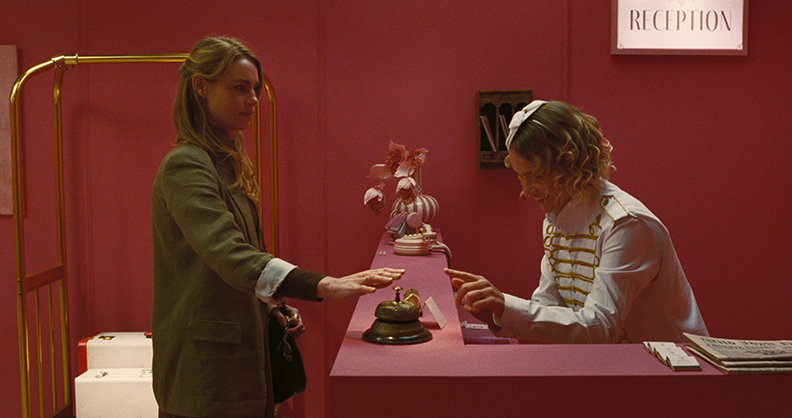
RAVING REVIEW: Visuals in I LIVE HERE NOW flood your palette. Saturated pinks, bruised reds, and artificial pastels dominate the frame as if emotion has soaked into the walls. Writer/director Julie Pacino’s feature debut doesn’t ask to be interpreted in the traditional sense. It wants you disoriented, uncomfortable, and locked inside Rose’s fractured perception. There’s something here that is about more than the experience itself, something that digs deeper than the story. This is a film that you don’t just watch passively; you have to be invested in it.
Rose, played by Lucy Fry, is a struggling actress whose life shifts violently after an unexpected pregnancy clashes with a potential career breakthrough. Her boyfriend’s mother exerts a suffocating control, and judgment closes in from every direction (quite literally at times). Instead of grounding the story in domestic drama, Pacino pushes Rose toward The Crown Inn, a desheveled motel where time splinters and reality distorts. The film doesn’t move in straight lines. It operates in chapters, drifting between memory, hallucination, and emotional fracture. Pacino isn’t concerned with structure. She’s interested in how trauma lives in the body long after the mind has tried to rewrite it.
Fry anchors the chaos with restraint. She doesn’t follow straightforward paths in the process of unraveling. It’s in her posture, the hesitation in her voice, the way she seems uncomfortable in her own skin. Rose’s relationship to her body is the true battleground. Pregnancy is the catalyst, not the thesis. The deeper wound is childhood trauma, and the film slowly circles that pain rather than foregrounding it in a way that makes it too clear.
Madeline Brewer, as Lillian, brings an unpredictability that cuts through the haze. She’s theatrical without losing control. Sheryl Lee leans into a controlled menace, weaponizing quiet judgment rather than overt cruelty.
The decision to shoot on 35mm with 16mm inserts gives the film a texture that matches its themes. Grain isn’t aesthetic decoration here. It reinforces instability. Scratches and imperfections feel intentional. The production design turns The Crown Inn into a psychological extension of Rose rather than just a setting. Every hallway feels focused on confronting her. There’s something intrinsically stylistic about shooting on film; it gives the film a feel that no amount of filters or after-effects can achieve.
Where the film earns its praise is in its commitment. It refuses to dilute its perspective on bodily autonomy, shame, and generational damage. The antagonistic energy coming from other women complicates the narrative instead of simplifying it. That’s a bold choice. It acknowledges that control and judgment aren’t always external forces. Sometimes they’re internalized and inherited. The symbolism here can become aggressive. Characters sometimes function more as embodiments of emotional states than as fully grounded people. The imagery occasionally sits with you past its breaking point in a few stretches, and the pacing occasionally slows to the edge of indulgence.
This is anything but a timid debut though. Pacino doesn’t play it safe. She fully embraces surrealism, even at the risk of alienating part of the audience. Some viewers will feel intoxicated by its boldness. Others may feel lost in its maze. That divide is baked into the film’s DNA. And I don’t think it's by mistake, the film picks the fast lane and then floors it.
The film's emotional intent keeps it moving. Beneath the stylization is a story about reclaiming agency from a body that carries memory without consent. When the film narrows its focus to that core idea, it’s powerful to the nth degree. When it widens into a layered metaphor, it can feel oversaturated. An ambitious, imperfect, but undeniably confident debut. It doesn’t always balance its ideas, but it refuses to lessen them either. That counts for more than you know.
What ultimately lingers is how I LIVE HERE NOW treats bodily autonomy not as a slogan, but as a psychological battlefield. The horror here isn’t just in distorted hallways or the questionable motel inhabitants; it’s in the quiet erosion of choice. Rose’s pregnancy becomes less about shock and more about ownership, about who gets to decide what her body means and what it’s for. The film understands that autonomy isn’t only threatened by certain authority figures. It’s compromised by family expectation, romantic pressure, cultural shame, and the internalized voices that echo long after the room is empty. By filtering that struggle through horror imagery, Pacino makes the violation feel visceral. Control becomes something physical. Memory becomes invasive. Even kindness carries manipulation. The genre framework allows the film to externalize what often stays invisible: the terror of losing agency over your own future. It’s an urgent message, but it never feels like a lecture. Instead, it’s embodied in Rose’s fear, confusion, and eventual confrontation with herself. That’s what gives the film weight. It argues that reclaiming autonomy is frightening, messy, and destabilizing, but necessary.
Please visit https://linktr.ee/overlyhonestr for more reviews.
You can follow me on Letterboxd, Instagram, Twitter, and YouTube. My social media accounts can also be found on most platforms by searching for 'Overly Honest Reviews'.
I’m always happy to hear from my readers; please don't hesitate to say hello or send me any questions about movies.
[photo courtesy of UTOPIA]
DISCLAIMER:
At Overly Honest Movie Reviews, we value honesty and transparency. Occasionally, we receive complimentary items for review, including DVDs, Blu-rays, CDs, Vinyl Records, Books, and more. We assure you that these arrangements do not influence our reviews, as we are committed to providing unbiased and sincere evaluations. We aim to help you make informed entertainment choices regardless of our relationship with distributors or producers.
Amazon Affiliate Links:
Additionally, this site contains Amazon affiliate links. If you purchase through these links, we may receive a commission. This affiliate arrangement does not affect our commitment to honest reviews and helps support our site. We appreciate your trust and support as you navigate these links.
