A Haunting Bridge Between Revolutions
Time Machine Maidan
MOVIE REVIEW
Time Machine Maidan
 -
- 

Genre: Documentary, War, History
Year Released: 2026
Runtime: 1h 26m
Director(s): Roman Liubyi, Volodymyr Tykhyy
Where to Watch: shown at the 2026 Sheffield DocFest
RAVING REVIEW: TIME MACHINE MAIDAN is the kind of documentary that not only asks viewers to remember history. It asks them to stand within its consequences. Roman Liubyi and Volodymyr Tykhyy’s film looks back at the Maidan revolution through the eyes of a generation now fighting a full-scale Russian invasion. That perspective changes the shape of the story. This isn’t only a vision of historical reflection. It’s a wounded return, a film made from the understanding that the past doesn’t stay behind you when the fight that started there never really ended.
The connection between 2013 and the present gives TIME MACHINE MAIDAN its balance. The film opens from the vantage point of today’s war, following a young Ukrainian soldier wounded on the Donbas front in 2023. Suspended between consciousness and death, he was carried backward into Kyiv during the Maidan uprising, when he was still a child, and the future he would inherit was being formed. The premise sounds almost impossible on paper, blending documentary, memory, first-person experience, and speculative framing, but the film makes that feel purposeful rather than forced. The idea of time travel becomes less about changing history than confronting the painful truth that history has already changed you.
Liubyi and Tykhyy build the film around an emotional paradox. The protagonist wants to warn Maksym Kryvtsov, also known as Dali, a poet and future warrior destined to die in the war. That search gives the film a personal anchor, but it also opens up something larger and harder to really understand. If you could return to the moment before catastrophe, would knowledge be enough to save anyone? TIME MACHINE MAIDAN doesn’t treat that question as fantasy. It treats it as grief, trying to bargain with reality. The film understands the human desperation behind wanting to reach back, to interrupt fate, to pull one person out of the path of history before history claims them.
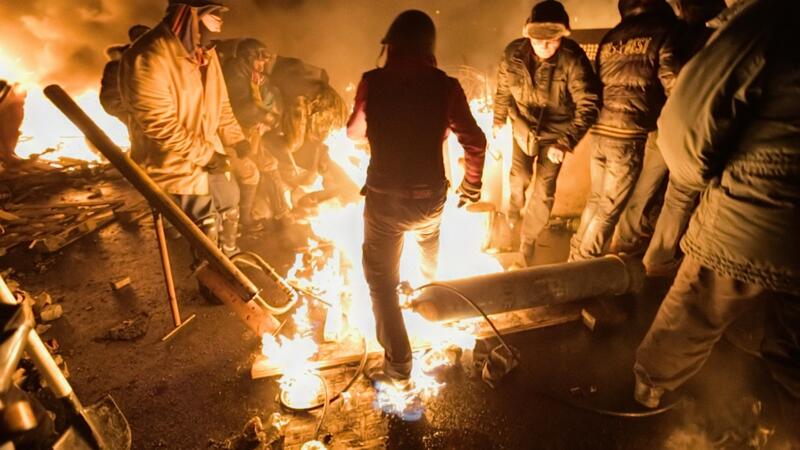
The documentary’s first-person approach is what makes that feeling so focused on the present. The camera doesn’t sit comfortably outside the events. It moves through crowds, barricades, fire, snow, voices, bodies, and fear. The film’s lack of stability becomes part of its moral design. It refuses to let Maidan become a sealed chapter of history. The revolution feels lived, unstable, exhausting, and alive. Viewers aren’t watching a diagram of resistance. They’re pushed into the space where resistance is happening.
That immersive strategy could’ve become overwhelming or disorienting without purpose, but TIME MACHINE MAIDAN keeps it so clear. The film moves from the peaceful March of Millions toward the violence in Kyiv’s government, and the shift is devastating because the hope never disappears. The film doesn’t reduce Maidan to bloodshed, even though it doesn’t look away from bloodshed. It remembers the gathering, the self-organization, the sense of people building a future with their own hands. Then it lets the viewer feel how fragile and costly that future becomes once power answers dignity with force.
What keeps the documentary from becoming an exercise in form is the real emotional and political urgency underneath it. TIME MACHINE MAIDAN was made by artists whose relationship to this history isn’t abstract. Liubyi has been part of Babylon’13 since 2013 and later joined the Ukrainian army. Tykhyy’s work with Babylon’13 is tied to the visual record of the Revolution of Dignity and the ongoing war. That closeness gives the film authority, but it also makes the piece feel vulnerable. TIME MACHINE MAIDAN is so emotionally loaded and ambitious that some viewers may need more grounding than the film is interested in providing. Its first-person design can make certain transitions feel less explanatory than experiential, and anyone coming to the Maidan revolution with a limited background may have to work to keep up. The film is more invested in emotional truth than conventional orientation.
The film’s refusal to behave like a standard historical overview is also what makes it stand apart. There are many ways to document a revolution, but TIME MACHINE MAIDAN is trying to capture how a revolution lives inside those who came after it. Tykhyy’s stated focus on young Ukrainians is felt throughout the film. It’s addressed to a generation that may have been children during Maidan but is now being asked to defend the country shaped by it. That idea gives the film a painful clarity. This isn’t only about what happened. It’s about inheritance, identity, and the burden of understanding yourself through struggle.
The film’s use of Maksym Kryvtsov as both a person and a symbol could’ve felt heavy-handed, but the reality behind it prevents that. His death at the front changes the film’s search into something almost unbearable. The protagonist isn’t only looking for a friend. He’s looking for the version of the future where warning someone might be enough. TIME MACHINE MAIDAN knows better, and that knowledge is what makes its conclusion resonate. Freedom isn’t presented as control over fate. It’s framed as the courage to choose a path even when the cost is known.
TIME MACHINE MAIDAN is inventive, urgent, and direct without becoming simplistic. It takes a major event in modern Ukrainian history and refuses to let it sit in the past. The film turns memory into movement, technology into mourning, and documentary form into an act of resistance. It’s challenging, sometimes demanding, and occasionally uneven in the way ambitious films often are, but its conviction is undeniable.
TIME MACHINE MAIDAN understands that nations aren’t only shaped by victories and defeats. They’re shaped by the people who keep returning to the places where everything changed, searching for meaning, warning signs, lost friends, and proof that sacrifice was not swallowed by time. Liubyi and Tykhyy have made a film about history as something alive, unstable, and still demanding an answer. It doesn’t offer comfort because comfort would be dishonest. It offers memory as responsibility, and for a film about Ukraine’s past and present, that feels like the only honest place to begin.
Please visit https://linktr.ee/overlyhonestr for more reviews.
You can follow me on Letterboxd, Instagram, Twitter, and YouTube. My social media accounts can also be found on most platforms by searching for 'Overly Honest Reviews'.
I’m always happy to hear from my readers; please don't hesitate to say hello or send me any questions about movies.
DISCLAIMER:
At Overly Honest Movie Reviews, we value honesty and transparency. Occasionally, we receive complimentary items for review, including DVDs, Blu-rays, CDs, Vinyl Records, Books, and more. We assure you that these arrangements do not influence our reviews, as we are committed to providing unbiased and sincere evaluations. We aim to help you make informed entertainment choices regardless of our relationship with distributors or producers.
Amazon Affiliate Links:
Additionally, this site contains Amazon affiliate links. If you purchase through these links, we may receive a commission. This affiliate arrangement does not affect our commitment to honest reviews and helps support our site. We appreciate your trust and support as you navigate these links.
