The Revival Learns to Look Forward
Futurama: Season 14
TV SERIS REVIEW
Futurama: Season 14
TV-14 - 

Genre: Animation, Comedy, Science Fiction
Year Released: 2026
Runtime: 6 x approximately 22m episodes reviewed
Cast: Billy West, John DiMaggio, Katey Sagal, Tress MacNeille, Maurice LaMarche, Lauren Tom, Phil LaMarr, David Herman
Where to Watch: premieres August 3, 2026 on Hulu and Hulu on Disney+ for bundle subscribers in the US, and on Disney+ internationally. New episodes will stream on Mondays
RAVING REVIEW: FUTURAMA no longer has to prove that it can return from cancellation. At this point, resurrection has become part of its production cycle. The harder question is whether another season can justify diving deeper into Fry, Leela, Bender, and the Planet Express crew after they’ve already received several perfectly good endings. Across the first six episodes of Season 14, the answer is an encouraging yes.
The Hulu revival has occasionally struggled with its eagerness to attach the 31st century to whatever people were discussing during the week an episode was written. The future became crowded with recognizable streaming services, cryptocurrencies, chatbots, and other references carrying short cultural expiration dates. Season 14 hasn’t abandoned topical satire, nor should it. FUTURAMA has always used tomorrow to make fun of today. The improvement comes from allowing its characters to shape those ideas instead of merely placing them inside a parody.
Lab-grown meat, online deception, healthcare anxiety, manipulation, and the commercialness surrounding celebrity are all present during these six episodes. Most of them could have become responses to contemporary headlines. Instead, they’re filtered through Fry’s appetites, Bender’s vanity, Professor Farnsworth’s reckless ingenuity, Hermes’ family obligations, and Zoidberg’s enduring need to be loved by somebody who isn’t legally required to tolerate him.
That distinction gives the season a sense of confidence. The writers aren’t pretending the series has never covered similar territory, and the episodes don’t waste time reintroducing relationships that viewers have understood for decades. They begin from the assumption that Fry will make an impulsive choice, Bender will turn humiliation into everyone else’s problem, and the Professor will regard ethics as an obstacle developed by people with less scientific imagination.
Fry’s entry into a hotdog-eating championship during “Beef” creates the kind of wonderfully foolish goal the character can pursue with absolute sincerity. At the same time, the Professor’s attempt to manufacture lab-grown meat gives the episode a focus to play off of (with that said, lab-grown meat isn’t a boogeyman; it’s perfectly fine and more sustainable; once production costs come down, it’ll be a wonderful substitute for the consumer). The premise works because the technology isn’t the joke. Food production, consumer appetite, the doctor's shortcuts, and competitive excess are all present, but Fry remains the person foolish enough to turn them into a crisis.
The episode also understands that FUTURAMA’s best ideas usually begin with something mundane. A meal, delivery route, appliance, or annoying custom becomes the entry point into a problem large enough to threaten New New York. “Beef” doesn’t reach the conceptual brilliance of the series’ finest science-based stories. However, it creates a satisfying mixture of physical comedy, escalating consequences, and the Professor refusing to admit that his solution may be worse than the original problem.
“Catfish Hunter” shifts attention toward Bender, who travels to Mississippi after an online scammer targets his grandmother. The setup allows the series to approach internet fraud without simply giving a futuristic name to a familiar app. Bender’s indignation is personal, hypocritical, and completely believable. He has no objection to dishonesty as a profession; he objects to another violating what he considers his territory. Giving Bender a family reason to care keeps the episode from becoming one prolonged joke about people lying online. John DiMaggio has always been excellent at finding the tiny amount of vulnerability hiding beneath Bender’s limitless self-regard. The character can experience genuine affection without becoming less selfish, and the episode benefits from refusing to clean up that contradiction.
The setting occasionally encourages some more generic jokes than the story needs, and some of the scam material follows obvious expectations before arriving at its twist. Its better moments come from Bender confronting a deception he can’t solve through his usual combination of theft, shouting, and abandoning everyone involved. The result is less ambitious than several celebrated Bender episodes. However, it gives DiMaggio enough room to remind us that the robot’s worst qualities and most endearing ones frequently share the same power supply.
“Our Flag Means Medical Coverage” comes closest to the interplanetary adventures that defined much of the show’s original hijinks. Fry and Bender are trusted with valuable cargo, space pirates interfere, and the consequences expand into a dispute where survival and bureaucracy become equally dangerous. The title makes you expect a healthcare satire, but the episode is smarter when that subject emerges through the crew’s predicament rather than becoming a collection of direct complaints. Medical coverage is an ideal FUTURAMA subject because little exaggeration is required to make the system appear inhuman. Moving it into a universe of aliens, pirates, dodgy doctors, and corporate delivery contracts gives the writers enough distance to expose the absurdity without trapping the story inside present-day terminology. Zoidberg’s existence also means that any discussion of medicine arrives with the possibility that the physician may understand less than the patient.
The episode can become a little overcrowded as it balances its cargo mission, pirate encounters, and institutional satire. The compressed runtime also gives the story momentum, and it’s satisfying to see Planet Express functioning as an actual delivery company rather than simply a room where the crew waits for the next modern reference to appear.
“Lords of the Ring” takes the cast to a world inhabited by intelligent rats, turning a crash landing into one of the season’s more playful outings. The title points toward fantasy parody, but the episode works best when it treats the rats as a society rather than just a reference. FUTURAMA has spent years building civilizations from creatures and biological functions that shouldn’t be capable of organizing a government, and this excursion fits comfortably within that tradition.
The story’s affection for genre material occasionally overwhelms the personalities. References accumulate, and a few jokes are almost too clear. The setting compensates for much of that familiarity. The rat world has enough character to keep the episode lively. At the same time, the Planet Express crew’s complete inability to behave diplomatically ensures that the civilization doesn’t remain orderly for long.
“The Charm Offensive” returns to Earth for a story about a major pop star using musical programming to control her followers. Celebrity worship, algorithmic influence, manufactured intimacy, ticket pricing surges, and the frightening organization of enormous fan communities are obvious targets. The episode doesn’t uncover an entirely new idea about any of them, although the framing gives those ideas a satisfying physical form.
FUTURAMA has always been particularly good at taking figurative language literally. Fans who claim to be controlled by an artist’s music can become an actual brainwashed army. A song engineered for maximum appeal can contain something far more invasive than a catchy chorus. The episode’s jokes work because the premise makes cultural exaggerations visible rather than stopping to explain why celebrity devotion can become unhealthy. The satire is sometimes too easy, particularly when it relies on observations about fame and followers surrendering their judgment. The pop star receives enough personality to avoid becoming just a target, but the fans function more as a force than individual characters.
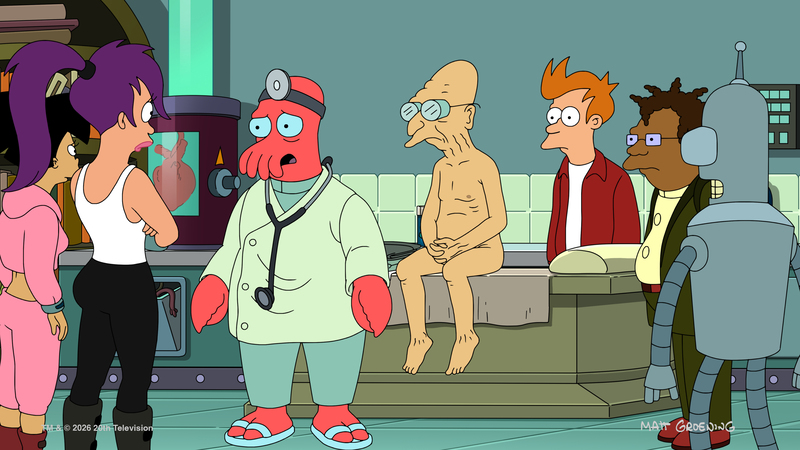
“Late Bloomers” is the most rewarding episode of the six provided. Hermes attempts to help his dying father while Zoidberg reconnects with an old love, bringing two supporting characters into stories involving family, mortality, regret, and the frightening possibility that happiness has come too late. Pairing them is unexpectedly effective because Hermes and Zoidberg occupy opposite positions within the Planet Express hierarchy. Hermes has built an identity around responsibility, order, and providing for the people who depend on him. Zoidberg has spent years surviving humiliation, hunger, and the widespread belief that any room would improve if he left it. Both stories ask what remains unresolved after a person has grown accustomed to a particular role.
Phil LaMarr gives Hermes’ emotional material the restraint it needs. The character’s frustration and devotion are allowed to coexist, avoiding the simpler version where impending loss erases years of complicated feeling. The story recognizes that trying to save someone can be an expression of love and an attempt to postpone a conversation nobody knows how to finish. Billy West’s work as Zoidberg remains one of the series’ most peculiar achievements. The voice is ridiculous, the character is absurd, and his behavior frequently makes him unbearable. Somehow, Zoidberg’s loneliness continues to carry real emotional weight. Bringing back a past romantic connection could have felt like an exercise in continuity for its own sake, but “Late Bloomers” uses that history to ask whether a person defined by rejection can recognize affection when it returns.
The voice ensemble remains the series’ most dependable piece. Billy West doesn’t merely return as Fry, Farnsworth, and Zoidberg; he makes them sound as natural as they did years ago. John DiMaggio gives Bender’s insults the necessary force without losing the insecurity beneath them. Katey Sagal continues to make Leela the person most capable of recognizing how foolish everyone else has become, while never placing her so far above the group that she stops participating in the foolishness. Lauren Tom and Phil LaMarr receive valuable opportunities to move Amy and Hermes beyond supporting roles. Maurice LaMarche, Tress MacNeille, and David Herman continue filling the universe with characters who can appear for seconds and immediately feel as though they’ve been causing trouble somewhere offscreen. The cast knows these people well enough to find small variations without disturbing what audiences love about them.
Maintenance isn’t an insult when the machine remains this distinctive. FUTURAMA can combine theoretical science, wordplay, workplace comedy, romantic disappointment, and a lobster’s digestive system without resembling any other series. Season 14 understands that its longevity comes from those combinations, not from proving that the writers have heard about the same trends as everyone else. Certain plots become overloaded with references, and several conclusions have to resolve ideas faster than their potential deserves. The season also depends on viewers bringing years of affection to characters who may receive only a few important moments within an episode. That history is used more responsibly here. Supporting characters are granted personal stakes, and even the parodies usually find a connection to somebody aboard Planet Express. The show feels less desperate to demonstrate relevance because its people remain relevant to one another.
FUTURAMA once found sadness in a dog waiting outside a pizza shop, a brother living in someone else’s shadow, and a robot discovering that immortality doesn’t protect anyone from loneliness. Season 14 doesn’t reach those devastating heights within its first six episodes, but “Late Bloomers” proves that the instinct remains. The comedy lands more consistently when that emotional possibility is nearby, even during stories that never pursue it directly. Another cancellation may eventually arrive. Another revival may follow after everyone involved has once again insisted that the conclusion was permanent. Season 14 accepts that uncertainty with the calm of a series that has outlived almost every prediction made about it. The future remains strange, the crew remains dysfunctional, and Planet Express somehow continues operating despite considerable evidence that it shouldn’t. That familiarity could have become a trap. These episodes turn it into a home worth revisiting.
Please visit https://linktr.ee/overlyhonestr for more reviews.
You can follow me on Letterboxd, Instagram, Twitter, and YouTube. You can also find my social media accounts on most platforms by searching for 'Overly Honest Reviews'.
I’m always happy to hear from my readers; please don't hesitate to say hello or send me any questions about movies.
[photo courtesy of HULU, DISNEY+, THE CURIOSITY COMPANY, 20TH TELEVISION ANIMATION, THE ULULU COMPANY]
DISCLAIMER:
At Overly Honest Movie Reviews, we value honesty and transparency. Occasionally, we receive complimentary items for review, including DVDs, Blu-rays, CDs, Vinyl Records, Books, and more. We assure you that these arrangements do not influence our reviews, as we are committed to providing unbiased and sincere evaluations. We aim to help you make informed entertainment choices regardless of our relationship with distributors or producers.
Amazon Affiliate Links:
Additionally, this site contains Amazon affiliate links. If you purchase through these links, we may receive a commission. This affiliate arrangement does not affect our commitment to honest reviews and helps support our site. We appreciate your trust and support as you navigate these links.
