Guilty Pleas and the Price of Innocence
The Best Justice System in the World
MOVIE REVIEW
The Best Justice System in the World
 -


Genre: Documentary, Crime, Comedy, Social Issues
Year Released: 2026
Runtime: 1h 28m
Director: Suja A. Thomas
Where to Watch: world premiere at DOC NYC on November 15, 2026, with a second screening on November 16
RAVING REVIEW: For a country that constantly celebrates its constitutional freedoms, the United States has developed some remarkably creative ways to make those protections difficult to exercise. THE BEST JUSTICE SYSTEM IN THE WORLD aims at one of the most troubling examples. The gradual disappearance of jury trials from a legal system that supposedly considers them fundamental to justice. Director Suja A. Thomas approaches the subject with an unusual combination of legal expertise and dark comedy, questioning why ordinary Americans have become increasingly disconnected from decisions that can determine whether someone loses their freedom or livelihood. It's a subject that deserves considerably more attention, especially when the consequences extend well beyond the criminal cases that dominate television. The documentary makes a persuasive argument that Americans should be more concerned about the rights they've already lost than the ones they're constantly being warned someone might take away.
Thomas brings an unusual background to documentary filmmaking. A professor at the University of Illinois College of Law, she's spent decades researching civil procedure, discrimination law, and the diminishing role of juries in American courts. Her experience isn't limited to academic research, either. Early in her legal career, she represented clients whose cases exposed troubling limits on juries' authority. In one discrimination case, a jury awarded her client more than $219,000, but a judge reduced the amount to $20,000. That experience shaped her interest in how much power the legal system places in judges' hands and how little authority ordinary citizens sometimes retain, even after they've been selected to decide a case.
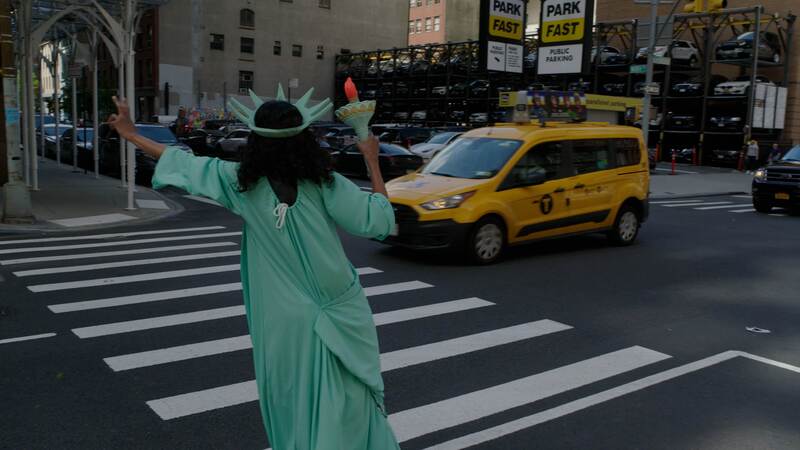
Rather than constructing a traditional documentary around legal scholars explaining complicated procedures, Thomas places herself at the center of the investigation. She's comfortable challenging the assumptions surrounding the justice system, but she also recognizes that most people aren't going to spend their free time studying court statistics or constitutional law. Her decision to use comedy is deliberate, drawing inspiration from Michael Moore's confrontational approach to political documentaries. At various points, Thomas even dresses as the Statue of Liberty, turning one of the country's most recognizable symbols of freedom into an unexpectedly useful tool for questioning how much freedom people actually possess within the legal system. The absurdity is intentional, although the subject beneath the costume is anything but funny.
The documentary's central argument is that jury trials are increasingly rare, despite their prominent place in American constitutional history. Popular entertainment has spent decades convincing audiences that legal disputes naturally progress toward dramatic courtroom confrontations. Witnesses testify, attorneys argue, and twelve ordinary citizens eventually determine the outcome. That familiar process remains part of American law, but it's far less representative of how cases are resolved than television suggests. Thomas examines the procedures that have pushed juries aside, explaining how plea bargaining dominates criminal proceedings while summary judgments and mandatory arbitration frequently prevent civil disputes from reaching a jury at all.
The criminal justice portion examines one of the most disturbing pressures facing defendants. The enormous difference between the punishment offered through a plea agreement and the sentence they could receive after a trial. Michael Johnson's experience illustrates this problem through a particularly difficult decision. Accused of a crime he maintains he didn't commit, Johnson faces the possibility of eleven years in prison if he exercises his right to a jury trial and loses. The alternative is to plead guilty and receive probation. On paper, he's being offered a choice. In practical terms, the consequences of choosing incorrectly are so severe that the decision becomes something considerably different from the voluntary exercise of a constitutional right.
What makes that situation so troubling is that guilt becomes only part of the calculation. A defendant must consider whether proving their innocence is worth risking years of their life, regardless of how strongly they believe the evidence supports them. A plea agreement doesn't establish innocence, of course, and not every negotiated resolution reflects injustice. Nevertheless, the enormous disparity between possible outcomes raises a clear concern about whether the system encourages truthful resolutions or simply rewards people for avoiding trial. Thomas highlights an uncomfortable contradiction. A constitutional protection has far less value when exercising it can expose someone to punishment far greater than the alternative.
Robert Davis provides another example of the human consequences behind those legal procedures. As a high school student, Davis faced the possibility of life imprisonment if he went to trial and was convicted. He instead accepted a plea agreement, ultimately spending thirteen years incarcerated before being exonerated. His experience demonstrates why these discussions can't remain confined to abstract debates about efficiency or courtroom resources. The consequences aren't temporary administrative inconveniences. People lose years of their lives, families are separated, and the damage doesn't disappear simply because a wrongful conviction is eventually overturned. The prospect of avoiding an extreme sentence can influence decisions even when someone maintains their innocence.
The distinction between these cases matters because they expose different aspects of the same institutional problem. Johnson's situation illustrates the immediate pressure of a vastly harsher sentence. In contrast, Davis shows how the consequences of accepting a plea can continue long after the original decision. Together, they challenge the comforting assumption that an innocent person would naturally refuse to admit guilt. It's easy to insist that someone should stand on principle when you aren't the person facing a potentially devastating prison sentence. Thomas focuses on the circumstances under which those decisions are made, rather than treating the eventual outcome as evidence that the process was fair.
The documentary also makes a worthwhile decision by extending its examination beyond criminal law. Most conversations about the justice system concentrate on arrests, prosecutors, and incarceration, leaving the civil side largely overlooked. Yet people who experience workplace discrimination or harassment can encounter significant barriers when attempting to have their claims heard. Thomas explores how judges can resolve cases through summary judgment, a legal procedure that allows certain disputes to be decided without a trial when the applicable legal standards are met. The procedure serves a legitimate purpose, but its use raises difficult questions about who decides whether disputed evidence deserves jury consideration.
Leah Hebert and Rita Pasarell's experiences illustrate the frustration that can arise when workplace harassment allegations don't receive the courtroom examination their claimants seek. Their allegations involve harassment by a New York State legislator, with recorded evidence playing a role in their accounts. Their inclusion broadens the documentary's examination of institutional power, showing that the obstacles facing people seeking legal accountability aren't limited to those accused of crimes. Someone attempting to challenge an employer can find the process almost as intimidating as the circumstances that prompted the complaint, particularly when the legal system prevents a jury from considering the allegations.
Mandatory arbitration introduces another problem, particularly when private employers require workers to resolve disputes outside traditional courts. The documentary examines Glenda Perez's experience after her supervisor fired her and she found that her employment arrangement prevented her from pursuing a jury trial. Instead, her dispute went before a private arbitrator, whose decision favored the employer. Thomas investigates the relationship between the arbitrator and the employer's attorney, raising concerns about how independence and fairness are maintained when dispute-deciders operate within a system funded by the parties appearing before them.
Arbitration isn't inherently illegitimate, and resolving disputes outside court can be beneficial in some circumstances. The concern becomes considerably more serious when participation isn't meaningfully voluntary or when an employee has little practical ability to negotiate the terms of an agreement. A system that presents arbitration as an efficient alternative can look very different from the perspective of someone who has lost the opportunity to have independent citizens evaluate their claim. Thomas' attention to this issue helps explain why the disappearance of jury trials matters beyond the people most commonly associated with legal proceedings.
One of the documentary's more interesting filmmaking choices involves its willingness to confront the people working within these institutions. Thomas questions legal professionals and officials about procedures that are often accepted as ordinary components of the system. Her background gives those exchanges a different foundation from the typical documentary confrontation. She's not simply asking provocative questions for an entertaining reaction. She understands the legal framework behind them and can challenge explanations that might otherwise pass without scrutiny. That expertise becomes especially useful when the discussion moves into technical areas that could easily become inaccessible to viewers unfamiliar with the law.
The comic approach also forces the documentary into an interesting balancing act. Dressing as the Statue of Liberty and engaging people through humor can make an intimidating subject more approachable, but the cases themselves involve consequences that shouldn't be trivialized. Thomas clearly recognizes that distinction in her stated intentions, using comedy to attract attention to subjects that might otherwise struggle to reach a broad audience. The approach recalls the more confrontational tradition of political documentary filmmaking, where absurd situations and uncomfortable encounters expose serious institutional failures. The challenge is maintaining enough space for the people affected by those failures so their experiences don't become secondary to the filmmaker's personality.
That distinction matters because Thomas is both the documentary's director and its primary advocate. Her position gives the film clarity, but it also means the investigation is organized around an argument she's spent much of her professional career developing. There's nothing inherently dishonest about making a documentary with a defined position. Some of the most valuable investigative films begin with filmmakers who are deeply invested in the subjects they're examining. Advocacy works best when audiences understand the legal complexities alongside the argument for reform. The American justice system contains procedures developed for different reasons, and recognizing those distinctions can strengthen criticism of how they're applied rather than weaken it.
The participation of executive producer Kirsten Johnson and consulting producer Kurt Engfehr adds another connection to the documentary filmmaking community. Johnson's work on CAMERAPERSON and DICK JOHNSON IS DEAD has demonstrated an interest in examining difficult personal subjects through unconventional nonfiction storytelling. Engfehr's involvement with BOWLING FOR COLUMBINE and FAHRENHEIT 9/11 connects this production more directly to the tradition of using confrontation and humor to challenge powerful institutions. Their experience offers relevant context for Thomas' approach, although the documentary remains fundamentally her project. Its perspective comes from her legal career and her determination to make the disappearance of jury trials a subject ordinary Americans will recognize as personally important.
The film's comparison with the United Kingdom introduces another valuable dimension to the discussion. American audiences are often encouraged to see their constitutional framework as uniquely protective, with little consideration of how other democratic countries handle comparable legal disputes. Thomas' examination of another system challenges the assumption that current American procedures represent the only practical way to administer justice. Comparisons between legal systems require some caution, since different countries have distinct institutions and traditions. Nevertheless, looking beyond the United States is a reasonable way to question whether practices commonly defended as unavoidable are actually necessary.
At eighty-eight minutes, THE BEST JUSTICE SYSTEM IN THE WORLD attempts to cover a considerable amount of material. Criminal plea agreements and civil summary judgments involve different legal standards, while employment arbitration presents another distinct set of concerns. The connecting argument is clear, but each subject could support its own documentary. That breadth lets Thomas show how widely jury removal affects American life. It also limits attention to the procedural distinctions and potential reforms tied to each issue. The documentary's accessibility is valuable, but the subject's complexity makes meaningful compression difficult.
Perhaps the most important distinction in Thomas' argument is that restoring access to juries wouldn't automatically guarantee just outcomes. Juries can misunderstand evidence, make mistakes, and bring their own prejudices into deliberations. American legal history offers plenty of examples of those failures. Thomas' case rests instead on the principle that decisions should not be concentrated unnecessarily in the hands of institutional authorities. A jury introduces ordinary citizens into a process otherwise controlled primarily by professionals, creating an additional opportunity for scrutiny. That safeguard isn't perfect, but imperfection alone doesn't establish that removing it produces a fairer alternative.
A democratic argument also underlies the legal one. Jury service is among the few situations in which ordinary Americans are given direct responsibility for decisions made in the justice system. Voting determines who holds public office, but juries allow citizens to participate in the administration of law itself. Reducing that participation changes the relationship between the public and the institutions supposedly operating on its behalf. Thomas' documentary challenges viewers to consider whether a legal system can continue presenting itself as accountable to the people when those people are increasingly excluded from decisions that profoundly affect their lives.
THE BEST JUSTICE SYSTEM IN THE WORLD has the advantage of a filmmaker whose professional expertise gives her argument genuine substance. Thomas isn't approaching the subject because of a passing interest in legal controversy. She's spent much of her career examining the mechanisms that determine whether ordinary citizens ever receive an opportunity to have their cases considered by a jury. That experience gives the documentary a clear purpose, even when its ambitious collection of legal issues competes for attention within a relatively short running time. Its humor offers a way into material that could easily become exhausting, and the individual cases show why these procedural questions deserve concern beyond academic circles.
The title is deliberately provocative, challenging a national tendency to equate constitutional promises with the everyday reality of how institutions function. THE BEST JUSTICE SYSTEM IN THE WORLD doesn't need to establish that every court or legal professional operates unfairly to make its broader argument worthwhile. Its central concern is more specific and, in many respects, more disturbing. A right can remain written into law while becoming increasingly difficult to exercise in practice. Thomas wants Americans to recognize that distinction and question how much power they've surrendered without realizing it. For a documentary about something as seemingly ordinary as jury trials, that's an important conversation to bring into public view. The Statue of Liberty costume might earn a laugh, but the reasons Thomas wears it deserve far more serious attention.
Please visit https://linktr.ee/overlyhonestr for more reviews.
Follow me on Letterboxd, Instagram, Twitter, and YouTube. You can also find my social media accounts on most platforms by searching for 'Overly Honest Reviews'.
I’m always happy to hear from my readers; please don't hesitate to say hello or send me any movie questions.
DISCLAIMER:
At Overly Honest Movie Reviews, we value honesty and transparency. Occasionally, we receive complimentary items for review, including DVDs, Blu-rays, CDs, Vinyl Records, Books, and more. We assure you these arrangements do not influence our reviews, as we are committed to unbiased, sincere evaluations. We aim to help you make informed entertainment choices regardless of our relationship with distributors or producers.
Amazon Affiliate Links:
This site also contains Amazon affiliate links. If you purchase through these links, we may receive a commission. This affiliate arrangement does not affect our commitment to honest reviews and helps support our site. We appreciate your trust and support as you navigate these links.
