A Meditative Story About the Lives We Miss
We Are Aliens (我々は宇宙人)
MOVIE REVIEW
We Are Aliens (我々は宇宙人)
 -
- 


Genre: Animation, Drama
Year Released: 2026
Runtime: 1h 57m
Director(s): Kohei Kadowaki
Writer(s): Kohei Kadowaki
Cast: Ryota Bando, Amane Okayama
Where to Watch: shown at the 2026 Cannes Film Festival
RAVING REVIEW: WE ARE ALIENS moves with the patience of memory itself. Not filmmaking memory, where every moment arrives on queue and heightened, but actual memory, fragmented, uneven, specific, and often tied to feelings that become harder to explain with age. Kohei Kadowaki’s film understands how childhood relationships can shape the architecture of an entire life, even when those relationships eventually disappear into distance and silence.
The premise sounds almost too simple. Two boys meet during elementary school, form a meaningful friendship, then become separated after a small but life-altering incident. From there, the film stretches outward across more than thirty years, tracing the emotional remains left behind by that connection. What’s remarkable is how resistant the movie is to pure nostalgia. WE ARE ALIENS doesn’t treat childhood as a magical lost paradise. Instead, it presents youth as a period where emotions are experienced with intensity because nothing has developed protective layers around them.
That directness becomes such a remarkable quality. Kadowaki approaches loneliness with restraint, refusing melodrama even when the material could easily drift toward it. There are long stretches where the film feels almost observational, lingering on ordinary interactions, routines, pauses in conversation, and moments of emotional hesitation. Rather than constantly announcing its themes, WE ARE ALIENS allows them to accumulate slowly through repetition and absence.
The title itself initially sounds larger than the story being told, almost cosmic in implication, but the film gradually reveals how appropriate it really is. The “alien” feeling here has less to do with science fiction than alienation. The growing awareness that even among family, friends, classmates, or partners, people often remain somewhat unknowable to one another. Kadowaki explores that discomfort without bitterness. The film aches, but it doesn’t condemn its characters for drifting apart or failing to articulate themselves fully.
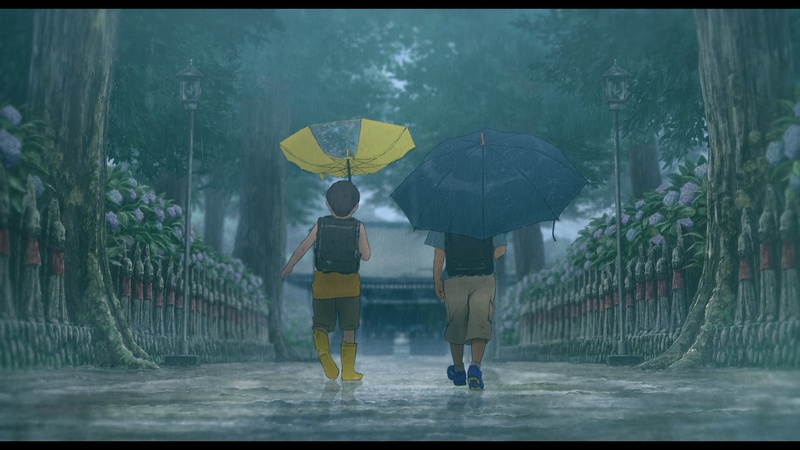
The animation leans into softness without becoming overly softened. There’s a muted quality to much of the film’s aesthetic, especially during its quieter stretches, that beautifully mirrors the emotional tone. Rather than overwhelming the audience with hyperactive movement or exaggerated visual spectacle, the animation often emphasizes stillness, atmosphere, and physical distance between people. Empty rooms, train rides, hallways, changing neighborhoods, and seasonal transitions quietly become emotional landmarks.
WE ARE ALIENS manages to separate itself from a lot of contemplative animated dramas by how naturally it handles the passage of time. Many films covering multiple decades end up feeling episodic or fragmented, but Kadowaki finds a connective tissue in behavior and echoes of emotion. Childhood insecurities don’t vanish with adulthood. They evolve, harden, or resurface years later. The movie pays close attention to those recurring emotions without overexplaining them.
Ryota Bando and Amane Okayama’s voice performances play a major role in grounding the material. Neither performance feels theatrical. The delivery is understated, conversational, and occasionally almost awkward, making the characters feel like real participants in this story. Kadowaki seems interested in incompleteness, the idea that people rarely say the exact thing they mean when it matters most. The vocal performances preserve that uncertainty instead of sanding it away into polished emotional clarity.
One of the film’s smartest decisions is refusing to manufacture constant escalation. There are no giant revelations that suddenly reframe everything. No manipulative twists intended to force catharsis. WE ARE ALIENS understands that many relationships don’t end through betrayal or conflict. Sometimes people simply drift apart while carrying emotions they never processed. That lingering incompletion becomes central to the film’s emotional power.
WE ARE ALIENS recognizes how people continue living inside us long after contact ends. Not in a romanticized way, but in quieter ways, habits of thought, emotional reflexes, lingering regrets, recurring dreams, or moments where the past reasserts itself in the present. There’s a sequence late in the film where that accumulation solidifies, not through a giant dramatic gesture, but through recognition. Recognition of time lost, opportunities missed, and the impossibility of recovering who we once were. Kadowaki handles that realization with remarkable poignant interaction. The film never tries to force closure where it wouldn’t feel truthful.
In many ways, WE ARE ALIENS operates less like a narrative and more like an excavation. It keeps digging through memory, searching for meaning inside moments that initially seem ordinary. Sometimes it finds heartbreak there. Sometimes comfort. Sometimes confusion; usually a mixture of all three. The film leaves behind a strange quiet. Not devastation, not triumph, not melancholy. Something softer and harder to define. The feeling of realizing how deeply another person shaped your life, even if neither of you understood it at the time. That ambiguity gives WE ARE ALIENS its staying power. It’s a film less interested in delivering answers than in preserving emotion before it disappears completely.
Please visit https://linktr.ee/overlyhonestr for more reviews.
You can follow me on Letterboxd, Instagram, Twitter, and YouTube. My social media accounts can also be found on most platforms by searching for 'Overly Honest Reviews'.
I’m always happy to hear from my readers; please don't hesitate to say hello or send me any questions about movies.
[photo courtesy of CHARADES, THE PR FACTORY]
DISCLAIMER:
At Overly Honest Movie Reviews, we value honesty and transparency. Occasionally, we receive complimentary items for review, including DVDs, Blu-rays, CDs, Vinyl Records, Books, and more. We assure you that these arrangements do not influence our reviews, as we are committed to providing unbiased and sincere evaluations. We aim to help you make informed entertainment choices regardless of our relationship with distributors or producers.
Amazon Affiliate Links:
Additionally, this site contains Amazon affiliate links. If you purchase through these links, we may receive a commission. This affiliate arrangement does not affect our commitment to honest reviews and helps support our site. We appreciate your trust and support as you navigate these links.
