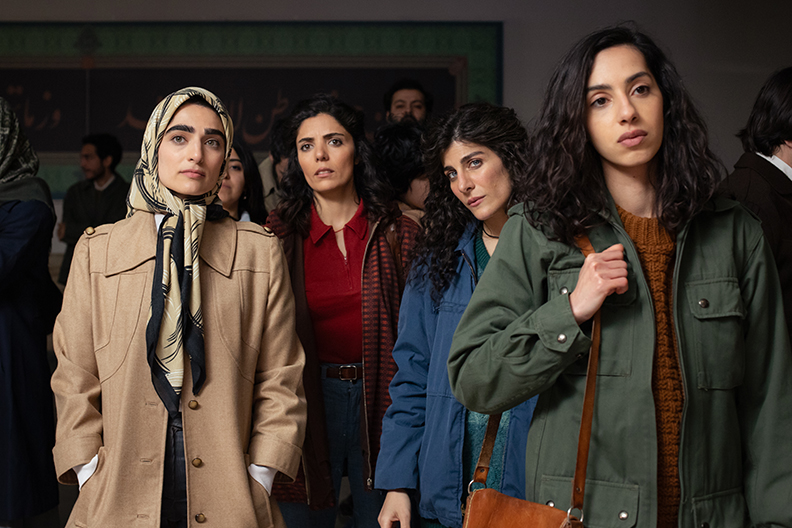
Women Claiming Private Space
Reading Lolita in Tehran
MOVIE REVIEW
Reading Lolita in Tehran
 -
- 


Genre: Drama
Year Released: 2024, 2026
Runtime: 1h 47m
Director(s): Eran Riklis
Writer(s): Marjorie David, Eran Riklis, based on the book by Azar Nafisi
Cast: Golshifteh Farahani, Zar Amir, Mina Kavani, Bahar Beihaghi, Isabella Nefar, Raha Rahbari, Lara Wolf, Arash Marandi, Reza Diako, Catayoune Ahmadi
Where to Watch: opens July 10, 2026, in New York and July 17 in Los Angeles
RAVING REVIEW: A book passed from one person to another feels so vital, until an outside force steps in and decides it’s dangerous. READING LOLITA IN TEHRAN builds around the idea of that reversal, taking a private act of study and turning it into a form of survival. Eran Riklis adapts Azar Nafisi’s bestselling memoir with attention to the ways women protect their inner lives under a regime determined to control their bodies, language, classrooms, and imagination.
The story follows Azar Nafisi, played by Golshifteh Farahani, as she secretly gathers seven of her most dedicated female students to read banned works of Western literature. The selections include LOLITA and PRIDE AND PREJUDICE, but the real subject isn’t the reading list. The real subject is what happens when women are denied freedom and begin building a world from whatever remains available to them. A living room becomes a classroom, a classroom becomes a refuge, and refuge becomes one of the few places where the women can speak without first measuring every word against fear.
Farahani portrays Azar as neither saintly nor distant, and that ultimately matters more than I expected. She plays her as a woman with conviction, doubt, pride, exhaustion, and a need to keep teaching even when the act itself becomes dangerous. Farahani doesn’t oversell the character’s strength. She makes it feel frayed in some ways, and often carries on because stopping would mean accepting a lesser version of life and herself. That avoids turning Azar into a symbol before she’s allowed to be a person.
Zar Amir brings some of the film’s most immediate impact as Sanaz, while Mina Kavani gives Nassrin a wounded complexity that adds weight to the group’s shared conversations. The ensemble is strongest when the women are allowed to disagree, tease, question, or sit with discomfort. READING LOLITA IN TEHRAN works best in those scenes, when literature stops being a topic and becomes a way for the characters to test the boundaries of their own lives. These women aren’t just reading to escape. They’re reading to identify the shape of their captivity.
READING LOLITA IN TEHRAN has the bones of a piercing chamber drama, especially when the women are gathered together, and the outside world presses against the walls. The adaptation sometimes spreads itself thin trying to cover the memoir’s emotional, political, and literary reach. Certain students come into focus beautifully, while others feel defined more by what they represent than by who they are. The film clearly wants each woman’s experience to matter, but the runtime doesn’t always give every thread enough room to breathe.
The production carries an impressive sense of control. Shooting outside Iran and recreating Tehran through other locations could’ve created a distracting layer of distance. The film’s design, costuming, sound, and Hélène Louvart’s cinematography help maintain a convincing emotional environment. The outside world is watched, inspected, and narrowed. Inside Azar’s home, the frame opens just enough for breath.
That contrast gives the film some of its best moments. A veil removed carries as much meaning as any speech. A glance between students can hold fear, judgment, relief, or recognition. Small gestures accumulate because the movie understands that oppression isn’t only made of major acts of violence. It’s also made of daily humiliations, rules that shrink the body, and the exhausting knowledge that one wrong sentence can change everything. READING LOLITA IN TEHRAN is at its most affecting when it focuses on those intimate losses.
The film’s emotional pull also comes from how it conveys feelings without needing to force the connection. This is set in revolutionary Iran, but its questions aren’t confined to one country or decade. Who gets to learn? Who decides which stories are dangerous? What happens when women are treated as problems to be managed instead of people with private lives, public voices, and intellectual hunger?
A softer final impression keeps READING LOLITA IN TEHRAN from hitting with the full force it’s reaching for. The film is sincere, well-acted, and frequently stirring, yet it can be more reverent than alive in stretches. A little more friction inside the group, a little more patience with the debates, and a less conventional dramatic shaping could’ve made it feel more dangerous. The story is about forbidden literature, but the filmmaking itself rarely feels forbidden.
Even so, this is a thoughtful and worthwhile drama carried by a strong cast and a subject that deserves serious attention. READING LOLITA IN TEHRAN honors the power of Nafisi’s story while also revealing the difficulty of adapting a memoir built from memory, literature, politics, and resistance. It doesn’t always find the most powerful version of that material, but when the women gather, read, argue, and reclaim a corner of themselves, the film understands exactly what’s at stake. In a world trying to make them smaller, the act of reading becomes a refusal to disappear.
Please visit https://linktr.ee/overlyhonestr for more reviews.
You can follow me on Letterboxd, Instagram, Twitter, and YouTube. My social media accounts can also be found on most platforms by searching for 'Overly Honest Reviews'.
I’m always happy to hear from my readers; please don't hesitate to say hello or send me any questions about movies.
[photo courtesy of GREENWICH ENTERTAINMENT]
DISCLAIMER:
At Overly Honest Movie Reviews, we value honesty and transparency. Occasionally, we receive complimentary items for review, including DVDs, Blu-rays, CDs, Vinyl Records, Books, and more. We assure you that these arrangements do not influence our reviews, as we are committed to providing unbiased and sincere evaluations. We aim to help you make informed entertainment choices regardless of our relationship with distributors or producers.
Amazon Affiliate Links:
Additionally, this site contains Amazon affiliate links. If you purchase through these links, we may receive a commission. This affiliate arrangement does not affect our commitment to honest reviews and helps support our site. We appreciate your trust and support as you navigate these links.
