Freedom Waits Across the Street
Olmo
MOVIE REVIEW
Olmo
 -
- 


Genre: Comedy, Drama, Coming-of-Age
Year Released: 2025, 2026
Runtime: 1h 24m
Director: Fernando Eimbcke
Writers: Fernando Eimbcke, Vanesa Garnica
Cast: Aivan Uttapa, Gustavo Sánchez Parra, Diego Olmedo, Andrea Suárez Paz, Rosa Armendariz, Melanie Frometa
Where to Watch: in select theaters August 7, 2026
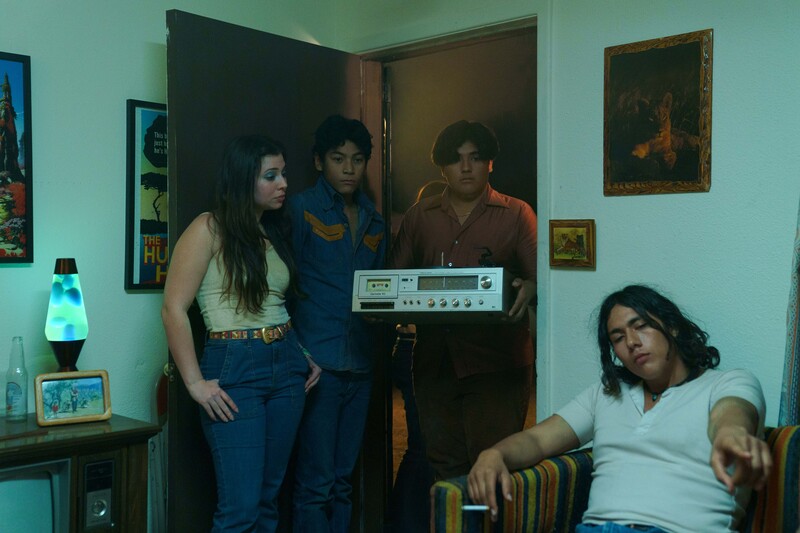
RAVING REVIEW: The stereo in OLMO is far too heavy for what it promises. To fourteen-year-old Olmo, it’s a possible ticket into the party being held by Nina, the neighbor who occupies most of his daydreams. It also belongs to his father, a bedridden man whose illness has reorganized the entire family’s existence. Before Olmo can carry the music across the street, he has to confront everything waiting for him inside his own home. It’s such an intriguing premise, because there are so many lessons to be learned in the relatively simple story.
Fernando Eimbcke’s first feature in more than a decade takes place in New Mexico during 1979, where Olmo lives with his parents and older sister in a home near the railroad tracks. His father, Nestor, has multiple sclerosis and requires constant assistance. His mother, Cecilia, works long hours to keep the family afloat, leaving Olmo and Ana to divide the remaining care between them. Neither child wants the responsibility, particularly when friends, parties, cars, music, and everything associated with teenage freedom appear to be passing directly outside their windows. It’s the core of a coming-of-age story that becomes something more in front of us.
Eimbcke and co-writer Vanesa Garnica don’t try to make Olmo admirable through premature maturity. He complains, argues, avoids chores, and can be cruel toward a father who has no control over his situation. Olmo wants to impress Nina more than he wants to consider what Cecilia has sacrificed or how humiliating dependence has become for Nestor. The movie refuses to condemn him for that selfishness because it recognizes what the family has required him to become before he’s prepared.
Caregiving has made Olmo older in some ways and kept him young in others. He knows how to help manage an adult’s physical needs, yet he barely understands how to speak to a girl. He’s expected to recognize the seriousness of his father’s condition while remaining consumed by fantasies involving fast cars, crushes, and the social possibilities of a single night. Those contradictions make him a convincing character. OLMO doesn’t treat adolescence as a lesson waiting to be learned. It presents it as an accumulation of desires that rarely arrive in the order we’re prepared for.
Aivan Uttapa is a wonderfully natural fit for the title role. He never appears to be setting up Olmo’s reactions for an audience, allowing irritation, embarrassment, tenderness, and panic to cross his face before the character has decided which emotion he wants anyone else to see. His timing comes from that lack of control. Olmo frequently believes he looks confident while Uttapa lets us see the frightened kid improvising underneath.
Diego Olmedo provides an ideal companion as Miguel, the best friend who encourages Olmo’s escape without becoming just a sidekick. Their friendship has the unguarded quality of two boys who have spent enough time together that neither needs to maintain much dignity. They rehearse dance moves, discuss girls with misplaced certainty, and treat the stereo as though access to music can solve every social problem awaiting them.
Their journey brings some of the movie’s funniest passages, including an unexpected stop at a gathering they badly misinterpreted. Eimbcke stretches the situation without turning the people involved into objects of ridicule. The joke remains attached to Olmo and Miguel’s limited understanding of the room they’ve entered, not to the grief surrounding them. Humor becomes a way for the boys to move through experiences they aren’t equipped to process directly.
That combination of sadness and absurdity keeps OLMO from becoming a lecture about family obligation. Nestor’s illness is serious, but the household isn’t preserved as a shrine to suffering. People argue over food, money, time, possessions, and whose turn it is to help him. They become impatient. They make inappropriate jokes. They say unforgivable things and continue living together because an apology can’t always come before the next task needs to be completed.
Gustavo Sánchez Parra is especially good at protecting Nestor from sentimental treatment. The character has lost much of his independence, not his pride, anger, intelligence, or ability to make everyone around him miserable. He can be demanding and vindictive, using the little authority he retains to frustrate the children who resent caring for him. Those moments don’t make him a villain. They reveal a man resisting the possibility that his family now sees only a body that must be washed, moved, fed, and monitored.
The scenes between Nestor and Olmo carry greater impact because neither is really innocent. Olmo’s resentment is understandable, although the words he uses can be vicious. Nestor’s humiliation invites sympathy, even when he retaliates against his son. Their relationship contains love, dependence, anger, and mutual embarrassment without asking one emotion to cancel the others.
The 1979 setting is relaxed in a natural feeling, from the clothing, radios, cars, roller skates, and neighborhood details that establish the period without turning every object into a demand for recognition. Music carries much of that work. Mexican pop, disco, and rock move through radios and stereos, offering the characters a temporary relief beyond illness and unpaid bills. Olmo and Miguel’s devotion to their dance moves is funny because they perform them with total sincerity, not because the movie considers them ridiculous.
Melanie Frometa gives Nina enough warmth to explain Olmo’s fascination, though the character remains closer to a cliched projection than a fully formed person. Her primary function is to represent the life Olmo imagines other teenagers enjoying without him. That limitation may be appropriate to his perspective, but it leaves one of the story’s most important relationships thinner than the family material surrounding it.
Cecilia and Ana could have used more attention. Andrea Suárez Paz conveys the mother’s exhaustion without turning her into a figure defined by sacrifice. At the same time, Rosa Armendariz gives Ana a harder, more openly defiant response to the same responsibilities burdening Olmo. The film understands that both women have lives extending beyond the boy’s crisis. It just doesn’t spend enough time exploring them.
Ana’s resentment is particularly revealing because she has reached an age when leaving home is becoming conceivable. Her smoking, roller skating, and hostility aren’t merely signs of rebellion. They’re efforts to claim control inside a household where everyone’s lives depend upon Nestor’s condition and Cecilia’s schedule. Olmo receives the deeper emotional journey, while Ana is left carrying a parallel story around its edges.
Eimbcke avoids pretending that Olmo has become selfless by morning. The boy gains perspective, not a transformed personality. His father will remain ill. Cecilia will continue working. Ana will continue wanting a life that belongs to her. Caregiving won’t become easier because the family has briefly recognized what they mean to one another.
That restraint protects OLMO from the lie that love eliminates resentment. Family members can become each other’s deepest source of pain precisely because they remain responsible for one another. Olmo’s home restricts him, embarrasses him, and demands more than a child should have to give. It also contains the people who understand why he’s angry enough to run.
OLMO finds its heart inside that contradiction. Its familiar coming-of-age pursuit and occasionally arranged sentiment keep it from reaching the depth suggested by its strongest moments. Eimbcke lets affection coexist with exhaustion, allows a sick father to remain difficult, and grants a selfish boy the space to grow without punishing him for wanting one ordinary night. The stereo may promise escape, but the music eventually leads Olmo back to the people who taught him how to listen.
Please visit https://linktr.ee/overlyhonestr for more reviews.
You can follow me on Letterboxd, Instagram, Twitter, and YouTube. You can also find my social media accounts on most platforms by searching for 'Overly Honest Reviews'.
I’m always happy to hear from my readers; please don't hesitate to say hello or send me any questions about movies.
[photo courtesy of GREENWICH ENTERTAINMENT]
DISCLAIMER:
At Overly Honest Movie Reviews, we value honesty and transparency. Occasionally, we receive complimentary items for review, including DVDs, Blu-rays, CDs, Vinyl Records, Books, and more. We assure you that these arrangements do not influence our reviews, as we are committed to providing unbiased and sincere evaluations. We aim to help you make informed entertainment choices regardless of our relationship with distributors or producers.
Amazon Affiliate Links:
Additionally, this site contains Amazon affiliate links. If you purchase through these links, we may receive a commission. This affiliate arrangement does not affect our commitment to honest reviews and helps support our site. We appreciate your trust and support as you navigate these links.
