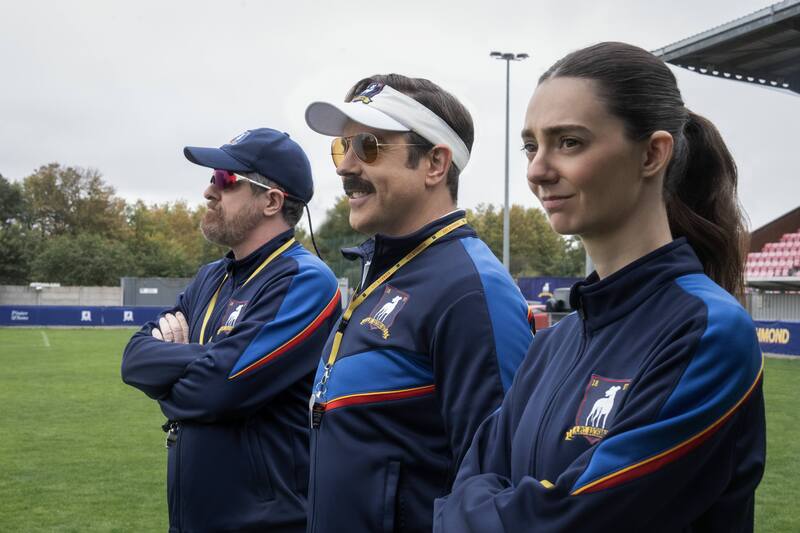
Richmond Finds Another Reason to Believe
Ted Lasso: Season 4 (ep. 1-4)
TV SERIES REVIEW
Ted Lasso: Season 4 (ep. 1-4)
 -
- 

Genre: Comedy, Drama, Sports
Year Released: 2026
Runtime: 45m episodes
Directors: Erica Dunton, Ellie Heydon
Writers: Jason Sudeikis, Brett Goldstein, Leann Bowen, Sarah Walker, Phoebe Walsh, Julia Lindon, Dylan Marron
Cast: Jason Sudeikis, Hannah Waddingham, Juno Temple, Brett Goldstein, Brendan Hunt, Jeremy Swift, Tanya Reynolds, Jude Mack, Faye Marsay, Rex Hayes, Aisling Sharkey, Abbie Hern, Grant Feely
Where to Watch: the fourth season will premiere globally on Apple TV on August 5, 2026, with the first episode, followed by new episodes every Wednesday through October 7, 2026
RAVING REVIEW: The third season gave Ted Lasso an ending everyone deserved. Ted returned to his son, Richmond continued without him, and nearly every major character stepped toward a future that no longer required the series to follow along. Bringing everyone back three years later could have exposed the conclusion as a temporary pause inserted before Apple backed another truck of money onto the pitch. The first four episodes of Season 4 understand that concern, and the best decision they make is refusing to pretend it doesn’t exist. Jason Sudeikis thought TED LASSO was done after season three, and it wasn’t until he knew more stories needed to be told.
Ted’s return to Richmond isn’t treated as though nothing happened after he boarded that plane. Time moved along, relationships have changed, and the people who once depended on his guidance have built lives in his absence. The season doesn’t argue that Ted was wrong to leave England. It recognizes that one choice can’t settle every question that follows it.
That distinction allows the premiere, “Home,” to begin somewhere that has more depth and meaning rather than rushing Ted back into Rebecca’s office before the opening credits have finished. His years in Kansas have given him what he believed he needed, including the chance to remain a bigger part of Henry’s life. Grant Feely takes over the role of Ted’s son and brings enough personality to Henry that the relationship no longer exists mainly as motivation delivered through phone and Zoom calls.
Ted remains loving and attentive, although the distance between being a good father and knowing what comes next has begun to trouble him. Sudeikis plays that uncertainty with less visible strain than the panic attacks and buried pain of earlier seasons. Ted isn’t falling apart again. He has reached the point where he discovers that emotional progress doesn’t produce a permanent answer.
The circumstances bringing him back to Richmond contain a little “convenience,” but the series wisely spends time making the decision feel like a continuation rather than a reversal. Familiar faces revolving around Ted’s Kansas life provide the expected joy of a reunion without leaning entirely on the jokes you’d expect. Rebecca, Keeley (huge props for the Oz-inspired outfit), Higgins, and the others haven’t arrived to drag their old coach back toward the exact job he left. They’re offering him a challenge that carries a different kind of purpose.
That challenge is AFC Richmond’s second-division women’s team, an idea planted during the Season 3 finale and finally given the room to become something more than a hopeful note passed between Keeley and Rebecca. The new team doesn’t receive Richmond’s resources, legitimacy, or patience automatically. Before the players can worry about winning matches, they must convince people with money that their team deserves to exist.
“Richmond’s Got Talent” handles that fight particularly well. Shareholders approach the women’s side as a questionable expense that should prove its worth before anyone invests enough for it to succeed. The circular logic is familiar far beyond sports. Withhold the money, facilities, attention, and time needed to develop, then point to the resulting struggle as evidence that the investment would have been wasteful.
Rebecca’s response brings Hannah Waddingham back into the part of her performance that has always been most satisfying. She can make a room feel smaller with a look, but the authority now comes from a place of purer heart than the anger driving Rebecca during the first season. She no longer needs to imitate the men who occupied these rooms before her. Waddingham lets confidence sit alongside irritation, humor, and a growing refusal to treat every sexist objection as though it deserves a cool, calm, and collected answer.
The women’s team also forces the series to reconsider its own methods. Ted’s approach worked with Richmond’s men because he recognized the emotional problems hidden beneath aggression, competition, and masculine posturing. Coaching women doesn’t mean repeating those lessons with different uniforms. The new players have their own histories, ambitions, insecurities, and reasons to distrust the people suddenly claiming they want to help.
Ted initially approaches the assignment with his usual supply of optimism and references, though the season doesn’t let charm substitute for listening. Some players are receptive. Others see an American celebrity coach wandering into their careers with limited understanding of their experiences and existing relationships. Ted has spent years teaching people that curiosity matters, and now he must practice it in a setting where his reputation cannot do all the work for him.
The first four episodes are strongest when they allow that resistance to remain reasonable. Not everyone who doubts Ted is cruel, bitter, or waiting for a speech to change their life. Several women have survived by depending on teammates, controlling what they reveal, or expecting institutions to disappoint them. “Clique Fix” examines divisions within the developing squad without treating friendship groups as childish problems that can be eliminated through a team-building drill.
The players haven’t really defined themselves, which is the largest concern after four episodes. The established Richmond characters bring years of affection into every scene, leaving the newcomers to compete against people the audience already loves. The tryouts and early practices introduce distinct personalities. A few of the women remain more defined by their traits or their position within the group than by anything happening beyond football.
There is enough movement early on to suggest that imbalance will improve. Jude Mack, Faye Marsay, Aisling Sharkey, Abbie Hern, and the rest of the new ensemble generate a convincing mixture of competitiveness, awkwardness, suspicion, and shared excitement. The group doesn’t feel like a female copy-and-paste of the men’s Greyhounds, even when the writers knowingly echo situations from Ted’s first time around.
Tanya Reynolds is an especially welcome addition to the core of the coaching team. Her dry delivery gives Ted another person capable of interrupting his mental and verbal detours without reproducing what Beard offered with his silence or Roy with his profanity. Their differences create an amusing adjustment needed by Ted, while her presence helps prevent the women’s side from becoming a project designed entirely by men.
Roy and Beard haven’t been pushed aside to clear room for the new story. Brett Goldstein still knows exactly how long Roy should glare before speaking, and Brendan Hunt remains invaluable whenever an episode needs someone to accept an absurd situation as completely ordinary. Their coaching experience also creates a new question about where Ted belongs now that Richmond no longer needs him to teach the same lessons.
Roy’s growth is handled with greater care than a simple return to his furious baseline. He remains abrasive, impatient, and capable of turning encouragement into something that sounds like a threat, but his years of work on himself haven’t vanished. The comedy comes from watching Roy attempt to apply the emotional intelligence while resenting nearly every word required to express it.
Keeley’s place in the first four episodes is less settled. Juno Temple immediately restores her chemistry with Waddingham and Goldstein, yet the season still feels like it’s piecing together Keeley’s personal and professional decisions. Her involvement with the women’s team makes sense, particularly given her original proposal, but a few scenes lean on old questions that don’t feel as urgent as they once did.
That tendency connects to the season’s other weakness. Certain throwbacks to the previous seasons linger long enough to remind viewers that they’re watching the continuation of a beloved hit. Biscuits, signs, locations, habits, and surprise appearances can still earn laughs, but the opening episodes occasionally seem nervous that moving forward might require leaving too much behind. The anxiety fades whenever the show commits to the women’s team. The football aspect has a renewed energy because nobody can rely on Richmond’s established structure, reputation, or chemistry. Tryouts are messy, some tactics remain uncertain, and the coaching staff must build trust among players who haven’t agreed on what kind of team they want to become. Is football still life?
Sudeikis also appears comfortable allowing Ted to share the center rather than reclaiming every storyline. He remains the title character and the connective tissue. Yet, Rebecca’s business struggles, the players’ internal tensions, Roy’s evolution, and Henry’s growing independence aren’t treated as problems waiting for Ted’s wisdom. The show’s original message was never supposed to be that one unusually kind man could fix everyone. Season 4 seems interested in testing whether the culture he helped create can challenge him in return.
Four episodes can’t reveal whether the new team will receive the same depth once the season’s larger conflicts take over. They establish that the continuation has a reason to exist beyond nostalgia. The series has found a way to preserve Ted’s departure, respect the people who grew without him, and give his coaching philosophy an environment where past success offers no guarantee.
Season 4 returns to the kindness, emotional honesty, and ensemble comedy that made TED LASSO matter without acting as though kindness alone resolves structural inequality, professional resentment, or the fear of beginning again. The important part of the season is that the women’s team is the reason the reunion becomes worthwhile, not just an additional storyline.
The previous finale closed one chapter with unusual grace. These opening episodes don’t damage it; they ask what happens after people receive the ending they thought they wanted. By the end of “Clique Fix,” Richmond feels recognizable without being trapped in its old formation, and Ted’s return feels less like retreating to safety than accepting that he still has something new to learn.
Please visit https://linktr.ee/overlyhonestr for more reviews.
You can follow me on Letterboxd, Instagram, Twitter, and YouTube. You can also find my social media accounts on most platforms by searching for 'Overly Honest Reviews'.
I’m always happy to hear from my readers; please don't hesitate to say hello or send me any questions about movies.
[photo courtesy of APPLE TV, RUBY'S TUNA, UNIVERSAL TELEVISION, DOOZER, WARNER BROS. TELEVISION]
DISCLAIMER:
At Overly Honest Movie Reviews, we value honesty and transparency. Occasionally, we receive complimentary items for review, including DVDs, Blu-rays, CDs, Vinyl Records, Books, and more. We assure you that these arrangements do not influence our reviews, as we are committed to providing unbiased and sincere evaluations. We aim to help you make informed entertainment choices regardless of our relationship with distributors or producers.
Amazon Affiliate Links:
Additionally, this site contains Amazon affiliate links. If you purchase through these links, we may receive a commission. This affiliate arrangement does not affect our commitment to honest reviews and helps support our site. We appreciate your trust and support as you navigate these links.
