The Land Remembers What Government Forgets
MOVIE REVIEW To Use a Mountain
MOVIE REVIEWS
To Use a Mountain
 -
- 

Genre: Documentary
Year Released: 2025, 2026
Runtime: 1h 39m
Director: Casey Carter
Where to Watch: opens theatrically on August 21, 2026, in New York (DCTV) with a theatrical expansion and a nationwide TVOD release to follow in the US/Canada.
RAVING REVIEW: TO USE A MOUNTAIN spends most of its runtime in communities that can look different depending on who is doing the looking. To federal agencies searching for places to bury nuclear waste, these stretches of Louisiana, Mississippi, Texas, Utah, Washington, and Nevada can be evaluated through their geology, distance, and risk. For the people already living there, none of those places are empty land waiting to be studied.
Casey Carter’s documentary concerns the long and still unresolved American search for somewhere to store high-level nuclear waste. In the early 1980s, rural communities across the country found themselves under consideration for a repository meant to isolate dangerous material for thousands of years. The Department of Energy had maps, technical reports, projections, and criteria. Residents had farms, rivers, family histories, cemeteries, tribal sovereignty, memories, and the uncomfortable realization that somebody elsewhere had begun discussing their homes as potential sacrifice zones.
Anyone hoping for 99 minutes of experts and talking heads debating the merits of nuclear energy, explaining reactor technology, or ranking storage methods may find the approach initially frustrating. TO USE A MOUNTAIN is interested in something else, something deeper. What happens to a community once people with institutional power begin evaluating its land for what might be buried underneath it? The contrast is never accidental. A government report can identify soil composition, access, groundwater, population density, and geological stability. None of those categories can measure what it means when Susan Hicks describes becoming almost inseparable from land that has been worked through years of blood, sweat, and tears. Carter’s point is that the second kind was much easier for a federal process to disregard.
That pattern repeats without making the individual communities interchangeable. In Heflin, Louisiana, wooded land that might appear expendable from a distance belongs to people with a deep communal relationship to it. Richton, Mississippi carries a different past with it, including families whose connection to their property reaches back through generations that fought simply to own and maintain it. Deaf Smith County, Texas brings farmers and ranchers into the story, people who recognized that selecting a location on a map could eventually mean removing families who had built their lives there.
Carter allows that to accumulate instead of forcing them into a series of identical segments. The people aren’t simply introduced as “opponents of nuclear waste.” Their reasons emerge from the places themselves. Experiences with pollution, industry, government intervention, displacement, radiation, and resource extraction alter how each community understands the latest promise that experts know how to manage the risk.
Moab brings uranium mining into the story from another point of view. Nuclear history isn’t something imposed entirely from outside these communities; in some places, it provided jobs, shaped local culture, and became entangled with family identity. TO USE A MOUNTAIN would be much easier if everyone could be separated into institutions and innocent residents. Carter is more interested in how prosperity and damage can occupy the same space.
His own background helps explain the approach. Carter grew up in East Tennessee surrounded by an industrial environment whose economic importance existed alongside pollution and the region’s connection to atomic history. The film carries that awareness without becoming autobiographical. Technology can create livelihoods, power, scientific achievement, and environmental consequences at the same time.
Hanford, Washington, makes that opposition especially difficult to ignore. Its role in the Manhattan Project and subsequent nuclear production belongs to American history, while contamination and a cleanup effort belong to the same inheritance. Carter moves between those scales without losing sight of the Columbia River, farming, salmon, and the people whose lives continue beside a nuclear site that history books can make sound finished.
Government decision-making appears in old footage as moments with dates attached to them. The consequences refuse to remain in the past. A policy declared decades ago continues through contaminated land, unresolved storage, inherited activism, and communities whose younger generations live with decisions made before they were born.
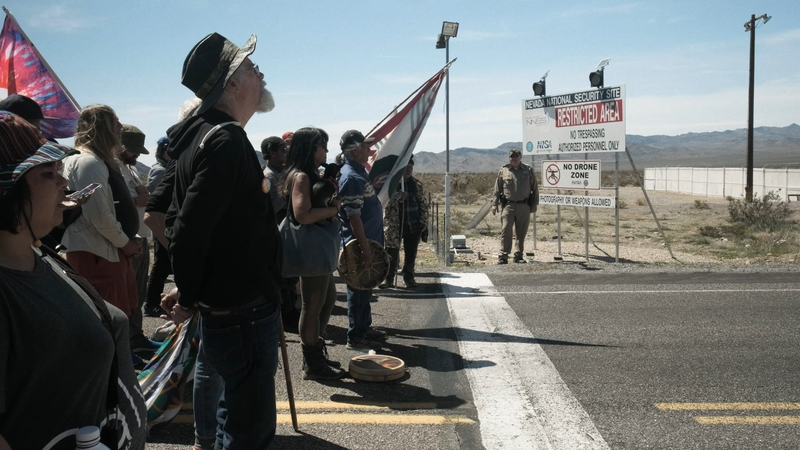
Yucca Mountain brings so many questions and contradictions together. Located on Western Shoshone land, it eventually became the site selected for the permanent repository, only for decades of political and grassroots resistance to prevent the project from reaching its intended completion. Ian Zabarte’s presence gives Carter’s treatment of the area a dimension that the technical arguments about repository design can’t answer. The question isn’t only whether Yucca Mountain could contain nuclear waste. It’s also who possessed the authority to decide that the land was available in the first place. Scientific study can become incredibly detailed while leaving a more basic human question outside its chosen field of vision. The mountain can be measured without resolving ownership, sovereignty, trust, or historical grievance. TO USE A MOUNTAIN deliberately avoids presenting itself as the movie that finally solves nuclear waste disposal.
Viewers entering with little knowledge of nuclear waste management may occasionally want a deeper foundation. The documentary provides enough history to understand the conflict, but its contemplative structure can leave technical questions hanging. What specifically distinguishes one repository design from another? What are the competing arguments surrounding geological storage? What happens at the temporary facilities where the material remains? What alternatives have been proposed, and what risks do those alternatives carry?
Answering all of those questions would require an additional film altogether, and stuffing them into this one could destroy the impact Carter has constructed. Their absence is only noticeable because the documentary deals with an issue where scale and technical complexity matter. TO USE A MOUNTAIN is better at showing why people resisted than teaching a viewer everything necessary to evaluate the underlying engineering problem.
The approach of bouncing between cities becomes more effective as the communities begin to feel connected by experience rather than geography. Louisiana, Mississippi, Texas, Utah, Washington, and Nevada don’t share a culture or a history. What brings them together is the discovery that distance from political centers can make a community appear as an easy target. Places described as remote still belong to somebody.
That gives the film relevance well beyond the policy fights of the 1980s. America still has tens of thousands of tons of high-level nuclear waste without an operating permanent repository. In contrast, renewed interest in nuclear power has returned alongside climate concerns and rapidly growing energy demand. The argument over what nuclear technology may provide in the future can’t erase the material already produced in the past. TO USE A MOUNTAIN refuses the comfort of pretending that stopping one project solved the problem. Yucca Mountain never became the answer it was intended to be. The waste didn’t disappear. Much of it remains stored at locations around the country, and any future solution will eventually encounter another terrain and another group of people who live there.
That unresolved ending is exactly where Carter leaves us. He doesn’t manufacture a final revelation because there isn’t one. The documentary instead changes the scale at which the question is examined. Nuclear waste can be discussed in tons, years, geological formations, transportation corridors, and engineering tolerances. Those measurements are necessary. They’re also incomplete. Carter asks us to look again at everything that disappears when a map becomes too abstract. A river, a graveyard, a ranch, a fishing ground, a church, a treaty, a family story. Government planning needs lines on paper. TO USE A MOUNTAIN keeps returning to the lives underneath them.
Please visit https://linktr.ee/overlyhonestr for more reviews.
You can follow me on Letterboxd, Instagram, Twitter, and YouTube. My social media accounts can also be found on most platforms by searching for 'Overly Honest Reviews'.
I’m always happy to hear from my readers; please don't hesitate to say hello or send me any questions about movies.
DISCLAIMER:
At Overly Honest Movie Reviews, we value honesty and transparency. Occasionally, we receive complimentary items for review, including DVDs, Blu-rays, CDs, Vinyl Records, Books, and more. We assure you that these arrangements do not influence our reviews, as we are committed to providing unbiased and sincere evaluations. We aim to help you make informed entertainment choices regardless of our relationship with distributors or producers.
Amazon Affiliate Links:
Additionally, this site contains Amazon affiliate links. If you purchase through these links, we may receive a commission. This affiliate arrangement does not affect our commitment to honest reviews and helps support our site. We appreciate your trust and support as you navigate these links.
