When Survival Becomes Resistance
Knife: The Attempted Murder of Salman Rushdie
MOVIE REVIEWS
Knife: The Attempted Murder of Salman Rushdie
 -
- 


Genre: Documentary, Biography
Year Released: 2026
Runtime: 1h 47m
Director: Alex Gibney
Where to Watch: in select theaters across North America, beginning September 17, 2026
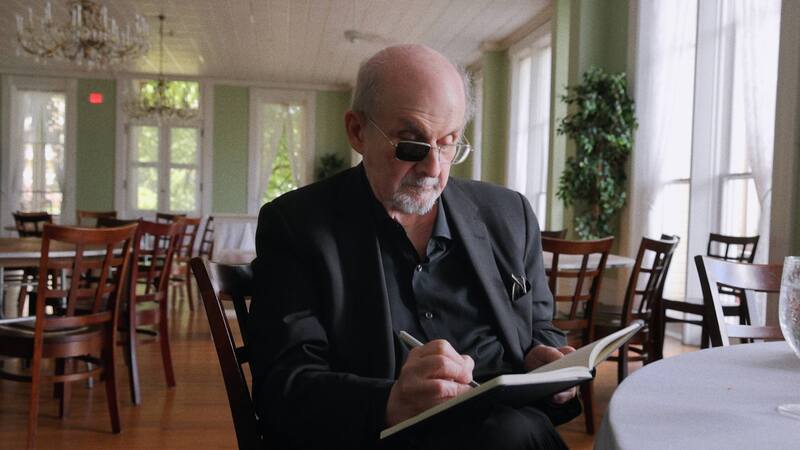
RAVING REVIEW: KNIFE: THE ATTEMPTED MURDER OF SALMAN RUSHDIE is one of those documentaries where you know going in that parts of it are going to be difficult to watch. I wasn't prepared for how much of that would come from seeing what happened afterward rather than simply revisiting the attack itself. Rushdie survived being stabbed repeatedly onstage in 2022, but survival was only the beginning of what he and his wife, Rachel Eliza Griffiths, had to endure.
Director Alex Gibney has plenty of history to cover before getting there. Rushdie had been living under threat for decades after the publication of THE SATANIC VERSES and the 1989 Fatwa calling for his death. For a long time, the danger surrounding his name was almost inseparable from the man himself. KNIFE provides enough background to understand, without letting it take over, a documentary much more interested in Rushdie after the attack.
Griffiths began recording Rushdie during his recovery, capturing footage never intended for an audience, and those images give KNIFE an intimacy that would have been impossible to recreate later. There are moments when it almost feels inappropriate to be seeing someone this injured and vulnerable, which is also why those scenes are so difficult to shake. That’s what makes the film work the way it does. There’s something here that you can’t get from a surface-level exploration.
Gibney doesn't hide the physical. Rushdie's wounds are depicted in graphic detail, along with the slow process of regaining movement, independence, and a sense of normal life. He lost sight in his right eye and suffered lasting damage to one of his hands, and the documentary makes those consequences far more real than simply listing them ever could. What keeps those scenes from becoming too much is Rushdie himself. His sense of humor survived right along with him, and some of KNIFE's most memorable moments come from the way he talks about an experience that could understandably have consumed everything else in his life. He's funny without pretending that any of this was easy, and it's reassuring to watch his personality gradually become more recognizable as his body heals.
Griffiths becomes just as important to the documentary as the documentary itself. She's not merely the person holding the camera while Rushdie recovers, and KNIFE is better whenever it makes room for what the attack did to them both. Loving someone through something this horrific means living through your own version of it, and her footage captures fear, exhaustion, tenderness, frustration, and relief without needing someone to explain those emotions afterward.
That vision is so strong that some of Gibney's more elaborate choices struggle to compete with it. The documentary incorporates movie clips, literary references, reconstructed ideas, and imagined conversations involving Rushdie's attacker. At times, those ideas add something to Rushdie's way of processing the world through stories, but other times I wanted Gibney to return to the people sitting right in front of him. I don’t mean that as a negative; the impact gets a little washed away by the roller coaster of it all.
The fictionalized parts involving the attacker are where I had the biggest problem. Trying to understand why someone would attempt to murder a writer over a book is certainly a reasonable question, especially considering the decades of threats surrounding Rushdie. The approach doesn't uncover enough to justify how much attention it occasionally pulls away from Rushdie, and the documentary is far more compelling when it admits that understanding hatred doesn't necessarily make it any less senseless.
Some of the more overt stylistic choices also become a little too noticeable. They make sense within the film’s attempt to connect memory, art, culture, and personal experience, but the approach occasionally feels more deliberate than necessary. The documentary's core content is already so intimate and affecting that it rarely needs additional emphasis. When the film trusts that and lets it sit with the viewer, it is often at its strongest, while some added flourishes can feel more like distractions than enhancements.
That also contributes to a runtime that feels slightly longer than necessary. At 107 minutes, KNIFE has room to cover Rushdie's history, the attack, his recovery, his marriage, censorship, free expression, his writing, and the strange relationship he now has with the man who tried to kill him. Not every part gets the same attention, and tightening a few of the detours could have made the documentary hit harder without sacrificing anything important.
Thankfully, Rushdie never gets lost inside all of that. It's easy to reduce someone who’s lived under threats for decades to a symbol of free speech, especially when the violence everyone feared finally happened. KNIFE keeps bringing him back down to the person who wants to write, eat, joke with his wife, recover his independence, and continue living without allowing somebody else's hatred to dictate what that life looks like.
There’s also something disturbing about where the attack happened. Rushdie was preparing to speak at an event connected to providing refuge for writers when a man rushed the stage and tried to murder him. You couldn't manufacture something harder to take in and witness if you tried, and Gibney doesn't need to push very hard for the significance of that moment to register.
The documentary eventually returns to the attack itself, and seeing what happened rather than hearing it described is brutal. There's no dramatic distance between the audience and the violence, and KNIFE doesn't give you one. What happened was monstrous, chaotic, and horrifying, which makes the people who rushed toward Rushdie rather than away from the danger just as important to what we're seeing as the attack itself.
That contrast may be the part I carried away from KNIFE more than anything else. One person came onto that stage intending to kill a stranger because of ideas attached to something he had written, while several others risked their own lives almost immediately to save him. The worst and best instincts people can muster were separated by only a few feet.
The strongest moments here are enough to outweigh some of the film's minor struggles. Rushdie isn't shown as someone who conquered trauma and moved beyond it, because recovery doesn't work that way. He's alive, altered, funny, angry, thoughtful, loved, and still writing, which turns out to be a much better response to the person who tried to silence him than any statement Gibney could have added. That’s why there’s so much impact in this exploration of his story. There’s something more here than just what happened.
For all of its talk about censorship, violence, religion, art, and freedom, KNIFE is ultimately most affecting when it becomes very simple. A man was nearly killed, people helped save him, his wife helped put him back together, and he decided that the person holding the knife didn't get to decide how the rest of his story would go. This is a true story about overcoming the reality of a horrific event, and in the end, that’s why it matters.
Please visit https://linktr.ee/overlyhonestr for more reviews.
You can follow me on Letterboxd, Instagram, Twitter, and YouTube. You can also find my social media accounts on most platforms by searching for 'Overly Honest Reviews'.
I’m always happy to hear from my readers; please don't hesitate to say hello or send me any questions about movies.
[photo courtesy of ABRAMORAMA]
DISCLAIMER:
At Overly Honest Movie Reviews, we value honesty and transparency. Occasionally, we receive complimentary items for review, including DVDs, Blu-rays, CDs, Vinyl Records, Books, and more. We assure you that these arrangements do not influence our reviews, as we are committed to unbiased, sincere evaluations. We aim to help you make informed entertainment choices regardless of our relationship with distributors or producers.
Amazon Affiliate Links:
This site also contains Amazon affiliate links. If you purchase through these links, we may receive a commission. This affiliate arrangement does not affect our commitment to honest reviews and helps support our site. We appreciate your trust and support as you navigate these links.
