Stillness As Storytelling
Two Seasons, Two Strangers (Tabi to Hibi)
MOVIE REVIEW
Two Seasons, Two Strangers (Tabi to Hibi)
 -
- 


Genre: Drama, Romance, Slice-of-Life
Year Released: 2025, 2026
Runtime: 1h 29m
Director(s): Sho Miyake
Writer(s): Sho Miyake (based on works by Yoshiharu Tsuge)
Cast: Shim Eun-kyung, Yuumi Kawai, Shinichi Tsutsumi, Mansaku Takada
Where to Watch: theatrical launch at Metrograph April 24, 2026, with limited nationwide expansion to follow
RAVING REVIEW: TWO SEASONS, TWO STRANGERS doesn’t ever stretch for attention. It sits back and waits to see if you’re willing to meet it where it exists. There’s no push, no urgency, no signal telling you what you’re supposed to expect while watching. What you get instead is a series of moments that feel disconnected at first, almost resistant to interpretation, until the accumulation starts to settle into something more defined.
Writer/director Sho Miyake doesn’t guide you through this film so much as he places you inside it. The structure reflects that. Two halves, separated by season, loosely connected by a kind of symmetry through emotion, rather than narrative continuation. Summer carries one set of characters, winter another. There’s no real handoff between them, no explicit bridge. What ties them together is a shared inability to connect with the people and spaces around them fully.
The first section moves through a humid, overcast coastline where conversation feels like work. Characters speak in fragments, hesitate mid-thought, and often leave things unfinished. It isn’t stylized discomfort. It feels closer to the idea that language itself is failing them. Miyake lingers in those pauses longer than most filmmakers would, letting silence do the heavy lifting instead of stepping in to explain everything.
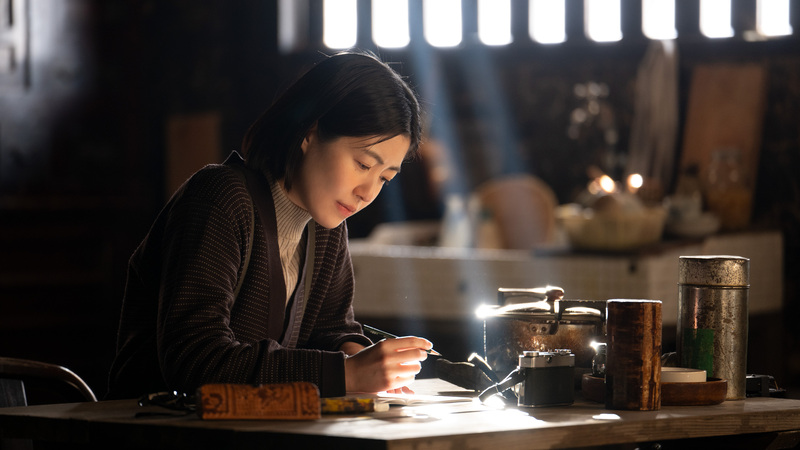
That restraint sets the tone for everything that follows. When the film shifts into its winter half, it doesn’t reset. It narrows. The focus turns to a screenwriter caught in a creative standstill, drifting into a snow-covered village that feels cut off from any semblance of forward movement. The environment changes, but the emotional temperature stays consistent. Isolation just takes on a different shape.
What’s striking is how little the film explains. There’s no effort to translate these characters into something that all connect and work within the same world. Their motivations aren’t laid out in the way you expect. Their histories remain mostly implied. Even their relationships exist in a kind of uncertain space, never really defined. That lack of clarity could feel like avoidance in a different film. Here, it feels intentional. It mirrors the experience of trying to understand someone who doesn’t quite understand themselves.
The approach reinforces the idea here without drawing attention to itself. The summer sequences carry a muted heaviness, the air feels thick, the light diffused, everything slightly weighed down. Winter strips that away, replacing it with something more exposed. Snow creates distance, emptiness, a kind of quiet that feels different from the coastal silence earlier on. The contrast isn’t decorative. It’s structural. It shapes how the film breathes.
Performance-wise, everything operates under the same philosophy of restraint. Shim Eun-kyung holds together the latter half with a presence that never pushes outward. She doesn’t ask for sympathy or demand engagement. Instead, she invites the audience to come to her, revealing just enough to keep the character from feeling opaque without over-defining her. It’s a careful balance, and it works surprisingly well here.
Yuumi Kawai and Mansaku Takada bring a similar vibe to the opening half, creating a dynamic that feels built on hesitation. Their interactions rarely resolve, which adds to the strain. You’re watching two people hesitating around a connection without ever quite reaching it. Shinichi Tsutsumi’s presence later on adds contrast, but even then, the film refuses to shift into anything more conventional. It stays controlled, measured, and consistent in its approach.
Even as the film progresses, it resists the urge to solidify its ideas into a definitive form. It circles emotion without expressing the idea that it wants to focus on. That can be frustrating if you’re waiting for a clear statement piece. But it’s also consistent with what the film is exploring. These characters don’t have clarity, so the film doesn’t pretend to offer it.
There’s also a quiet risk in how much the film asks from its audience. It doesn’t meet you halfway. It expects patience, attention, and a willingness to sit with stillness that doesn’t instantly reward you. That’s where some viewers will disconnect. Not because the film fails, but because it refuses to adapt itself to more familiar rhythms. But when it all works together, it lands in a way that’s difficult to shake. Not through big emotional swings or dramatic revelations, but through recognition. The feeling of conversations that don’t go where you expect. The sense of being slightly out of place in your own life. The awareness that connection isn’t always something you can force into existence.
That’s where TWO SEASONS, TWO STRANGERS finds itself. It’s not telling a story in the conventional sense. It’s capturing a state of being. Something uncertain, incomplete, and often difficult to articulate. It’s deliberately distant, occasionally frustrating, and uninterested in making itself easy to interpret. But there’s a confidence in that choice that gives the film its identity. It knows exactly what it’s doing, even when it refuses to explain it. And in a landscape where so many films feel the need to over-clarify everything, something is energizing about one that doesn’t. It leaves space. It trusts that space. Whether that trust pays off depends entirely on how willing you are to sit inside it.
Please visit https://linktr.ee/overlyhonestr for more reviews.
You can follow me on Letterboxd, Instagram, Twitter, and YouTube. My social media accounts can also be found on most platforms by searching for 'Overly Honest Reviews'.
I’m always happy to hear from my readers; please don't hesitate to say hello or send me any questions about movies.
[photo courtesy of THE FOOL, SEVERAL FEATURES]
DISCLAIMER:
At Overly Honest Movie Reviews, we value honesty and transparency. Occasionally, we receive complimentary items for review, including DVDs, Blu-rays, CDs, Vinyl Records, Books, and more. We assure you that these arrangements do not influence our reviews, as we are committed to providing unbiased and sincere evaluations. We aim to help you make informed entertainment choices regardless of our relationship with distributors or producers.
Amazon Affiliate Links:
Additionally, this site contains Amazon affiliate links. If you purchase through these links, we may receive a commission. This affiliate arrangement does not affect our commitment to honest reviews and helps support our site. We appreciate your trust and support as you navigate these links.
