A Family Curse Served in Courses
Salt Along the Tongue
MOVIE REVIEW
Salt Along the Tongue
 -
- 


Genre: Horror, Drama, Mystery
Year Released: 2024, 2026
Runtime: 1h 53m
Director(s): Parish Malfitano
Writer(s): Parish Malfitano
Cast: Laneikka Denne, Dina Panozzo, Caroline Levien, Mayu Iwasaki, Maria de Marco, Liz Lin
Where to Watch: coming to VOD in the US on May 1, 2026
RAVING REVIEW: SALT ALONG THE TONGUE is one of those movies that you’re either going to love or have no clue how to feel about it. That confidence in itself matters so much because this is not a film interested in making itself easy. It invites you into a world of grief, food, family ritual, superstition, female inheritance, and possession, then lets all of those elements bleed into each other until separating them stops mattering. What makes the film stand out is that it doesn’t treat food as decoration or quirky texture. Food is memory here. Food is language. Food is warning. Food is comfort. Food is violation. Food is how love survives, and how damage gets passed down. That alone gives the film a personality most genre work would kill for.
Writer/director Parish Malfitano is working with material that could’ve easily become overdesigned or self-consciously “elevated,” but SALT ALONG THE TONGUE feels too personal for that. The emotion in it is messy and intimate, even when the filmmaking is highly stylized. You can feel that tension all through the film. It wants to be lush and unnatural, but it also wants to hurt. It wants to drift into dream logic, but it’s still rooted in a family wound that never really healed. That combination is what gives the movie its pull. Even when it becomes obscure, it rarely feels empty.
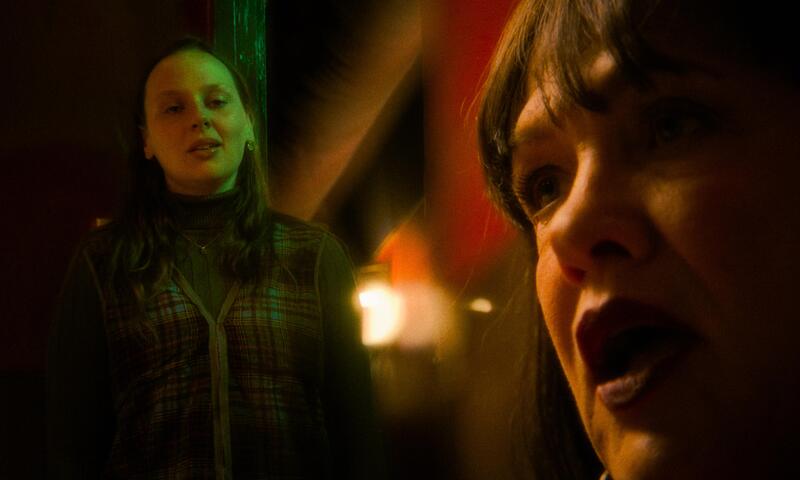
The setup alone is strong enough to hold attention. After her mother dies, Mattia is forced back into the company of her estranged aunt, who also happens to be her mother’s identical twin. That’s already a loaded emotional arrangement before the supernatural side even starts tightening around it. The film understands that twins aren’t just a visual device here. They’re about split histories, unresolved resentment, mirrored identities, and the terror of seeing someone who looks like the person you lost but isn’t the person you lost. SALT ALONG THE TONGUE gets a lot of mileage out of that discomfort, and Dina Panozzo ends up carrying a huge portion of the film’s drama because of it.
Panozzo is the standout for me. Playing both Mina and Carol means she has to create a meaningful emotional distinction between two women whose faces are identical but whose lives clearly split long before the story begins. She does that without feeling forced. One presence carries warmth and ache; the other, volatility, bitterness, and a kind of confidence that feels half-earned and half-performed. The film needs you to believe both the closeness and the rupture between these sisters, and she makes that believable. Laneikka Denne also gives the film something crucial as Mattia: vulnerability without passivity. She’s not a huge, showy center in the traditional horror sense, but that works for the film. Mattia feels like someone absorbing inherited pain before she can even name it.
What I admired most was the film's commitment to its own sensory language. This is one of those horror films where objects, textures, and gestures matter as much as plot mechanics. Kitchens, ingredients, bodies, bloodlines, recipes, preparation, eating, all of it carries emotional and spiritual meaning. You’re not just watching scenes unfold. You’re watching a system of inheritance reveal itself through routine. That gives the movie a tactile quality that sticks. There are images in this that feel genuinely authored, not just assembled. Even when the film is plainly wearing some of its influences on its sleeve, it still feels like it’s processing them through something personal and culturally specific rather than flattening them into homage.
I’d much rather watch a horror film that overreaches in a fascinating direction than play everything safe and leave no impression. SALT ALONG THE TONGUE has too much on its mind to ever feel generic. It’s processing family trauma through folklore and ritual. It’s exploring womanhood, inheritance, and identity through food, superstition, and possession. It’s also doing all of that in a way that feels deeply tied to its cultural textures rather than using them as background flavor. That matters. The movie’s sense of specificity gives it an identity that makes the rougher patches easier to accept.
The horror itself is worth talking about because this isn’t a constant-frights kind of film. It isn’t built around jolts or conventional escalation. The unease comes from contamination, repetition, memory, and the sense that the body is no longer entirely private. There’s something old-world and intimate in the way the supernatural operates here. It doesn’t feel imported from a trend cycle. It feels inherited. Even when it tips toward surrealism, the fear has roots.
I also appreciated that SALT ALONG THE TONGUE never plays its female-centered perspective like a gimmick. It just is what the film is. Men barely register as physical presences, yet their damage still lingers over the story in ways that are impossible to miss. That choice gives the film a strange and powerful balance. It becomes a work about harm without centering the people who caused it. Instead, the emphasis stays on the women left to carry it, reinterpret it, survive it, and sometimes pass it on in altered form. That’s one of the smartest things the film does.
SALT ALONG THE TONGUE is the kind of film I respect a lot, admire in major stretches, and still wish had a firmer grip on its own shape. But even with that reservation, this is one of those genre pieces that feels like it came from someone with an actual point of view. It has its own taste, texture, and emotional logic. That alone makes it worth paying attention to. It may not come together how I wanted in every scene, but it leaves behind the feeling that you’ve seen something made with real conviction, and that goes a long way.
Please visit https://linktr.ee/overlyhonestr for more reviews.
You can follow me on Letterboxd, Instagram, Twitter, and YouTube. My social media accounts can also be found on most platforms by searching for 'Overly Honest Reviews'.
I’m always happy to hear from my readers; please don't hesitate to say hello or send me any questions about movies.
[photo courtesy of YELLOW VEIL PICTURES]
DISCLAIMER:
At Overly Honest Movie Reviews, we value honesty and transparency. Occasionally, we receive complimentary items for review, including DVDs, Blu-rays, CDs, Vinyl Records, Books, and more. We assure you that these arrangements do not influence our reviews, as we are committed to providing unbiased and sincere evaluations. We aim to help you make informed entertainment choices regardless of our relationship with distributors or producers.
Amazon Affiliate Links:
Additionally, this site contains Amazon affiliate links. If you purchase through these links, we may receive a commission. This affiliate arrangement does not affect our commitment to honest reviews and helps support our site. We appreciate your trust and support as you navigate these links.
