One of the Year’s Most Fascinating Animated Experiments
Jinsei (無名の人生)
MOVIE REVIEW
Jinsei (無名の人生)
 -
- 


Genre: Animation, Drama, Psychological, Science Fiction
Year Released: 2025, 2026
Runtime: 1h 33m
Director(s): Ryuya Suzuki
Writer(s): Ryuya Suzuki
Cast: ACE COOL, Taketo Tanaka, Shohei Uno, Remi Tyon, Miho Ohashi, Kanji Tsuda
Where to Watch: releasing in New York on June 5, 2026, and in theaters nationwide on June 12
RAVING REVIEW: JINSEI feels less like a normal animated film and more like somebody emptying decades of anxiety, loneliness, ambition, media obsession, political dread, personal memory, and existential confusion directly onto the screen before the feeling disappears. There are moments where it barely seems interested in coherence at all. Entire stretches drift through fragmentation, abrupt stylistic pivots, and surrealism with almost reckless confidence. Yet somehow, by the end, the film leaves behind an impression far stronger than many more polished animated features ever manage. That’s because JINSEI understands something a lot of coming-of-age epics don’t, that identity rarely develops in a straight line.
Ryuya Suzuki’s feature debut follows one man over roughly a century of existence, repeatedly reframing him under different names, roles, and phases as the world changes around him. Idol culture, bullying, alienation, internet-era loneliness, violence, aging, political instability, social collapse, and spiritual searching all become part of the same evolving landscape. The protagonist keeps changing, yet somehow never changes completely.
The structure initially feels intentionally disorienting. The opening stretch almost dares viewers to keep up. Characters enter and vanish. Timelines blur together. Emotion arrives before the audience understands the context. For a while, the movie risks collapsing under its own ambition because Suzuki throws ideas onto the screen faster than the narrative can organize them. Then the larger idea slowly begins to reveal itself.
JINSEI isn’t trying to create a conventional biographical arc. It’s attempting to capture the instability of memory, self-perception, and identity over time. Certain chapters feel personal and intimate, while others spiral outward into something almost apocalyptic. The film constantly reshapes its style to match the story's emotion at any given moment. Sometimes it plays like a social drama. Sometimes it resembles something experimental. Sometimes it drifts into abstract futurist nightmare territory. The farther the film moves into the future, the stranger and more daring it becomes.
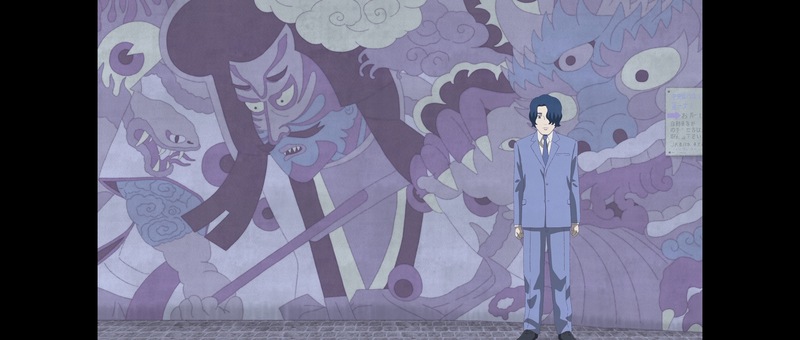
What’s especially remarkable is that Suzuki hand-drew the entire feature himself over roughly eighteen months. That fact alone could easily overshadow the movie itself, but thankfully, the work stands on its own beyond the production story. The animation style isn’t conventional, yet the imperfections become part of the texture. There’s a rawness to the linework that makes everything feel unstable and alive at the same time. You can feel the solitary nature of its creation in almost every frame. Large studio animation often sands away artistic fingerprints in pursuit of uniformity. JINSEI does the opposite. Every transition, every rough edge, every visual flourish feels connected directly to a singular perspective.
ACE COOL’s vocal performance anchors the experience surprisingly well, considering how fragmented the narrative becomes. The character constantly evolves across different phases of life, but an underlying exhaustion and yearning hold everything together. ACE COOL captures that continuity without overplaying the material. The performance works because it rarely forces intensity where silence or restraint communicates more effectively.
The film’s treatment of idol culture is particularly interesting because Suzuki refuses to romanticize it. Fame, performance, identity, and emotional commodification all blur together throughout the middle portion of the story. There’s admiration there, but also sadness. The protagonist spends much of the film chasing versions of himself that never satisfy him upon reaching them.
What surprised me most was how politically charged portions of JINSEI became without ever becoming direct. The further the timeline advances, the more the world around the protagonist begins deteriorating socially and spiritually. Violence, isolation, generational trauma, and societal fragmentation creep further into the edges of the narrative until they eventually dominate huge sections of the film. Yet Suzuki never frames the future like a clean dystopian genre exercise. Instead, the collapse feels gradual, mundane, and emotionally numbing.
There are sequences late in the film that honestly border on hypnotic. The imagery becomes colder, emptier, and more abstract as the story stretches toward its final chapters. Some viewers will absolutely lose patience with these sections because the film becomes far more meditative and symbolic than plot-driven. Personally, I found those moments fascinating, even when they occasionally overstretch. Suzuki clearly trusts atmosphere and emotional accumulation more than straightforward explanation.
The editing deserves enormous credit as well. Despite the fragmented structure, Suzuki somehow maintains continuity through rhythm rather than exposition. Time passes through association, recurring patterns, and tonal echoes rather than through explanation. The movie trusts viewers to interpret emotion rather than spell it out. Some audiences will find JINSEI frustratingly opaque or self-indulgent. Others will likely connect with its emotional messiness and thematic ambition. It’s rough, strange, and significantly more personal than your standard animation.
JINSEI feels haunted by the fear of disappearing without ever understanding oneself. Every phase of the protagonist’s life becomes another attempt to define meaning, only for time to move forward and strip that identity away. The film keeps asking whether reinvention is genuine growth or simply survival disguised as transformation.
There’s a point where the movie stops feeling like one man’s story and starts to resemble a fractured meditation on modern existence itself. JINSEI doesn’t always work scene-to-scene. Some chapters are stronger than others. Some symbolism feels more profound than it actually is. But the overall experience lingers because Suzuki made something deeply human in all its confusion, inconsistency, ambition, and vulnerability. You don’t watch a film like this because it’s perfect. You watch it because it feels alive.
Please visit https://linktr.ee/overlyhonestr for more reviews.
You can follow me on Letterboxd, Instagram, Twitter, and YouTube. My social media accounts can also be found on most platforms by searching for 'Overly Honest Reviews'.
I’m always happy to hear from my readers; please don't hesitate to say hello or send me any questions about movies.
[photo courtesy of GREENWICH ENTERTAINMENT]
DISCLAIMER:
At Overly Honest Movie Reviews, we value honesty and transparency. Occasionally, we receive complimentary items for review, including DVDs, Blu-rays, CDs, Vinyl Records, Books, and more. We assure you that these arrangements do not influence our reviews, as we are committed to providing unbiased and sincere evaluations. We aim to help you make informed entertainment choices regardless of our relationship with distributors or producers.
Amazon Affiliate Links:
Additionally, this site contains Amazon affiliate links. If you purchase through these links, we may receive a commission. This affiliate arrangement does not affect our commitment to honest reviews and helps support our site. We appreciate your trust and support as you navigate these links.
