The Future Comes With Wrinkles
The A-Word: The Future of Aging
MOVIE REVIEW
The A-Word: The Future of Aging
 -
- 


Genre: Documentary
Year Released: 2026
Runtime: 1h 24m
Director(s): Greg Kohs
Where to Watch: shown at the 2026 Tribeca Festival
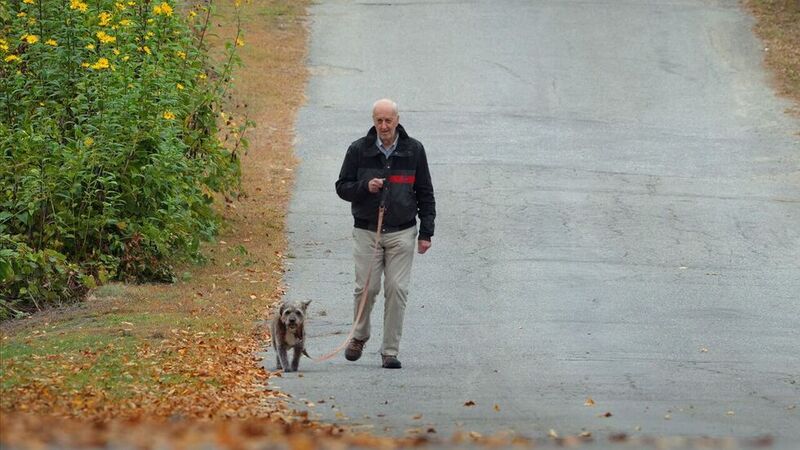
RAVING REVIEW: THE A-WORD: THE FUTURE OF AGING knows the quickest way to make longevity science feel less abstract. Just stop treating it like a billionaire fantasy and put an older man alongside an older dog. That gives Greg Kohs’ documentary a necessary emotional connection point because the subject itself could easily have drifted into the terminology of biotech conferences, medical forecasting, and future-facing optimism. Instead, the film keeps returning to George Betke, an 87-year-old widower in Maine, and Monica, his senior rescue dog. Their walks, their quiet moments, and their bond give the film a shape that no chart or expert interview could provide on its own. The science matters, but it matters because aging has a face, a body, a home, a schedule, a history of grief, and a companion moving a little slower with each passing year.
Kohs approaches longevity science with the understanding that many viewers will enter the film skeptically. That doubt is reasonable. The phrase “anti-aging” has been hijacked by supplement companies, influencers, grifters, wellness opportunists, and wealthy people who seem less interested in human dignity than in turning death into a personal inconvenience. THE A-WORD: THE FUTURE OF AGING understands that perceived stopping point and wisely separates itself from the more questionable corners of the field. This isn’t a documentary about refusing to age. It’s about asking whether medical philosophy has approached the treatment of age-related diseases as separate emergencies rather than viewing aging itself as a major driver.
Modern medicine often fights cancer, dementia, heart disease, organ failure, and other conditions as isolated battles. The scientists in this film are asking whether there’s a deeper biological process connecting many of those battles, and whether intervening earlier could extend not just life, but the years when life remains active, lucid, connected, and sustainable. The term "healthspan" becomes more important than "lifespan". The goal isn’t simply to add years at the end. The goal is to preserve the part of life people actually recognize as life.
Celine Halioua becomes the main bridge into that world. As the founder and CEO of Loyal, she’s pursuing what could become the first FDA-approved drug designed to extend healthy lifespan in dogs. That choice carries both scientific and emotional logic. Dogs age faster than humans, share our homes, develop many of the conditions humans fear, and hold a place in family life that makes this approach hit home rather than just a theoretical exploration. Halioua’s presence gives the film a unique impact because her story isn’t framed as a detached laboratory experiment. She’s running a company, managing uncertainty, carrying the pressure of proving a new category of medicine, and tying that effort to the animals we all love.
The film is at its most effective when it allows that ambition to sit beside the reality of George and Monica. Their relationship prevents THE A-WORD: THE FUTURE OF AGING from becoming a pitch. George isn’t a symbol of decline. He’s sharp, independent, reflective, and still moving through the world with purpose. Monica isn’t used as emotional leverage either, though animal lovers should prepare themselves for the material's obvious tenderness. The film’s affection for her comes from observation, not manipulation. Her age matters because George’s age matters. They mirror each other in ways that are unforced and moving.
THE A-WORD: THE FUTURE OF AGING includes enough scientific context to give the subject weight, particularly through figures such as Cynthia Kenyon and Laura Deming, but it doesn’t overload the audience with too much. Kenyon’s groundbreaking work in aging biology lends the film a historical foundation. At the same time, Deming helps connect scientific interest to the investment and therapeutic landscape that could shape the field’s future. These voices help establish that longevity research isn’t merely speculative. It’s a serious area of study with real disagreement, real promise, real limitations, and real ethical consequences.
Koh’s restraint also keeps the documentary from becoming a debate panel. He’s not making a policy paper. He’s making a film about time. That becomes clearer as George’s story deepens. The film’s most memorable passages aren’t necessarily the ones explaining biology; they’re the ones observing how age changes the scale of a day. A walk matters. A dog’s appetite matters. A familiar street matters. A conversation carries the weight of memory without needing to announce it. Through George, the documentary keeps reminding us that the future of aging isn’t only about breakthroughs. It’s about whether people can remain themselves longer.
The science is fascinating, especially when the film explains why aging may be more malleable than assumptions suggest. People fear losing the ability to recognize themselves, care for themselves, love, remember, move, and remain present for the people and animals who depend on them. By placing an 87-year-old widower and his rescue dog beside scientists trying to rewrite the rules of healthspan.
THE A-WORD: THE FUTURE OF AGING isn’t a flawless examination, and viewers looking for a harder investigative edge may wish it pressed more into the field’s economic and ethical fault lines. Even so, it's gentler and has real value. The film makes a complex scientific frontier accessible without feeling simplistic, and it finds a sincere emotional center without turning grief, aging, or animal companionship into cheap ammunition.
The documentary’s foremost insight is that wanting more time isn’t inherently shallow. It depends on what kind of time we’re talking about, who gets it, and what we do with it. Kohs doesn’t pretend science can answer every part of that. He simply places the question in front of us with enough warmth, curiosity, and care to make it difficult to dismiss. THE A-WORD: THE FUTURE OF AGING may be about medicine, biology, and the future, but its most persuasive argument is much more focused. More healthy time matters because love always makes our time feel too short.
Please visit https://linktr.ee/overlyhonestr for more reviews.
You can follow me on Letterboxd, Instagram, Twitter, and YouTube. My social media accounts can also be found on most platforms by searching for 'Overly Honest Reviews'.
I’m always happy to hear from my readers; please don't hesitate to say hello or send me any questions about movies.
DISCLAIMER:
At Overly Honest Movie Reviews, we value honesty and transparency. Occasionally, we receive complimentary items for review, including DVDs, Blu-rays, CDs, Vinyl Records, Books, and more. We assure you that these arrangements do not influence our reviews, as we are committed to providing unbiased and sincere evaluations. We aim to help you make informed entertainment choices regardless of our relationship with distributors or producers.
Amazon Affiliate Links:
Additionally, this site contains Amazon affiliate links. If you purchase through these links, we may receive a commission. This affiliate arrangement does not affect our commitment to honest reviews and helps support our site. We appreciate your trust and support as you navigate these links.
