The Drop Is Still the Point
Fall 2: Deadpoint
MOVIE REVIEWS
Fall 2: Deadpoint
 -
- 


Genre: Thriller, Adventure, Drama
Year Released: 2026
Runtime: 1h 40m
Director(s): Michael Spierig, Peter Spierig
Writer(s): Jonathan Frank, Scott Mann
Cast: Harriet Slater, Arsema Thomas, Tom Brittney, Virginia Gardner, Grace Caroline Currey
Where to Watch: only theaters September 2, 2026
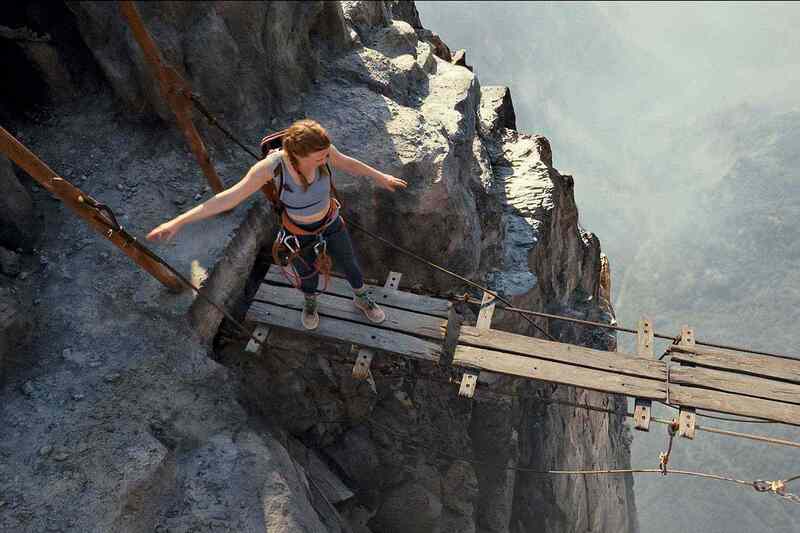
RAVING REVIEW: The most effective parts of FALL 2: DEADPOINT are the moments when Michael and Peter Spierig simply let the height register, a foot searches for somewhere safe to land. Loose material disappears over an edge. The camera looks down long enough for the distance to stop being an abstraction. You understand exactly where these people are, how little space they have to work with, and what one bad movement would mean. The original FALL figured out that a survival thriller like this doesn’t need much once it convinces you the drop is real. The sequel remembers that lesson.
There’s a physical quality to the movie that helps enormously. Harriet Slater and Arsema Thomas aren’t spending every scene planted safely on a studio floor while the scenery does all the work around them. The production put its actors at actual height on practical rigs, and that decision shows. FALL 2 doesn’t have to constantly manufacture fear through frantic editing because bodies really are moving through uncomfortable spaces. Even when you know every precaution was taken, there’s something different about watching an actor shift weight, reach across a gap, or steady themselves when there’s genuine open space underneath them.
Moving the story from an isolated radio tower to Thailand also gives the sequel a visual identity of its own. The first movie featured the brutally simple image of two women stuck atop one impossibly tall structure. DEADPOINT spreads the danger across cliffs, narrow walkways, and unstable terrain. Mount Kwan may be fictional, but the environment feels tangible enough that it never matters. Andrew Strahorn’s cinematography makes the most of the landscape without turning the movie into a sightseeing reel. The scenery is beautiful because of how hostile it can become.
The connection to FALL comes through Jax Hunter, played by Slater, who is dealing with the death of her sister Hunter from the first film. She eventually connects with Hunter’s friend Luce, played by Thomas, and their attempt to take on the dangerous plank walk becomes tied to Jax trying to live with that loss. It’s enough connective tissue to make DEADPOINT an actual sequel rather than another unrelated story built around people getting stuck somewhere high.
It also gives Slater something more complicated to play than fear. Jax isn’t simply reluctant to climb. Her relationship with danger has been shaped by what happened to her sister, so being up there carries emotional baggage before anything goes wrong. Slater handles that without overplaying it. She’s especially good during the quieter stretches when Jax has time to think about exactly what she has gotten herself into. Once survival takes over, the performance becomes increasingly physical, and Slater sells the exhaustion as convincingly as the panic.
Thomas brings a different energy to Luce. She’s bolder and far more comfortable with the situation initially, which could have made her little more than the reckless friend needed to get Jax onto the mountain. Thomas gives her enough personality to get past that function. The relationship between them becomes increasingly important because DEADPOINT spends so much time with a very small group of people. If you don’t believe these two would continue fighting for one another, the mechanics surrounding them don’t mean nearly as much.
Tom Brittney is useful for similar reasons. His presence gives the movie another perspective on risk without crowding a story that benefits from keeping its human population limited. One of the smarter decisions in FALL was recognizing how quickly a survival movie can dilute its own anxiety by repeatedly cutting away from the trapped characters. DEADPOINT keeps much of its attention where it belongs.
The screenplay has a harder time resisting escalation.
There are only so many ways someone can nearly fall before the audience begins anticipating the rhythm, and Jonathan Frank and Scott Mann clearly know they can’t repeat the first film obstacle for obstacle. Some of the new complications are clever applications of the location. Others feel like the screenplay looking for another problem because the previous one has been solved. DEADPOINT is at its strongest when the danger comes directly from gravity, unstable footing, limited supplies, and the characters’ own decisions. When additional threats begin competing with the mountain, the simplicity that makes this kind of movie effective gets weakened.
That also applies to some of the emotional writing. Jax’s grief gives the movie a worthwhile starting point, though there are moments when the connection between trauma and climbing is pushed too hard. Slater has already communicated plenty through her performance, and the movie doesn’t always trust that. A few conversations explain feelings that were already apparent.
The Spierig brothers are nevertheless a good match for material built around problem solving. Their genre work has frequently focused on characters trapped within systems with specific rules, and DEADPOINT gives them a wonderfully unforgiving one: gravity doesn’t negotiate. The pleasure comes from watching somebody study a seemingly impossible situation, inventory what remains available, and attempt something that seems only slightly less dangerous than doing nothing.
There’s an important difference between creating a dangerous-looking situation and making an audience understand it spatially. DEADPOINT usually does the latter. You know where people are standing, what they’re trying to reach, and what separates them from safety. That clarity becomes particularly important as the physical problems grow more complicated. The movie can cut closer during moments of panic because it has already established the geography around them.
At 100 minutes, it doesn’t linger much longer than the premise can support. There are sections where another tightening pass might have helped, particularly before or between some of the larger survival sequences, and the sequel machinery is easier to see this time around. The first FALL had the advantage of arriving as a wonderfully straightforward nightmare. DEADPOINT arrives with expectations, a franchise connection, and the responsibility of finding another reason to put people somewhere no sensible person would voluntarily go.
It succeeds often enough because it never loses sight of the basic appeal. Put capable people somewhere terrifying, remove every reasonable path back to safety, then make us watch them figure out what comes next.
FALL 2: DEADPOINT doesn’t recreate the surprise of discovering what FALL could do with one tower and a fear of heights. It doesn’t need to. The change in location, strong physical work from Slater and Thomas, and the Spierigs’ handling of vertical space give this sequel enough of its own personality. Some added complications make the movie busier than it needs to be, and its emotional material occasionally gets explained after the actors have already done the work. None of that changes how effectively DEADPOINT can make a perfectly stationary viewer very aware of the floor beneath their feet.
Please visit https://linktr.ee/overlyhonestr for more reviews.
You can follow me on Letterboxd, Instagram, Twitter, and YouTube. My social media accounts can also be found on most platforms by searching for 'Overly Honest Reviews'.
I’m always happy to hear from my readers; please don't hesitate to say hello or send me any questions about movies.
[photo courtesy of LIONSGATE, GRINDSTONE ENTERTAINMENT GROUP]
DISCLAIMER:
At Overly Honest Movie Reviews, we value honesty and transparency. Occasionally, we receive complimentary items for review, including DVDs, Blu-rays, CDs, Vinyl Records, Books, and more. We assure you that these arrangements do not influence our reviews, as we are committed to providing unbiased and sincere evaluations. We aim to help you make informed entertainment choices regardless of our relationship with distributors or producers.
Amazon Affiliate Links:
Additionally, this site contains Amazon affiliate links. If you purchase through these links, we may receive a commission. This affiliate arrangement does not affect our commitment to honest reviews and helps support our site. We appreciate your trust and support as you navigate these links.
