Love Lingers After the Last Goodbye
Ghost Song (Geister)
MOVIE REVIEWS
Ghost Song (Geister)
 -
- 


Genre: Drama, Romance, Fantasy
Year Released: 2026
Runtime: 1h 46m
Director: Fatih Akin
Writers: Ruth Toma, Fatih Akin
Cast: Mariam Dawoud, Eren M. Güvercin, Carlotta von Falkenhayn, Gabriel-Winner Amorin, Anna Bederke, Lama Alhalabi, David Schütter
Where to Watch: shown at the 2026 San Sebastián International Film Festival
RAVING REVIEW: GHOST SONG spends almost the entire runtime of the black-and-white version at the San Sebastián Film Festival denying itself the ability to use color to its advantage, turning Hamburg, young love, dreams, and death into shades of black, white, and gray. Somehow, that restriction gives Fatih Akin's supernatural romance much of its personality, making a story that can feel a little too familiar at times look like something pulled from a memory that's already starting to fade. It’s weird, because I didn’t know what to expect going into this (as I try to do with most films), and what I came out the other side with was a gorgeous journey into the afterlife through contrast, both visually and literally.
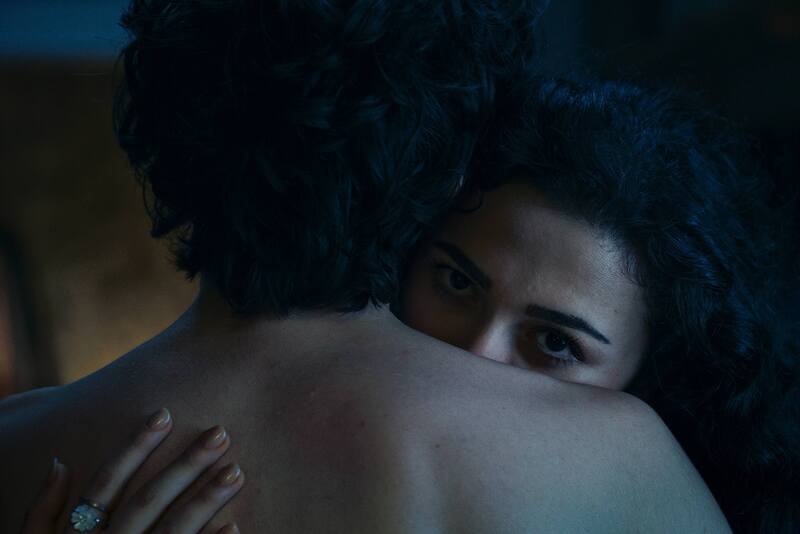
Farasha (Mariam Dawoud) and Faris (Eren M. Güvercin) meet at a graduation party and connect almost immediately. They're both 20, both standing at that point in life where school’s ended and an entire life seems to be waiting just around the corner, and both quickly realize there's something between them worth exploring. Then Farasha dies that same night, seemingly ending a relationship before the two have really had an opportunity to begin one. I considered adding a spoiler warning here, but that moment is more a part of the film than a twist or secret.
GHOST SONG understandably doesn't accept that ending as the finish. Farasha discovers that for 40 nights she can reach Faris through his dreams, giving them the time together that reality denied them. Every meeting also carries an expiration date, turning what might have been a straightforward ghost story into something much more concerned with grief, guilt, and the desperation to keep someone around when you already know you can't. It’s like Cinderella on steroids.
The setup here creates an unusual challenge for director/co-writer Fatih Akin because the entire movie depends upon believing these two people matter so much to each other while barely knowing one another. Dawoud and Güvercin do a remarkable amount of the work to help this cause. They share an immediate connection that feels like something only young love could be without diminishing its importance, and their conversations have enough awkward excitement to sell the idea that both are already imagining where this might go.
Frank Griebe's cinematography gives the black-and-white version an almost detached beauty, particularly once Hamburg empties at night and Faris begins moving between life and the places where Farasha can still find him. Reality doesn't just transform into some obvious fantasy world. Instead, the separation becomes so uncertain that a street, rooftop, room, or empty building can feel slightly removed without losing its physical reality.
There were several moments when I found myself thinking about A GIRL WALKS HOME ALONE AT NIGHT. The movies are doing very different things, and GHOST SONG has none of the vampire-western attitude of Ana Lily Amirpour's film, but the connection still felt natural to me. That gorgeous, stark black-and-white photography, empty streets, hypnotic music, young people drifting through a world they may not fully understand, and, of course, a romance involving a woman who isn’t part of the same world as the man drawn toward her create a similar kind of lonely beauty. (and come on, even the charcoal drawing, if it isn’t partially inspired by it, then I’m going to have to retire!)
GHOST SONG is considerably more sentimental, and Akin doesn't hide the fact that he wants this relationship to hurt; sometimes he pushes hard enough that you can almost feel the movie reaching for the audience. The score swells, emotions become larger than the moment, and certain images nearly scream their importance with enough confidence that viewers resistant to melodrama may find some of it excessive. I mostly went with it because Dawoud keeps Farasha from becoming nothing more than an idealized dead girlfriend. There's joy in her performance, but there's also frustration, fear, humor, sorrow, uncertainty, and a growing understanding that these 40 nights belong to her as much as they belong to Faris. She isn't simply waiting in another dimension for him to fall asleep.
Güvercin has to play a different role because Faris carries so much grief throughout the film. His sadness could have flattened the character, but Güvercin finds the little shifts in his behavior that keep Faris from becoming one long expression of misery. He's especially effective when the movie lets guilt interfere with romance, complicating the idea that seeing Farasha again automatically makes these dreams a gift.
The darker material is what makes GHOST SONG more interesting than its romantic premise might suggest. Faris isn't just missing someone he loved. He's stuck trying to understand why he's still here while Farasha isn't, and seeing her again can comfort him without letting him actually move forward. The movie recognizes how easily grief can turn remembering someone into refusing to live without them.
Each encounter brings Faris and Farasha closer to the end while moving them toward separation, and Akin is smart enough not to turn every night into a major event. Some of the quieter interactions matter more because they resemble the ordinary moments these characters would've had if their first night together had ended differently.
Una (Carlotta von Falkenhayn) and Max (Gabriel-Winner Amorin) are important to understanding the events surrounding Farasha's death and Faris' state of mind afterward. Although parts of their stories feel more functional than developed. The families add another layer to the grief, particularly through the different ways people process loss. However, GHOST SONG sometimes has so much emotional territory to cover that these relationships receive less space than they deserve.
Akin also lets culture and spirituality exist alongside the supernatural without treating the film like a rulebook explaining exactly how ghosts work. The 40 nights provide structure, but the story remains more interested in what Farasha and Faris believe than proving what happens after death. That helps the dream sequences because they don't have to follow an elaborate mythology every time the two meet.
The black-and-white presentation may be the biggest reason all of this held together for me. Without color, Hamburg becomes harder to place in the present, while the dream scenes can slip into the real world without requiring effects to show the transition. Faces become especially important, and Dawoud benefits from a camera that's willing to stay with her. That doesn't mean every beautiful shot earns the time Akin gives it. At times, GHOST SONG seems more fascinated with creating an image than moving the characters forward, and the movie's almost two-hour runtime begins to feel slightly longer during those passages. It's never dull, but being beautiful and being necessary aren't always the same thing.
Okay, I’ll put a minor spoiler here, although it really isn’t. The late use of color in the version screened at San Sebastián changes how you think about everything that preceded it. Without getting into what’s happening at that point, the shift matters because the movie spent so long training your eyes to stop expecting color. It's a simple decision, but after nearly an entire movie in monochrome, simplicity is enough.
I never found the movie's sincerity embarrassing. Akin believes completely in this enormous, tragic young romance, and Dawoud and Güvercin give him enough on-screen chemistry to keep that belief from becoming empty sentiment. GHOST SONG may not convince me that these two people lived an entire lifetime together in 40 nights, but it convinced me why neither of them wanted those nights to end, and ultimately, that’s more than enough!
Please visit https://linktr.ee/overlyhonestr for more reviews.
You can follow me on Letterboxd, Instagram, Twitter, and YouTube. You can also find my social media accounts on most platforms by searching for 'Overly Honest Reviews'.
I’m always happy to hear from my readers; please don't hesitate to say hello or send me any questions about movies.
[photo courtesy of BOMBERO INTERNATIONAL, WARNER BROS. FILM PRODUCTIONS GERMANY, RIALTO FILM]
DISCLAIMER:
At Overly Honest Movie Reviews, we value honesty and transparency. Occasionally, we receive complimentary items for review, including DVDs, Blu-rays, CDs, Vinyl Records, Books, and more. We assure you these arrangements do not influence our reviews, as we are committed to unbiased, sincere evaluations. We aim to help you make informed entertainment choices regardless of our relationship with distributors or producers.
Amazon Affiliate Links:
This site also contains Amazon affiliate links. If you purchase through these links, we may receive a commission. This affiliate arrangement does not affect our commitment to honest reviews and helps support our site. We appreciate your trust and support as you navigate these links.
