A Rhythm the Regime Couldn’t Control
Narciso
MOVIE REVIEWS
Narciso
 -
- 

Genre: Drama, Historical, LGBTQIA2S+
Year Released: 2026
Runtime: 1h 41m
Director(s): Marcelo Martinessi
Writer(s): Marcelo Martinessi
Cast: Diro Romero, Manuel Cuenca, Arturo Fleitas, Margarita Irun, Mona Martinez, Nahuel Pérez Biscayart
Where to Watch: shown at the 2026 Berlin International Film Festival
RAVING REVIEW: What happens when desire becomes visible in a society that survives by pretending not to see it? Set in Asunción in 1959, NARCISO unfolds at the precise moment when repression and possibility briefly occupy the same space. Rock ’n’ roll drifts into Paraguay like a strange external pulse, carrying warmth, speed, and the illusion that time itself might loosen its grip. For a fleeting moment, the city feels younger, more porous, as if something new might be allowed to take root. But that doesn’t arrive alone. Running beneath it is another cadence, slower and heavier, imposed by a military regime consolidating its authority through discipline, moral policing, and fear. The collision of those forces defines the film’s emotional grounding.
Marcelo Martinessi frames this historical moment not as a political thesis but as an atmosphere. Words like virtue, decency, and tradition don’t show up as slogans; they circulate quietly, shaping behavior, regulating desire, and narrowing what can be expressed without consequence. Within that tightening space, Narciso emerges as both participant and provocation. A charismatic musician newly returned from Buenos Aires, he carries rock ’n’ roll not just as music but as attitude, presence, and threat. His body and his comfort inhabiting the night make desire visible in a culture that depends on keeping it hidden.
The film is acutely aware that visibility is never neutral. Narciso’s appeal isn’t limited by gender or expectation, and Martinessi treats that openness as neither scandal nor exhibition. Desire simply exists until it’s noticed. And once it is seen, it becomes dangerous. What once passed without comment begins to attract scrutiny, suspicion, and judgment. Morality, in this world, is not an abstract concept but a practical tool of control, capable of reshaping both public behavior and private fear.
Rather than racing toward the inevitability implied by its premise, NARCISO moves deliberately, letting the weight of the regime seep into everyday interactions. The future doesn’t disappear in a single act of violence; it tightens gradually. It learns to monitor itself. Gestures become careful. Silences grow louder. Martinessi understands that repression is most effective when it compels people to participate in their own erasure, and the film’s tension arises from that internalization rather than from overt brutality.
Diro Romero’s performance as Narciso is built on presence more than dialogue. He doesn’t play the character as a martyr or a rebel in waiting. Instead, Narciso exists comfortably within his own freedom, unaware at first of how much attention that ease draws. That lack of self-consciousness becomes the film’s tragedy. The threat isn’t only external, it’s embedded in the assumption that joy can remain apolitical in a system designed to punish it.
One of the film’s more radical choices is how it treats music not as rebellion, but as contamination. Rock ’n’ roll doesn’t arrive in Asunción as a manifesto or a movement; it arrives as something unfamiliar that can’t be controlled once it’s heard. Martinessi understands that authoritarian systems fear influence more than opposition, and NARCISO frames sound itself as a destabilizing force. The music doesn’t instruct people to resist; it simply reminds them that other tempos exist. That reminder is enough. Narciso’s performances don’t rally crowds or articulate ideology, but they alter posture, attention, and proximity. People linger longer, move closer, watch differently. The regime responds accordingly, not because music is dangerous in itself, but because it loosens the discipline required to maintain order. In that sense, the film treats culture as exposure rather than expression. Once the body learns a different rhythm, it becomes harder to submit fully to the old one. NARCISO locates its tragedy in that moment of irreversible learning, when something has been felt that cannot be unfelt, even if it must later be denied.
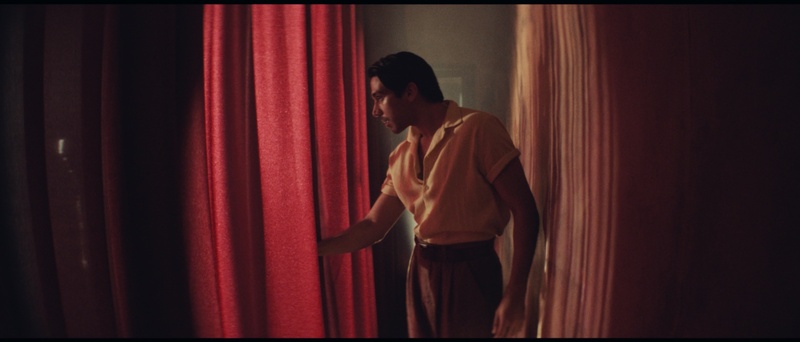
The film resists nostalgia. The late 1950s setting isn’t romanticized or softened. Cinematography and production design emphasize enclosure rather than period detail, reinforcing the sense that the walls are already closing in, even during moments of music and movement. Sound plays a crucial role here, with rock ’n’ roll functioning less as rebellion than as intrusion, a reminder that other ways of living exist, even if they’re unsustainable in this environment.
NARCISO isn’t structured as a mystery, even though its endpoint is known. The question isn’t who is responsible for what happens, but how a society makes such an ending feel inevitable. By situating personal desire within a larger system of surveillance and moral enforcement, Martinessi connects the intimate to the oppressive without reducing either to metaphor. The film’s power lies in that balance, refusing to isolate queerness, art, or youth from the political machinery that ultimately consumes them.
Please visit https://linktr.ee/overlyhonestr for more reviews.
You can follow me on Letterboxd, Instagram, Twitter, and YouTube. My social media accounts can also be found on most platforms by searching for 'Overly Honest Reviews'.
I’m always happy to hear from my readers; please don't hesitate to say hello or send me any questions about movies.
[photo courtesy of PANDORA FILM PRODUKTION, BOCACHA FILMS, ESQUINA PRODUÇÕES, OUBLAUM FILMES, BTEAM PRODS, LA FABRICA NOCTURNA CINÉMA, GUAY FILMS, LUXBOX, THE PR FACTORY]
DISCLAIMER:
At Overly Honest Movie Reviews, we value honesty and transparency. Occasionally, we receive complimentary items for review, including DVDs, Blu-rays, CDs, Vinyl Records, Books, and more. We assure you that these arrangements do not influence our reviews, as we are committed to providing unbiased and sincere evaluations. We aim to help you make informed entertainment choices regardless of our relationship with distributors or producers.
Amazon Affiliate Links:
Additionally, this site contains Amazon affiliate links. If you purchase through these links, we may receive a commission. This affiliate arrangement does not affect our commitment to honest reviews and helps support our site. We appreciate your trust and support as you navigate these links.
