Comfort Has Its Moral Limit
How to Divorce During the War
MOVIE REVIEW
How to Divorce During the War
 -
- 

Genre: Drama, Dark Comedy
Year Released: 2026
Runtime: 1h 48m
Director: Andrius Blaževičius
Writer: Andrius Blaževičius
Cast: Žygimantė Elena Jakštaitė, Marius Repšys, Amelija Adomaitytė, Indrė Patkauskaitė, Gintarė Parulytė
Where to Watch: in select theaters beginning August 21, 2026
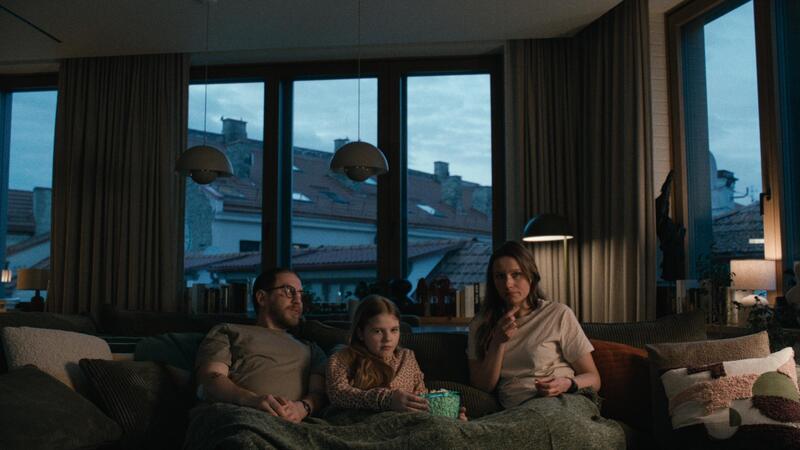
RAVING REVIEW: Adults often misunderstand a quiet child for an uninformed one. Dovile watches her parents discuss living arrangements, conceal resentments, contradict their own principles, and pretend that the family remains manageable. She also hears reports of Russia’s invasion of Ukraine, observes the adults around her judging one another’s responses, and absorbs fears that no one has explained. Her face becomes an unofficial record of everything Marija and Vytas believe they’re keeping from her.
Amelija Adomaitytė plays Dovile without the forced wisdom frequently given to children in adult dramas. She doesn’t exist to deliver truths that embarrass her parents into self-awareness. Her understanding is incomplete, emotional, and consequently more honest. Dovile knows the household has changed before she understands why. She can identify hypocrisy without possessing the language to describe it, and she recognizes that the world outside Lithuania has become more dangerous even as her own home becomes less secure.
HOW TO DIVORCE DURING THE WAR isn’t only told through Dovile’s perspective, though her presence determines how its conflicts land. Marija and Vytas can dismiss each other’s accusations as the debris of a failing marriage. Their daughter can’t separate the personal anger from global fear. To her, both represent adults losing control while insisting that everything is under control.
Writer and director Andrius Blaževičius begins with an event that would be large enough to support an entire film. Marija tells Vytas that she wants a divorce. The following day, Russia launches its full-scale invasion of Ukraine, forcing their crisis to continue within a much larger emergency. The timing doesn’t make their pain disappear. It merely makes every expression of that pain feel embarrassing, necessary, selfish, understandable, and absurd at once.
That contradiction supplies much of the movie’s lighter humor. No one can put a marriage on hold simply because history has become more important. Rent must be paid, children must be transported, work continues, relatives offer unwanted opinions, and one spouse needs somewhere else to live. Marija and Vytas remain trapped inside the procedures of separation while watching millions of people confront losses that dwarf their own.
Blaževičius doesn’t use the invasion to shame them for continuing to care about their lives. Personal suffering doesn’t vanish when someone else suffers more. The criticism concerns what Marija, Vytas, and their comfortable social circle do with that knowledge. Everyone wants to be compassionate. Everyone wants to be seen opposing Russian aggression. The trouble begins when support requires more than a statement, a donation, a volunteer shift, or an opinion expressed among people who already agree.
The film understands the social appeal of doing good in visible, controlled amounts. Volunteering offers a sense of usefulness. Publicly supporting Ukraine confirms that one has chosen the correct side. Opening a home to refugees sounds unquestionably decent until strangers need privacy, stability, food, patience, and access to the same domestic space that already feels too small for a separating family.
Blaževičius keeps finding the exact point where principle encounters inconvenience. The results are funny because the characters recognize their compromises even while explaining them away. No one announces that comfort matters more than solidarity. They produce practical reasons, temporary limitations, emotional complications, and carefully framed exceptions. Each excuse may contain some truth. Together, they reveal how quickly morality becomes negotiation.
Žygimantė Elena Jakštaitė refuses to weaken Marija for the audience. She’s decisive in ways that can appear cold, capable of shifting from legitimate frustration to casual cruelty without announcing the change. Marija has spent years supporting a husband whose creative ambitions haven’t produced stability, and her resentment hasn’t appeared overnight. Her desire to leave makes sense long before every reason becomes clear. Understanding her decision doesn’t require approving of every way she handles it.
Jakštaitė lets irritation settle into Marija’s posture and speech. She often looks as though she has completed an argument before Vytas realizes one has begun. There’s fatigue behind her impatience, along with the excitement of believing another life may be available. That possibility makes Marija reckless. Freedom, once imagined, becomes something she feels entitled to pursue immediately, regardless of the disruption left behind.
Marius Repšys gives Vytas a wounded quality that might initially invite sympathy. He’s a struggling filmmaker forced to retreat to his parents’ home, where financial disappointment and generational conflict reinforce his sense of humiliation. His career has failed to develop as expected, his wife no longer believes in their marriage, and the invasion makes his creative frustrations appear especially trivial.
Repšys gradually complicates that. Vytas has learned to treat artistic struggle as proof of seriousness, using disappointment as both identity and defense. He can recognize Marija’s selfishness more easily than his own. His sensitivity doesn’t automatically make him attentive, and his concern doesn’t prevent him from behaving badly when pride takes over. Repšys finds humor in Vytas’ indignation without turning him into a joke.
Neither performance asks the audience to choose a correct spouse. The movie provides enough evidence to defend either person and enough additional evidence to regret doing so. Their marriage hasn’t failed because one of them is good and the other is terrible. Years of unequal expectations, financial pressure, creative resentment, withheld information, and emotional neglect have produced a relationship in which every disagreement carries several older ones inside it.
Divorce and war are incomparable in scale, but both force people to reveal what they value when familiar structures collapse. Marija and Vytas lose the ability to assume that their household, country, economy, and future will continue operating as expected. One crisis is “chosen,” the other imposed. Both expose weaknesses that were easier to ignore during stable periods. The invasion also enters the film through Vytas’ parents, whose relationship with Russian propaganda creates some of its most uncomfortable exchanges. These scenes avoid treating misinformation as a harmless quirk. Their beliefs affect the people sharing their home, transforming political disagreement into a question of reality itself. Vytas can’t discuss the war with them without also confronting the history, loyalties, and resentments that shaped their worldview.
Blaževičius is especially perceptive about the emotional utility of activism. Supporting a cause can be meaningful and necessary. It can also give people somewhere to place anger that originated elsewhere. Marija and Vytas both attempt to convert dissatisfaction into action. Their motives don’t invalidate the assistance they provide, though the film keeps asking what will happen when generosity stops making them feel better.
No one receives a moral cleansing. A donation can matter even when partly motivated by guilt. A refugee can benefit from hospitality offered by an imperfect host. A parent can love a child while causing lasting instability. A person can oppose a war sincerely and remain unwilling to surrender much of anything. HOW TO DIVORCE DURING THE WAR allows these truths to coexist without flattening them into a lesson.
Dovile remains the person least capable of controlling how these crises affect her. The adults can choose divorce, volunteer work, political positions, career changes, new relationships, and living arrangements. She inherits their decisions along with the anxiety of a war unfolding nearby. Her observations give the film its quietest form of accountability because she sees the distance between what her parents say and how they behave.
HOW TO DIVORCE DURING THE WAR doesn’t argue that Marija and Vytas should abandon their personal needs because others face greater danger. It asks something more difficult. How much comfort are decent people willing to surrender when their values require it, and how many explanations will they create before admitting the answer?
Blaževičius doesn’t demand some heroic response, only a series of revealing choices. That refusal gives the film its honesty. Marija and Vytas aren’t uniquely hypocritical or unusually selfish. They’re frightened, privileged, caring, resentful people trying to remain recognizable to themselves while every stable part of life shifts beneath them. The discomfort comes from realizing how ordinary they are.
Please visit https://linktr.ee/overlyhonestr for more reviews.
You can follow me on Letterboxd, Instagram, Twitter, and YouTube. My social media accounts can also be found on most platforms by searching for 'Overly Honest Reviews'.
I’m always happy to hear from my readers; please don't hesitate to say hello or send me any questions about movies.
[photo courtesy of M-FILMS, RED LION SARL, FELINE FILMS, BIONAUT, KINO LORBER, ZEITGEIST FILMS]
DISCLAIMER:
At Overly Honest Movie Reviews, we value honesty and transparency. Occasionally, we receive complimentary items for review, including DVDs, Blu-rays, CDs, Vinyl Records, Books, and more. We assure you that these arrangements do not influence our reviews, as we are committed to providing unbiased and sincere evaluations. We aim to help you make informed entertainment choices regardless of our relationship with distributors or producers.
Amazon Affiliate Links:
Additionally, this site contains Amazon affiliate links. If you purchase through these links, we may receive a commission. This affiliate arrangement does not affect our commitment to honest reviews and helps support our site. We appreciate your trust and support as you navigate these links.
