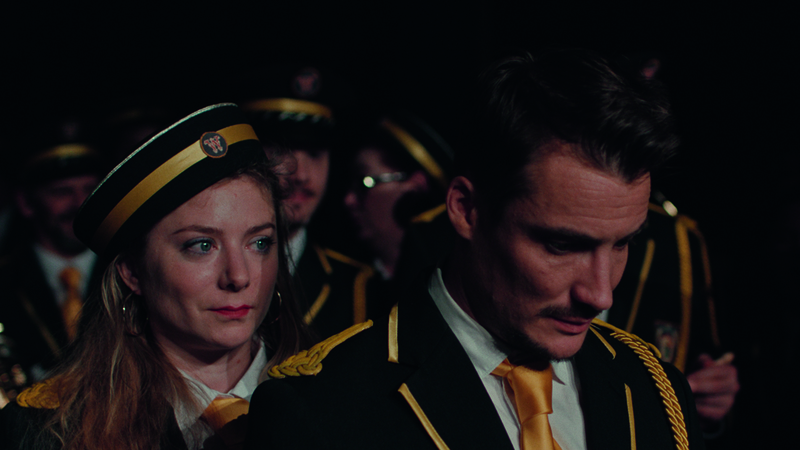
Two Brothers Learn How to Listen
The Marching Band (En fanfare)
MOVIE REVIEWS
The Marching Band (En fanfare)
 -
- 

Genre: Comedy, Drama, Music
Year Released: 2024, 2026
Runtime: 1h 43m
Director(s): Emmanuel Courcol
Writer(s): Emmanuel Courcol, Irène Muscari, Oriane Bonduel, Marianne Tomersy, Khaled Amara
Cast: Benjamin Lavernhe, Pierre Lottin, Sarah Suco, Jacques Bonnaffé, Ludmila Mikaël, Anne Loiret
Where to Watch: in select theaters August 28, 2026
RAVING REVIEW: Thibaut and Jimmy didn’t just grow up apart. They grew up with access to entirely different versions of what life could offer them. One became a celebrated conductor traveling between orchestras, while the other works in a school cafeteria and spends his free time playing trombone with a community brass band in northern France. Directior/co-writer Emmanuel Courcol could have used that disparity for a story about long-lost brothers discovering that they’re more alike than anyone thought. THE MARCHING BAND is far more interested in the uncomfortable question that comes afterward. How much of the distance between them was ever their choice?
A medical crisis leads Thibaut Desormeaux (Benjamin Lavernhe) to discover that he was adopted and has a biological brother he never knew existed. Jimmy Lecocq (Pierre Lottin) isn’t waiting around hoping to complete somebody else’s family tree. The news disrupts an established life filled with work, friends, music, and responsibilities, and his response carries understandable suspicion. Thibaut may be his brother by blood, but that doesn’t produce thirty years of missing history.
Courcol lets that matter, because their relationship develops through conversations that don’t always go well, small acts of attention, shared musical instincts, and the growing awareness that each man is looking at a life he could have conceivably lived. Music gives them somewhere to meet in the middle without requiring either brother to know how to talk about everything else suddenly.
THE MARCHING BAND never becomes the kind of aggressively sentimental crowdpleaser its premise could easily become. Courcol certainly wants emotion, and the screenplay isn’t shy about circumstances capable of producing it. Illness, adoption, family separation, unrealized potential, economic struggle, and music are enough ingredients to make an audience reach for tissues before the first rehearsal ends. The film earns most of those reactions because it rarely asks its characters to become anything less than they’ve shown themselves to be.
Lavernhe is especially good at preventing Thibaut from becoming a rich man who shows up just to improve everybody else's life. His privilege is obvious, and so is the discomfort that follows as he begins to recognize what that privilege has provided. Thibaut has talent, discipline, and years of work behind his success. Meeting Jimmy forces him to consider the opportunities that allowed those qualities to become a career in the first place.
That recognition gradually turns into guilt, which is where Lavernhe finds some of his best moments. Thibaut genuinely wants to help his brother, but good intentions don't automatically make his assumptions correct. There’s an arrogance hiding inside the belief that he can identify what Jimmy deserves and then adjust the world accordingly. Lavernhe allows kindness and condescension to occasionally coexist in the same acts, making Thibaut considerably more interesting than a straightforward, generous older brother.
Lottin has an even more difficult emotional line to walk. Jimmy is proud without being portrayed as foolishly stubborn, angry without becoming bitter, and talented without waiting for an outsider to validate him. His life has disappointments, but it’s still his life. The possibility that someone else had access to education, training, travel, and cultured spaces that might also have suited him lands harder because Lottin never turns the character into a symbol of working-class deprivation.
The brothers' difference isn't only financial. They’ve learned different ways of occupying a room. Thibaut enters spaces expecting his knowledge to matter. Jimmy is much quicker to detect judgment and defend himself against it. When those instincts collide, Courcol finds humor without making either man the joke.
The local marching band becomes the ideal place to test all of this. Thibaut comes from a professional environment governed by precision, preparation, hierarchy, and the expectations surrounding elite classical music. Jimmy’s band has its own discipline, but it also exists as part of a community. Rehearsals involve personalities, arguments, friendship, pride, and the familiarity of people who know one another as more than just whatever instrument they happen to be playing.
Courcol understands that neither needs to defeat the other. The film doesn't build toward the revelation that classical music is pretentious or that amateur musicians need a professional conductor to discover their greatness. Each space offers something the other lacks. Thibaut knows how to hear possibilities inside a group. The band understands that playing together can mean something beyond producing the correct sound.
Sarah Suco's Sabrina helps keep that community from feeling like scenery assembled for the brothers' benefit. She has a history with Jimmy, opinions of her own, and little patience for anyone who treats the band as a charming provincial diversion. Suco can change the temperature of a conversation almost immediately, particularly when Thibaut's enthusiasm starts outrunning his understanding of the people around him.
THE MARCHING BAND had already become a major French audience success before arriving in the United States, and it isn't difficult to understand why. Courcol knows exactly how accessible this story can be. Humor, the supporting characters, and the movie's easygoing nature make it easy company, and it rarely stays in discomfort long enough to become oppressive.
Music itself is used with care. Courcol moves between orchestral works, jazz, brass-band arrangements, and popular French music without treating the soundtrack like a playlist designed to demonstrate range. Listening becomes part of characterization. What catches someone's ear, what they dismiss, what they recognize, and how they respond to another musician often communicates more than a conversation could.
The film's strongest sequences aren't necessarily the most technically impressive ones. They're the moments when performance changes the relationship among the people in the room. Someone watches. Somebody hears ability they hadn't recognized. Pride replaces embarrassment, or admiration becomes complicated by resentment. Courcol understands that a piece of music can alter a conversation without stopping the film so everyone can explain what it meant. That approach is also why the illness driving the brothers together never completely takes over the movie. It's important and sometimes frightening, but THE MARCHING BAND isn't about facing mortality. The diagnosis creates urgency around something harder to measure. The realization that an entire relationship should have existed but didn't.
Neither brother can recover the childhood they lost together. Thibaut can't redistribute his past, and Jimmy can't discover what his talent might have become under different circumstances. Their connection matters because the film refuses to pretend that finding one another repairs any of that. Brotherhood now, carrying all of the unfairness that preceded it. A lesser version of this story would make Jimmy grateful for Thibaut's arrival and Thibaut noble for recognizing his brother's gifts. Courcol keeps pushing against that. Sometimes helping someone is partly about the helper's need to feel useful. Sometimes generosity carries assumptions. Sometimes love and resentment don't cancel each other out. That gives THE MARCHING BAND enough resistance to survive its more calculated sentimental choices. It knows when an audience is likely to laugh and has a very good idea when they're likely to cry, but the emotions underneath those cues aren't disposable. Lavernhe and Lottin make sure of that.
The title promises a movie about people playing together. What stuck with me is how long it takes these brothers to understand that playing together isn't the same thing as hearing each other. THE MARCHING BAND finds its warmth in that difference, allowing music to bring two lives into the same room without pretending it can erase everything that kept them apart.
Please visit https://linktr.ee/overlyhonestr for more reviews.
You can follow me on Letterboxd, Instagram, Twitter, and YouTube. My social media accounts can also be found on most platforms by searching for 'Overly Honest Reviews'.
I’m always happy to hear from my readers; please don't hesitate to say hello or send me any questions about movies.
[photo courtesy of GREENWICH ENTERTAINMENT]
DISCLAIMER:
At Overly Honest Movie Reviews, we value honesty and transparency. Occasionally, we receive complimentary items for review, including DVDs, Blu-rays, CDs, Vinyl Records, Books, and more. We assure you that these arrangements do not influence our reviews, as we are committed to providing unbiased and sincere evaluations. We aim to help you make informed entertainment choices regardless of our relationship with distributors or producers.
Amazon Affiliate Links:
Additionally, this site contains Amazon affiliate links. If you purchase through these links, we may receive a commission. This affiliate arrangement does not affect our commitment to honest reviews and helps support our site. We appreciate your trust and support as you navigate these links.
