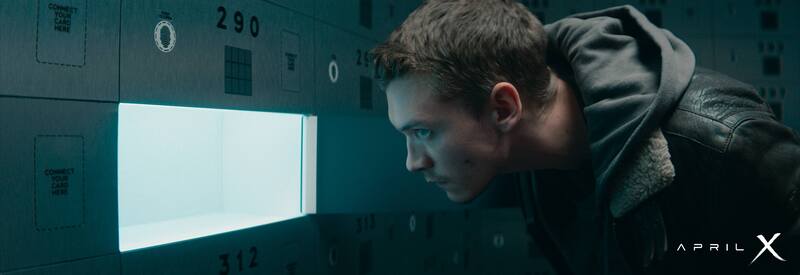
Lost in a Beautifully Broken Tomorrow
April X
MOVIE REVIEWS
April X
 -
- 

Genre: Action, Thriller, Sci-Fi
Year Released: 2025, 2026
Runtime: 1h 31m
Director: Michel K. Parandi
Writers: Michel K. Parandi, Jack Coulton
Cast: Connor Storrie, Lilly Krug, Tudor Chirilă, Șerban Pavlu, Tourialay Akbari, Marius Chivu, Iulian Postelnicu, Lavinia Postolache
Where to Watch: in select theaters, October 2, 2026
RAVING REVIEW: APRIL X is at its best when the future is just happening around its characters instead of telling us all about it. Michel K. Parandi builds a near-future society out of scattered details, technology, economic instability, criminal activity, and an underlying sense that civilization has reorganized itself into something slightly removed from the present. That makes the setting considerably more interesting than a parade of gadgets or giant effects could have been.
There’s something impressive about how much APRIL X attempts within the limits of an independent production. This isn’t a single-concept science-fiction story content to introduce one idea and build everything around it. Dream recording, memory, identity, body modification, exploitation, organized crime, and societies' collapse are all floating around Baxter’s increasingly desperate search for his missing twin sister, April. Sometimes that makes the world feel more authentic than I expected; other times, the movie introduces ideas faster than it can really process them.
Connor Storrie holds those pieces together as Baxter, and his performance becomes the easiest part of the film to invest in. Baxter begins in an already damaged place, carrying guilt and an unhealthy dependence on the one person who seems capable of keeping him connected to anything resembling stability. Once April disappears, Storrie gradually pushes him from desperation into obsession without making every step of that decline feel like another giant change to his personality. His performance grows more erratic as Baxter loses whatever control he had. There’s enough vulnerability underneath it to keep him from becoming nothing more than an angry man wandering through a dystopian crime story.
That relationship between Baxter and April is important because APRIL X isn’t really built like the missing-person thriller it originally makes you think. Finding April gives Baxter a direction, but Parandi and co-writer Jack Coulton are far more interested in what her absence does to him. His search begins to blur with grief, guilt, possession, and eventually questions about whether recovering someone physically means anything when the memories and experiences that made that person recognizable may no longer exist in the same way.
Those questions eventually become more interesting than the mechanics surrounding them. APRIL X gets into the territory of asking what actually creates identity and how much of another person can disappear before the familiar face standing in front of you becomes someone else. There’s enough here in that idea alone for an entire feature, which becomes part of the movie’s larger problem. Another concept often waits before the current one has had time to settle.
That approach can make the storytelling difficult to follow for reasons that aren’t always productive. There’s a difference between trusting an audience to connect pieces and simply moving through so quickly that some of those pieces never feel established, and APRIL X crosses that line more than once. The criminal stuff surrounding Baxter and April could have used more definition; certain characters show up with an implied significance that the movie doesn’t completely earn, and several developments feel as though we’ve skipped a scene that might have made the progression more natural.
April herself suffers the most from that imbalance. Lilly Krug has an intriguing presence whenever the film gives her space. APRIL X is overwhelmingly Baxter’s experience, leaving the character whose name is literally in the title feeling frustratingly distant for long stretches. Some of that absence is obviously necessary for Baxter’s story. However, giving us a stronger sense of April before everything falls apart would have made both the search and the film’s larger questions about memory hit harder.
The surrounding criminal world fares a little better because the movie doesn’t need everyone within it to become a fully developed character. Tudor Chirilă, in particular, gives Tetris the right mix of menace and eccentricity without pushing him into comic-book villain territory. Șerban Pavlu and Iulian Postelnicu also help make this world feel bigger than Baxter even when the script only allows brief glimpses of the systems operating around him.
One of the film's most effective choices is how casually it treats its technology. Characters aren’t constantly stopping to explain how everything works, and most of what we see has already become part of their everyday life. Dream recording and other developments aren’t presented as breakthroughs; they’re simply tools that can be bought, exploited, stolen, or manipulated depending on who has access to them. That makes the science fiction feel closer to the present because the technology isn’t automatically good or evil. Like everything else in this world, it becomes another way for people with money or power to take advantage of those without it.
That also gives Baxter’s story an uglier edge as he gets pulled deeper into places he probably wouldn’t have entered under normal circumstances. His desperation gradually lowers the threshold for what he’s willing to accept, and the movie understands that grief can make a person easier to manipulate without turning Baxter into someone helpless. He still makes some terrible choices, which keeps his downward spiral from feeling entirely forced by the plot.
APRIL X stretches itself far beyond what its scale would suggest. Nathan Haugaard’s cinematography and the Bucharest locations give Parandi plenty of concrete, glass, darkness, artificial light, cramped interiors, and worn-down spaces to work with, creating a future built from the remains of the present rather than dropped onto the screen through endless digital scenery. That matters because the film would lose a lot if this environment felt fake; Baxter needs to seem trapped inside a place that feels legit, but also off in some way.
Hugo Caruana’s editing also feeds into Baxter’s deterioration, though its aggressive cadence can be a mixed blessing. There are stretches where the fragmented movement between locations, people, and ideas places us effectively inside Baxter’s unraveling head, then others where the same approach contributes to the narrative confusion. Matthew Atticus Berger’s music and the overall soundscape do a lot of heavy lifting, often making the world feel unsettled before anything overtly threatening appears.
Parandi deserves credit for refusing to let the movie’s budget dictate the size of his imagination. APRIL X was never going to compete with studio science fiction through scale, so it instead builds its future through locations, atmosphere, behavior, and suggestion, and there are plenty of scenes when that strategy works remarkably well. The downside is that the screenplay seems equally unwilling to limit its imagination, leaving several strong ideas competing for attention rather than allowing the best ones to take over.
APRIL X lands somewhere between an exciting calling card and a completely satisfying feature. Storrie gives it an emotional throughline, the production creates an impressive sense of place, and Parandi clearly has ideas worth exploring about technology, grief, memory, and what makes somebody themselves. The movie simply reaches for more than its 91 minutes can comfortably contain, leaving some of its most interesting characters and concepts waiting for attention that never quite arrives. Three stars feels right for a film I admired almost as often as I wished it would slow down and dig deeper into what it had already found.
Please visit https://linktr.ee/overlyhonestr for more reviews.
You can follow me on Letterboxd, Instagram, Twitter, and YouTube. You can also find my social media accounts on most platforms by searching for 'Overly Honest Reviews'.
I’m always happy to hear from my readers; please don't hesitate to say hello or send me any questions about movies.
[photo courtesy of SUNRISE FILMS, RIALTO DISTRIBUTION]
DISCLAIMER:
At Overly Honest Movie Reviews, we value honesty and transparency. Occasionally, we receive complimentary items for review, including DVDs, Blu-rays, CDs, Vinyl Records, Books, and more. We assure you these arrangements do not influence our reviews, as we are committed to unbiased, sincere evaluations. We aim to help you make informed entertainment choices regardless of our relationship with distributors or producers.
Amazon Affiliate Links:
This site also contains Amazon affiliate links. If you purchase through these links, we may receive a commission. This affiliate arrangement does not affect our commitment to honest reviews and helps support our site. We appreciate your trust and support as you navigate these links.
