The Things Children Notice
Ah Girl
MOVIE REVIEWS
Ah Girl
 -
- 

Genre: Drama
Year Released: 2026
Runtime: 1h 39m
Director: Ang Geck Geck Priscilla
Writer: Ang Geck Geck Priscilla
Cast: Ong Xuan Jing, Sydney Wong, Doreen Toh, James Seah, Carrie Wong, Benjamin Heng
Where to Watch: shown at the 2026 Toronto International Film Festival
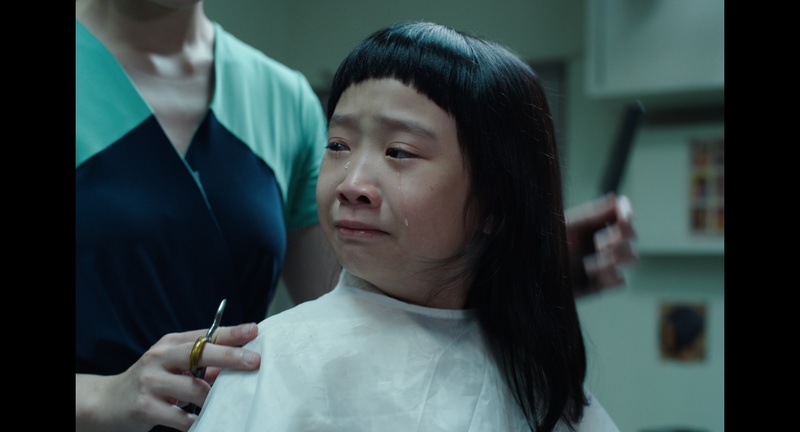
RAVING REVIEW: One of the hardest things for a movie about childhood to capture is how much kids understand without really understanding why any of it is happening. AH GIRL gets that part so right, putting us alongside a seven-year-old who can recognize when something is wrong long before she has the emotional connection to her world to explain it. There’s no magic wisdom shoved into her dialogue and no attempt to turn her into an adult before she was ready. She’s a kid, and the adults around her keep creating problems that she somehow has to learn how to live with.
Ong Xuan Jing holds an enormous amount of that responsibility as Ah Girl, also known as Swee Swee, and her performance is easily the strongest element of writer/director Ang Geck Geck Priscilla’s feature debut. Ong doesn’t seem to be reaching for emotion or waiting for a scene to tell her when to become sad, funny, angry, or scared. Those reactions overlap in ways that are just instinctive, especially when Ah Girl is trying to process something while still behaving like the seven-year-old she actually is. She can be mischievous, stubborn, jealous, affectionate, embarrassed, and unexpectedly resourceful without any of those traits feeling designed to make us love her.
That matters because AH GIRL would be much easier to manipulate if Ang wanted to. Singapore in 1994 provides the setting, as Ah Girl and her younger sister, Ah Tian (Sydney Wong), live in the aftermath of their parents’ separation; they primarily stay with their father and grandmother while seeing their mother on weekends. That arrangement is ultimately unstable even before Ah Girl is asked whether she’d rather live with her mother someday, a question that an adult might consider reasonable but feels enormous when you’re seven. Suddenly she’s being asked to consider homes, parents, loyalty, and the possibility of leaving her sister behind when she should be worrying about school and whatever trouble she can get into next.
The decision to keep so much of the movie at Ah Girl’s level makes the adults fascinating in a unique way. We don’t get the ability to step away from her POV to receive some clear explanation of who ruined the marriage, whose version of events is correct, or which parent deserves our sympathy. James Seah’s Ah Pa can be easygoing one minute and irresponsible the next. Carrie Wong’s Mummy is capable of overwhelming affection without necessarily providing the stability her daughters need. Doreen Toh’s Ah Ma adds another unpredictable adult presence to the household, leaving the girls surrounded by people who care for them but aren’t particularly good at recognizing what all this instability is doing to them.
Sydney Wong is also wonderful as Ah Tian, because the sisters' relationship never becomes a convenient emotional device. They annoy each other, play together, depend on each other, and sometimes seem to exist in their own universe while everything around them is changing. Their scenes provide some of the movie’s funniest moments without feeling like something inserted to save us from the heavier moments. The humor belongs there because childhood doesn’t stop being silly just because the adults have made life difficult. There’s something remarkable in the family structure in this film that I don’t know if I’ve seen before.
Ang finds that same balance in Ah Girl’s life away from home. School brings the expected life that coming-of-age stories offer, from crushes, friendships, awkwardness, wrongdoing, and a surprisingly enterprising little gum operation, allowing the film to show a girl who’s doing far more than simply surviving her parents’ separation. These stretches are important because AH GIRL isn’t interested in defining childhood by trauma alone. Ah Girl continues finding things that make her laugh, opportunities to push boundaries, and little victories that matter enormously at seven years old, even as worries she shouldn’t have are slowly taking up more room in her head. This is one of the most important aspects of the film. Life will always go on, no matter what’s going on in certain parts of our lives.
The visual style reinforces that perspective without constantly feeling like it's forcing itself on you. The tighter 4:3 frame makes apartments, hallways, classrooms, and family gatherings feel contained around Ah Girl, while the camera frequently stays close to the children's physical height and awareness. Adults can enter the frame in much the same way their decisions enter Ah Girl’s life. She sees the result even when she hasn’t been invited into the conversation that caused it. The 90s setting also avoids becoming an excuse for a parade of nostalgic references, instead creating a world where the period matters because this particular childhood happened there.
AH GIRL occasionally presses against the limits of its own perspective. Spending so much time with Ah Girl means some of the adults around her remain frustratingly difficult to understand, and there are points where another layer to Mummy or Ah Pa could’ve made their contradictions even more painful.
The restraint is generally one of the movie’s strengths, although there are moments when it also keeps the story from changing emotion as much as it could. What prevents that from becoming a larger problem is how seldom the film confuses sadness with importance. There are genuinely funny moments, ordinary distractions, bursts of imagination, and moments where Ah Girl simply gets to be difficult. Ang understands that the painful parts become more effective when they’re sitting alongside all that normalcy rather than ever trying to replace it. It also keeps the movie from turning its young protagonist into an object of pity, which would’ve been an especially easy mistake with this material.
Knowing that AH GIRL grew out of Ang’s own childhood experiences adds another dimension to the specificity of what we’re seeing. The movie never feels as though it’s demanding that personal history do the emotional work for it. What comes through most is the idea that children remember far more than adults assume, including conversations they weren’t supposed to understand and choices they never should’ve been asked to make. AH GIRL gives those memories space without pretending every wound has a convenient explanation attached to it.
The film leaves us with the sense that we've spent enough time with Ah Girl to recognize something that many of the adults around her repeatedly miss. She’s paying attention to all of it. Ong Xuan Jing makes that awareness visible without losing the innocence, humor, selfishness, and impulsiveness of an actual child, and that balance gives AH GIRL so much of the connection to her world and is ultimately why the story holds us as much as it does. The movie isn’t asking us to decide which parent was right or even to rewrite a broken family into an experience that’s easier to accept. It asks us to notice the little girl standing in the middle of the room while everyone else makes those decisions, and that turns out to be more than enough.
Please visit https://linktr.ee/overlyhonestr for more reviews.
You can follow me on Letterboxd, Instagram, Twitter, and YouTube. My social media accounts can also be found on most platforms by searching for 'Overly Honest Reviews'.
I’m always happy to hear from my readers; please don't hesitate to say hello or send me any questions about movies.
[photo courtesy of AGGREGATE FILMS, IFA MEDIA, KUSU FILMS]
DISCLAIMER:
At Overly Honest Movie Reviews, we value honesty and transparency. Occasionally, we receive complimentary items for review, including DVDs, Blu-rays, CDs, Vinyl Records, Books, and more. We assure you that these arrangements do not influence our reviews, as we are committed to providing unbiased and sincere evaluations. We aim to help you make informed entertainment choices regardless of our relationship with distributors or producers.
Amazon Affiliate Links:
Additionally, this site contains Amazon affiliate links. If you purchase through these links, we may receive a commission. This affiliate arrangement does not affect our commitment to honest reviews and helps support our site. We appreciate your trust and support as you navigate these links.
