Nobody Knew What Was Real
Clown Panic
MOVIE REVIEW
Clown Panic
 -
- 


Genre: Documentary
Year: 2026
Runtime: 1h 24m
Director: Ed Perkins
Where to Watch: premiering on Hulu and Hulu on Disney+ beginning October 12, 2026; Disney+ internationally
RAVING REVIEW: I wanted to really like this; plenty of bizarre stories from 2016 somehow feel even stranger ten years later (also, how has it been 10 years!), but the appearance of clowns across America remains in a category of its own. CLOWN PANIC goes back to the moment when reports of clowns hiding near the woods in South Carolina grew into police investigations, school lockdowns, viral videos, copycats, false reports, and a nationwide obsession that became increasingly difficult to separate from reality. The memory of those moments works on a deeper level than some of the talking heads presented here.
Director Ed Perkins doesn't approach the subject as a collection of creepy clips designed to make viewers laugh at how ridiculous everyone became. That's part of the story, and the documentary captures the absurdity of adults seriously debating whether clowns might be lurking in their communities. What makes CLOWN PANIC more interesting is how something this strange can become believable once enough people start repeating it.
The story begins in Greenville County, South Carolina, where children reported seeing clowns near an apartment complex in August 2016. Some accounts even included clowns trying to lure children into the woods, strange noises, and other details that sounded like something pulled from a horror movie. Law enforcement investigated, but evidence supporting many of the early claims remained scarce.
That uncertainty should have slowed everything down. Instead, it fueled the story. Once social media grabbed hold of the reports, the idea became almost perfectly designed for viral panic. Everyone already understood that clowns could be unsettling, smartphones meant any photograph or rumor could spread instantly, and the lack of concrete answers gave people room to fill in whatever details frightened them most. Suddenly a local story in South Carolina wasn't local anymore.
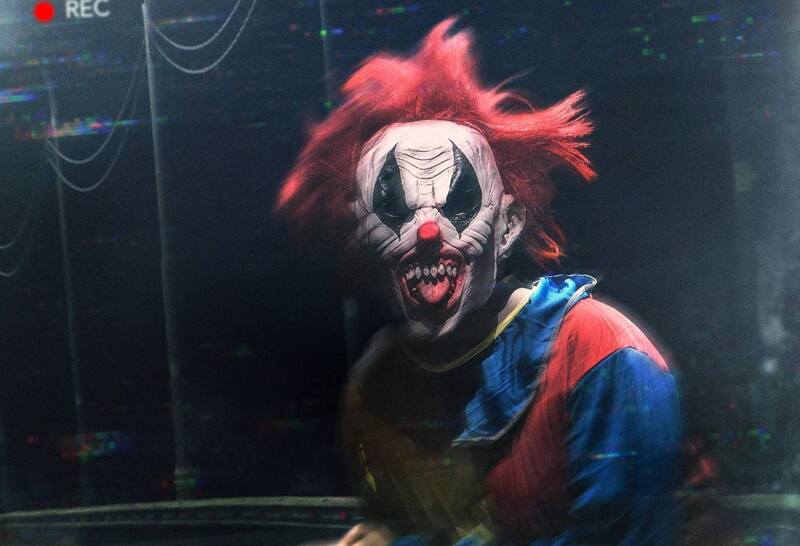
CLOWN PANIC is most effective when it lets the original footage speak for itself. News broadcasts, shaky videos, social-media posts, interviews, and old reports capture a moment when nobody seemed entirely sure whether they were covering a real threat, a prank, an urban legend, or some combination of all three. Watching that spread is considerably more unsettling than seeing someone in clown makeup standing beside a road.
Perkins understands that the subject is funny without needing to mock the people involved. That's an important distinction because plenty of the fear was real even when the supposed threat wasn't. Parents worried about their children, schools changed procedures, police departments devoted resources to reports, and professional clowns suddenly found themselves connected to something they had nothing to do with.
Those professional clowns offer one of the documentary's more unexpected perspectives. It would've been easy to treat them as comic relief. The panic had real consequences for people whose livelihoods depended on performing in the exact costume everyone had suddenly decided was terrifying. Their inclusion shows how quickly a joke can stop being harmless once the fear around it starts affecting real lives.
Their perspective also gives the documentary something the news coverage rarely had at the time. We get a viewpoint of the people who became collateral damage in a story they didn’t create. For professional performers, the panic wasn’t just an odd headline or a joke. Bookings were canceled, public appearances could become uncomfortable, and an entire profession built around entertaining people was temporarily associated with menace. That contrast says a lot about how quickly a cultural symbol can be rewritten once fear takes over. The clown had already spent decades shifting between comedy and horror in popular culture, but 2016 pushed that tension into the real world in a way performers couldn't simply ignore.
The cultural timing matters too. America in 2016 was already an anxious place, and CLOWN PANIC doesn't pretend the phenomenon developed inside a vacuum. Fear, distrust, online misinformation, and an increasingly frantic news cycle created ideal conditions for something this ridiculous to become plausible. The clowns may have been unusual, but the system spreading the story wasn't.
That connection is where the documentary has the most to say ten years later. Social media in 2016 could already spread rumors like wildfire across the country almost instantly, but looking back now makes the process feel almost primitive compared with what exists today. Images can be manipulated easily, video can be generated, context can disappear instantly, and false information can reach enormous audiences before anyone has time to question it.
Perkins doesn't need to force those parallels because they're sitting right underneath the archival footage. Watching people react to blurry photographs, anonymous claims, and secondhand stories feels uncomfortably modern. The specifics may have changed, but the process of deciding something must be true because everyone else seems to be talking about it hasn't gone anywhere.
The documentary also benefits from refusing to reduce every sighting to one explanation. Some incidents were obvious pranks. Others appear to have been copycats inspired by the growing coverage, while plenty of reports were never verified at all. That messiness is more honest than pretending one person, one hoax, or one clear origin caused everything that followed.
At times, CLOWN PANIC risks repeating itself because the phenomenon itself was repetitive. Another sighting happens, another town reacts, another social-media post spreads, and another television reporter explains why everyone is suddenly worried about clowns. The humor also prevents the documentary from becoming unbearably serious about something inherently ridiculous. There is no way to tell this story honestly without acknowledging how strange it is that clown sightings became a national concern. CLOWN PANIC laughs at the circumstances without using that humor to dismiss the genuinely frightened people. The biggest negative is that some of the interviews at the center of the film, while trying to be as serious as possible, end up sounding ridiculous.
That balance becomes increasingly important as the film moves away from the novelty of the sightings and toward the mechanics of mass panic. A person wearing a clown costume is easy to understand. Thousands of people becoming convinced that isolated sightings might represent a much larger threat is more complicated, and that's ultimately the question the documentary seems most interested in answering.
CLOWN PANIC also avoids turning the story into a traditional horror documentary. Creepy images, unsettling recordings, and enough clown imagery to make anyone with coulrophobia uncomfortable, but Perkins isn't trying to manufacture scares where they don't belong. The actual uneasiness comes from watching ordinary people lose confidence in their ability to tell what is real.
That makes the tenth anniversary feel like more than a convenient addition to Huluween programming. Looking back at 2016 from 2026 adds a layer the documentary wouldn't have had if it were released immediately after the trend. We now have a decade of additional evidence showing how rapidly online fear can move and how difficult it can be to correct something once it has been absorbed into public consciousness.
The strongest documentaries about strange moments aren't satisfied with simply asking, “Remember this?” They explain why remembering matters. CLOWN PANIC uses one of the most absurd American news stories of the last decade to examine something considerably less funny. It shows exactly how quickly uncertainty becomes fear, fear becomes certainty, and certainty becomes something people are willing to act on.
The clowns eventually disappeared from the headlines, but the conditions that made the panic possible never really went away. That's what gives CLOWN PANIC its staying power beyond the obvious Halloween appeal. Ten years later, the costumes look silly, the footage can be funny, and some of the reactions seem almost impossible to believe, yet the way the panic spread feels more recognizable than ever.
Please visit https://linktr.ee/overlyhonestr for more reviews.
You can follow me on Letterboxd, Instagram, Twitter, and YouTube. You can also find my social media accounts on most platforms by searching for 'Overly Honest Reviews'.
I’m always happy to hear from my readers; please don't hesitate to say hello or send me any questions about movies.
[photo courtesy of HULU, DISNEY+, LIGHTBOX]
DISCLAIMER:
At Overly Honest Movie Reviews, we value honesty and transparency. Occasionally, we receive complimentary items for review, including DVDs, Blu-rays, CDs, Vinyl Records, Books, and more. We assure you these arrangements do not influence our reviews, as we are committed to unbiased, sincere evaluations. We aim to help you make informed entertainment choices regardless of our relationship with distributors or producers.
Amazon Affiliate Links:
This site also contains Amazon affiliate links. If you purchase through these links, we may receive a commission. This affiliate arrangement does not affect our commitment to honest reviews and helps support our site. We appreciate your trust and support as you navigate these links.
