The Case Behind Anna Nicole
Trust Me, I'm a Doctor
MOVIE REVIEW
Trust Me, I'm a Doctor
 -
- 


Genre: Biography, Comedy, Drama
Year: 2026
Runtime: 1h 51m
Director: Thane Economou
Writer: Thane Economou
Cast: Kal Penn, Linda Hamilton, Abbie Cornish, David Julian Hirsh, Al Sapienza
Where to Watch: in theaters October 16, 2026
RAVING REVIEW: Anna Nicole Smith's death became the kind of media event where eventually the people standing around the story became stories themselves. TRUST ME, I'M A DOCTOR turns its attention toward Dr. Sandeep Kapoor, one of Smith's physicians, and finds its most interesting material in what happens when a private person's mistakes, relationships, and personal writings become pieces of public entertainment.
That distinction matters because this isn't really an Anna Nicole Smith biopic. Abbie Cornish plays Smith, and her presence naturally hangs over everything. Writer/director Thane Economou stays primarily with Kapoor as his medical career and private life begin collapsing under the weight of an investigation. Kal Penn's performance has to carry that narrower perspective, and he's strongest when Kapoor looks less like a heroic victim and more like somebody slowly realizing that every decision he's ever made is about to be examined by people who don't know him.
The story comes from Kapoor's memoir, TRUST ME, I'M A DOCTOR: MY LIFE BEFORE, DURING AND AFTER ANNA NICOLE SMITH, which immediately creates an interesting complication. We see this ordeal largely through the eyes of the person who experienced it, and the film occasionally accepts his perspective too easily. Kapoor was ultimately acquitted of every charge brought against him, but an acquittal doesn't automatically erase the ethical questions surrounding a physician becoming personally entangled with a celebrity patient.
Penn does a good job keeping some of that discomfort alive. Kapoor isn't presented as someone who never crossed a boundary or made a questionable choice, and that makes him substantially more interesting than he would've been as a completely spotless protagonist persecuted by an obviously corrupt system. His familiarity with Smith, including the parts of their relationship that slipped outside normal doctor/patient boundaries, gives the prosecution and the media something visually irresistible to latch onto.
The early 2000s tabloid environment becomes almost another antagonist. This was an era when celebrity coverage could turn nearly any photograph, rumor, or leaked personal detail into several days of television, and Smith existed near the center of that machine for years. Kapoor discovers that being connected to someone that famous can make the normal separation between personal life and public record disappear almost instantly.
Economou has fun with that chaos, which helps explain why the movie is sold partly as a dark comedy rather than an entirely straight courtroom drama. The absurdity isn't coming from Smith's death itself but from the machinery surrounding it. Reporters wait outside. Television personalities reduce complicated legal questions into quick segments. Private journals become potential evidence. Every new revelation generates another wave of speculation before anyone has established what actually happened.
There's a danger in making that circus too entertaining, and TRUST ME, I'M A DOCTOR occasionally bumps against it. The more colorful the tabloid material becomes, the easier it is for the actual medical and legal questions to fade behind personalities. The movie is strongest when it remembers that the spectacle matters because real people are being chewed up by it, not simply because the period provides an amusing collection of cable news personalities and celebrity excess.
Linda Hamilton gives the film some needed stability as defense attorney Ellyn Garofalo. Her presence shifts the energy whenever the story moves deeper into the legal fight because Garofalo approaches the situation with the practical focus Kapoor increasingly lacks. Penn plays him as someone emotionally caught inside the storm, while Hamilton has the advantage of standing just far enough outside it to see how dangerous every mistake can become.
That relationship also keeps the courtroom material from falling into the familiar rhythm of dramatic objections followed by speeches designed to tell the audience exactly what to believe. Garofalo's job is less about delivering inspirational courtroom moments than separating damaging appearances from criminal conduct. The case against Kapoor depended in part on whether questionable medical judgment or blurred personal boundaries could be turned into evidence that he had illegally supplied drugs to Smith.
That distinction is the movie's strongest argument. People can make bad decisions without necessarily committing the crime they're accused of, and public outrage isn't the same as legal proof. Kapoor's case becomes an example of how easily those concepts can collapse into one another once celebrity, drugs, and a sudden death enter the picture.
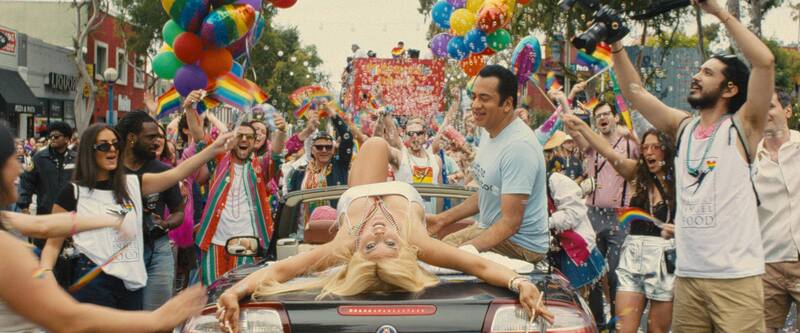
Abbie Cornish faces a different problem playing Smith because impersonation would've been the easiest route. Smith had such a recognizable public persona that exaggerating the voice, mannerisms, and appearance could've overwhelmed everything else. Cornish instead gives her enough vulnerability to remind us that the person at the center of this entire legal and media storm was also someone dealing with pain, grief, and dependence on people whose relationships with her were frequently complicated.
That doesn't mean the movie suddenly becomes her story, and that limitation is frustrating. Smith often exists through memories, legal arguments, and the experiences of people who survived her. Given how often she was treated as an object of fascination while alive, it's uncomfortable to watch other people explain what happened around her again after she's gone.
The film at least seems aware of that problem. Its better moments don't try to divide everyone cleanly into villains and innocent bystanders. Smith was surrounded by doctors, lawyers, assistants, friends, partners, and media figures whose roles frequently overlapped, and the resulting mess isn't easily reduced to one person causing everything that went wrong.
David Julian Hirsh's Howard K. Stern becomes part of that uncertainty. The investigation included Stern alongside Kapoor and psychiatrist Khristine Eroshevich, creating a legal case that attempted to connect several people around Smith through prescription practices and false names. Kapoor was acquitted on every count, while the outcomes for the other defendants became more complicated, reinforcing how much less straightforward the case was than the headlines often suggested.
The legal history gives TRUST ME, I'M A DOCTOR a stronger foundation than its occasional tonal unevenness. At times, the movie lets the absurdity of celebrity culture carry a scene, then quickly shifts to material involving addiction, pain management, medical ethics, or criminal prosecution. Moving between those registers isn't always smooth, and some of the lighter touches make the surrounding drama feel less immediate than it should.
At 111 minutes, the film also has a lot of territory to cover. Kapoor's relationship with Smith, the raid on his home, the exposure of his journals, his legal defense, and the broader public response are all competing for attention. The courtroom becomes the clearest organizing structure, but getting there requires enough background that the first half occasionally feels like it's arranging evidence for a trial we're waiting to begin.
Penn keeps it together through those shifts. I've always liked how naturally he can move between comedy and more serious material without announcing the change, and that ability is useful here. Kapoor can recognize the ridiculousness of what's happening around him while still understanding that the outcome could destroy the life he's built.
There is also something timely about a story in which private material becomes public, and strangers immediately interpret it without context. Kapoor's journals were written as personal records rather than statements intended for a jury or television audience. Yet, once they became part of the investigation, intimate thoughts could suddenly be treated as clues. The film understands how frightening that loss of context can be without pretending written words become meaningless simply because their author never expected anyone else to read them.
What keeps TRUST ME, I'M A DOCTOR from pushing into stronger territory is that its sympathy sometimes arrives before its interrogation. Because Kapoor's memoir is the foundation, the movie naturally spends more energy showing what happened to him than questioning how he got close enough to Smith for some of these problems to exist in the first place. A little more resistance to its own protagonist would've made the eventual acquittal feel even more meaningful.
The actual outcome matters. Kapoor wasn't charged with causing Smith's death, despite the way the case was often discussed publicly, and a jury eventually cleared him of all six charges he faced. That difference between what people believed happened and what prosecutors could prove gives the movie a reason to exist beyond revisiting another celebrity tragedy.
TRUST ME, I'M A DOCTOR works best when it stops asking us to decide whether Sandeep Kapoor was a perfect doctor and asks a more useful question about what happens when imperfection becomes evidence. Penn gives the movie enough humanity to keep that question interesting, Hamilton brings authority without overwhelming him, and Cornish avoids reducing Anna Nicole Smith to the cartoonish image that followed her for much of her public life.
The result is an uneven but worthwhile legal drama about celebrity, medicine, and how quickly a public narrative can harden before a courtroom ever reaches a verdict. It doesn't completely escape the limitations of telling the story from Kapoor's side, but there's enough complexity here to make his side worth hearing.
Please visit https://linktr.ee/overlyhonestr for more reviews.
You can follow me on Letterboxd, Instagram, Twitter, and YouTube. You can also find my social media accounts on most platforms by searching for 'Overly Honest Reviews'.
I’m always happy to hear from my readers; please don't hesitate to say hello or send me any questions about movies.
[photo courtesy of BRIARCLIFF ENTERTAINMENT]
DISCLAIMER:
At Overly Honest Movie Reviews, we value honesty and transparency. Occasionally, we receive complimentary items for review, including DVDs, Blu-rays, CDs, Vinyl Records, Books, and more. We assure you these arrangements do not influence our reviews, as we are committed to unbiased, sincere evaluations. We aim to help you make informed entertainment choices regardless of our relationship with distributors or producers.
Amazon Affiliate Links:
This site also contains Amazon affiliate links. If you purchase through these links, we may receive a commission. This affiliate arrangement does not affect our commitment to honest reviews and helps support our site. We appreciate your trust and support as you navigate these links.
