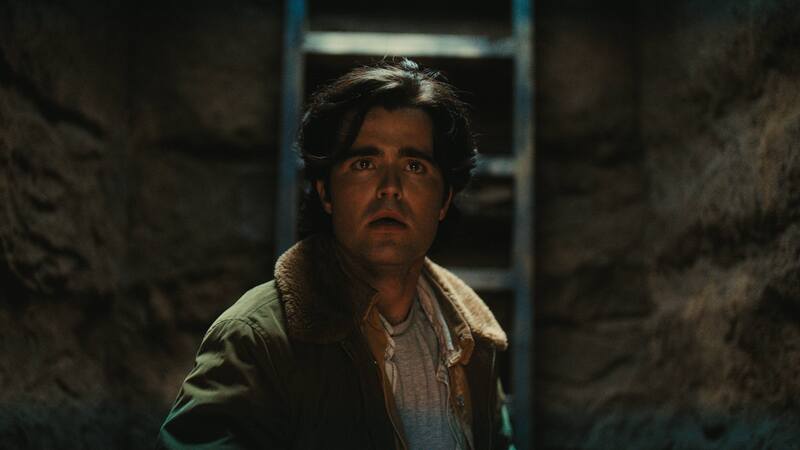
Escape Isn’t Part of the Rules
You Can't Leave
MOVIE REVIEW
You Can't Leave
 -
- 

Genre: Supernatural Horror, Thriller
Year: 2026
Runtime: 1h 32m
Director: Scott Windhauser
Writer: Scott Windhauser
Cast: Spencer Boldman, Paola Andino, Taylor Murphy, Cameron Inman, Thomas Bauer
Where to Watch: in theaters October 16, 2026
RAVING REVIEW: The most effective thing YOU CAN'T LEAVE does is contained right there in its title. Once James and his friends enter the woods looking for answers about his missing sister, the question isn't simply what's hiding out there with them. It's whether the place itself has already decided they're not going anywhere.
Scott Windhauser builds the movie around that sense of confinement even though most of it takes place outdoors. That's a smart contradiction. Forests usually represent open space, but here the trees begin to feel like walls, paths become unreliable, and distance stops meaning much when every attempt to move forward seems capable of folding the group back toward the same danger.
Spencer Boldman plays James with enough urgency to keep the search personal rather than turning it into an excuse for a group of friends to wander into obviously bad territory. He's chasing information about his sister's disappearance, which gives him a reason to keep pushing after everyone else has enough evidence to turn around. That motivation also creates some necessary friction because what feels essential to James can look increasingly reckless to the people following him.
Paola Andino gives Olivia a more grounded presence beside him. The movie needs someone capable of questioning what James is doing without becoming the character who repeatedly tells everyone to leave, and Andino handles that balance well. Her reactions often sell the supernatural elements because she responds like someone trying to understand an impossible situation rather than someone waiting for the next horror beat.
The setup is familiar enough that Windhauser has to fight against recognition almost immediately. A missing person, a remote forest, an abandoned cabin, and a group of young adults encountering something ancient could describe dozens of horror movies. YOU CAN'T LEAVE gets more interesting once it stops relying on those individual ingredients and begins explaining how they connect.
The idea of a supernatural prison is the strongest part of that construction. This isn't simply a haunted location where something attacks anyone unlucky enough to enter. The boundaries themselves become part of the threat, which changes how the characters have to think about survival. Running away means very little when you can't trust where running will take you.
That gives the middle stretch a fun problem-solving quality. James and the others aren't only trying to avoid the shadowy figures pursuing them; they're trying to understand what the area permits them to do. Horror tends to become more engaging once characters recognize that something has rules, because every discovery can either create an escape route or reveal another way they're trapped.
Windhauser doesn't overcomplicate those rules, although the movie occasionally has the opposite problem. Some of the mythology stays vague long enough that suspense starts turning into confusion, particularly when the characters begin connecting James' sister to what is happening around them. Mystery can carry a story for only so long before withholding information starts feeling like postponement.
The 92-minute runtime helps. YOU CAN'T LEAVE doesn't have enough story to support a two-hour exploration of its mythology, and Windhauser keeps things moving once the group reaches the forest. There are quieter stretches built around distrust and fear, but the movie usually understands when it's time to put the characters back in motion.
The shadow entities are most effective when they're kept partially obscured. Shapes at the edge of visibility and movement where nothing should be standing generate more unease than clearly explaining every creature in the woods. A simple fear attaches to noticing something in the darkness and realizing it has been watching longer than you've been aware of it.
That restraint doesn't always hold. Once the threat becomes more physically aggressive, some of the atmosphere gives way to straightforward pursuit sequences. They're competently staged and keep the movie moving, but the film is more distinctive when the characters don't fully understand what's happening than when they're simply running from something behind them.
Taylor Murphy, Cameron Inman and Thomas Bauer help keep the group dynamic from becoming anonymous bodies waiting to be separated. There isn't enough time for everyone to develop to the same extent, though, and some characters remain easier to identify by their function within the group than by individual personality. That's one area where the movie's short runtime becomes both an advantage and a limitation.
The psychological side works best through James because guilt and obsession are already built into his reason for entering the forest. His sister isn't just a missing-person case to him; she's an absence he hasn't been able to resolve. The supernatural elements begin exploiting that need for an answer, forcing him to decide how much of what he encounters helps him and how much uses his desperation against him.
That's where YOU CAN'T LEAVE has more potential than its familiar setup initially suggests. The forest isn't frightening merely because people may die there. It's frightening because it seems capable of identifying what someone most wants and using that desire to keep them moving in the wrong direction.
The movie could push that psychological element further. Several sequences suggest each character's experience might become more individually tailored, but the story returns to James quickly enough that some of those possibilities remain underdeveloped. A more aggressive use of the characters' personal fears could've made the supernatural prison feel even more specific and unpredictable.
Windhauser is more confident when dealing with physical geography. Repeated landmarks, uncertain routes, and the inability to measure progress give the location a quietly hostile quality. Even before anything openly supernatural happens, there's a growing sense that the normal relationship between direction and distance no longer applies.
That also gives the cabin more purpose than the usual creepy structure in the middle of nowhere. It becomes a fixed point inside a landscape that refuses to behave normally, making it both shelter and evidence that the group hasn't escaped anything. The more familiar it becomes, the worse it feels to see again.
At times, the dialogue becomes too functional, especially when characters need to explain a discovery or argue over their next move. The performances generally keep those exchanges from becoming distracting, but some conversations exist primarily to get information from one side of the group to the other. The horror is stronger when the setting does that communicating instead.
Visually, the film benefits from having been shot around the Dallas area rather than trying to make every forest sequence impossibly picturesque. The woods feel ordinary enough that the supernatural intrusion registers more clearly. Nothing inherently fantastical about where these people are standing makes the gradual realization that normal rules no longer apply more effective.
By the final stretch, YOU CAN'T LEAVE has moved well beyond the simple missing-person search that brought everyone into the woods. The story becomes about whether the answers are worth what James is willing to sacrifice for them, giving the climax more emotional weight than a simple race to the forest's edge.
Not every piece of the mythology lands with equal force, and in places the movie seems more interested in preserving mystery than making its supernatural logic satisfying. The supporting characters could also use more individual definition before the danger starts thinning the group. Those weaknesses keep the film from fully separating itself from the crowded supernatural-woods corner of horror.
There's enough thought behind the trap to keep YOU CAN'T LEAVE from feeling interchangeable. Windhauser understands that a frightening place becomes considerably worse once the characters realize leaving isn't simply difficult but potentially impossible. It's a compact supernatural thriller with a good central idea, a committed lead performance, and enough unsettling imagery to make wandering into these woods feel like a decision nobody should make twice.
Please visit https://linktr.ee/overlyhonestr for more reviews.
You can follow me on Letterboxd, Instagram, Twitter, and YouTube. You can also find my social media accounts on most platforms by searching for 'Overly Honest Reviews'.
I’m always happy to hear from my readers; please don't hesitate to say hello or send me any questions about movies.
[photo courtesy of BRAND STORY MEDIA, FORZA PARTNERS, GUILDER CINEMA GROUP]
DISCLAIMER:
At Overly Honest Movie Reviews, we value honesty and transparency. Occasionally, we receive complimentary items for review, including DVDs, Blu-rays, CDs, Vinyl Records, Books, and more. We assure you these arrangements do not influence our reviews, as we are committed to unbiased, sincere evaluations. We aim to help you make informed entertainment choices regardless of our relationship with distributors or producers.
Amazon Affiliate Links:
This site also contains Amazon affiliate links. If you purchase through these links, we may receive a commission. This affiliate arrangement does not affect our commitment to honest reviews and helps support our site. We appreciate your trust and support as you navigate these links.
