The Moment Safety Evaporates
Staring Contest
MOVIE REVIEWS
Staring Contest
 -
- 
Genre: Animation, Short
Year Released: 2026
Runtime: 1m 39s
Director(s): Courtney Sposato
Writer(s): Courtney Sposato
Where to Watch: shown at the 2026 Slamdance Film Festival
RAVING REVIEW: What happens to innocence when those in control no longer recognize it? STARRING CONTEST doesn’t frame that question through dialogue or exhibition; it lets it unfold in silence, trusting the viewer to feel the shift rather than having it explained. In just 99 seconds, the film constructs a space that feels harmless, then quietly dismantles it to an absolutely devastating effect.
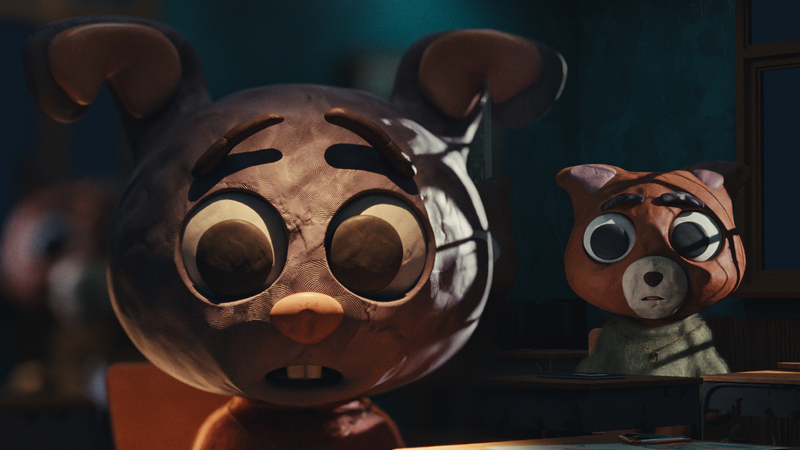
The opening is simple, showing two children locked in a staring contest inside a classroom. The animation is a light-hearted, claymation-style, inviting, and playful. The cadence is gentle, and the stakes seem genuinely small. But there’s a subtle imbalance embedded in the image from the beginning. One child is not like the others. No one comments on it. No one reacts. The film doesn’t underline the difference because it doesn’t need to. The difference simply exists. That restraint is crucial. The classroom feels neutral, even safe. It reflects a version of society that insists it treats everyone equally, that rules apply evenly, and that childhood is protected. The staring contest becomes a metaphor for belonging, for endurance, for the quiet competition of assimilation. Hold steady. Don’t blink. Prove you deserve to stay.
When unshown figures enter the room, the entire emotional wave shifts. The game becomes irrelevant. The rules evaporate. Nothing about our focus changes, but the system surrounding everything does. The surrounding children remain seated. There’s no accusation, no disruption, no wrongdoing presented. The change isn’t framed as a consequence; it’s framed as inevitable.
That distinction matters. The film isn’t exploring misconduct. It’s examining how power operates when it doesn’t need justification. By avoiding dialogue, it avoids debate. There’s no rhetorical cover, no policy, no comforting euphemisms. The action speaks for itself, and the silence surrounding it mirrors the silence that often follows in the real world. As director Courtney Sposato mentions in her director’s statement, “...in what world should a five-year-old know about active shooter drills, or ICE raids?”
What makes STARRING CONTEST so unsettling is how deliberately innocent its surface remains even as the meaning of it all darkens. The animation style is soft, rounded, and approachable, evoking early childhood programming rather than satire or provocation. The classroom feels designed to reassure the audience. Nothing visually prepares the viewer for rupture and break in silence. That aesthetic choice isn’t neutral. It’s the film’s most focused weapon. By refusing to escalate when the emotional stakes escalate, the short mirrors how real-world harm often hides behind familiar environments and bureaucratic calm. Violence often presents itself with an unnerving calm, leading to menace; it arrives wearing normality.
The children are presented to us as animals, which helps to soften the tone even further; they aren’t shown as victims in distress. That constraint forces the viewer to confront the disconnect between what is happening and how it’s presented. The result is cognitive whiplash. The mind recognizes the imagery as harmless, while the body reacts with overwhelming dread. That tension is the experience. It reflects how systems that claim order and safety can enact cruelty without raising their voices, especially when the targets are expected to remain quiet, compliant, and grateful for inclusion until the moment they are no longer allowed to exist in that space.
By choosing animation, the film doesn’t distance itself from reality; it exposes it. The abstraction removes excuses. There’s no debating intent or misunderstanding motive. The act is clear. The setting is familiar. The harm is undeniable. STARRING CONTEST understands that innocence isn’t a shield against perceived power. Using animals instead of people isn’t a softening device. It strips away reactions. With only two identities attached to the characters, the audience is forced to confront the structure rather than individual circumstances. The rabbit isn’t coded as criminal or defiant. They’re simply present, and that’s enough.
The brilliance of STARRING CONTEST lies in how it compresses systemic violence into an everyday moment without exaggeration. The classroom doesn’t explode into chaos. No one screams. The moment in time is procedural and almost routine. That’s what makes it so absolutely devastating. Harm doesn’t always present itself with theatrics. Sometimes it walks in, decides who belongs, and leaves without explanation.
Calling this “just” an animated short misses the point entirely. Animation here functions as a distillation. Every line, every color, every movement is intentional. The film's brevity intensifies its impact rather than limiting it. There’s no filler. The film moves from normalcy to fracture in seconds, mirroring how quickly stability can disappear when power shifts its gaze.
A five-star rating isn’t about scale; it’s about precision and resonance. STARRING CONTEST achieves both. It understands that childhood settings don’t neutralize political realities. It understands that systems don’t need volume to exert force. And it understands that sometimes the most honest way to depict injustice is to show it happening quietly, without commentary, and let the viewer sit with what that quiet really means. At 99 seconds, it hits like a warning. Not because it’s loud, but because it’s honest.
[photo courtesy of HOUNDSTOOTH STUDIOS]
DISCLAIMER:
At Overly Honest Movie Reviews, we value honesty and transparency. Occasionally, we receive complimentary items for review, including DVDs, Blu-rays, CDs, Vinyl Records, Books, and more. We assure you that these arrangements do not influence our reviews, as we are committed to providing unbiased and sincere evaluations. We aim to help you make informed entertainment choices regardless of our relationship with distributors or producers.
Amazon Affiliate Links:
Additionally, this site contains Amazon affiliate links. If you purchase through these links, we may receive a commission. This affiliate arrangement does not affect our commitment to honest reviews and helps support our site. We appreciate your trust and support as you navigate these links.
