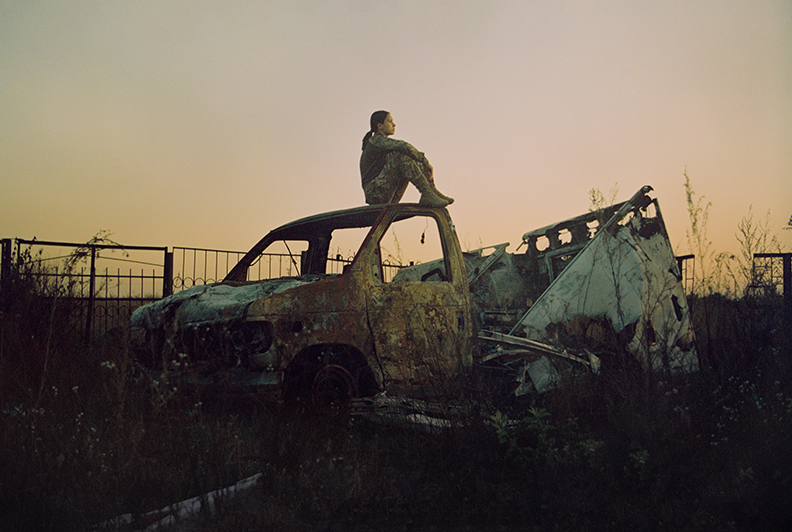
Dreams Under Drone Shadows
Mariinka
MOVIE REVIEWS
Mariinka
 -
- 

Genre: Documentary
Year Released: 2026
Runtime: 1h 34m
Director(s): Pieter-Jan De Pue
Where to Watch: shown at the 2026 Copenhagen International Documentary Festival (CPH:DOX)
RAVING REVIEW: MARIINKA doesn’t open with the expected invasion footage or tragic headlines. It begins in the quiet before the world started paying attention. Pieter-Jan De Pue’s documentary looks at Eastern Ukraine not from the vantage point of geopolitics, but from the ground level of adolescence. Before the full-scale invasion dominated global coverage, there were already young lives being shaped, fractured, and hardened by a war that refused to end.
Shot over nine years on 16mm, MARIINKA carries the texture of time in its grain. The visual style here matters more than you might think. The film doesn’t feel disposable; it feels weathered. That quality mirrors the town itself, scarred, fragile, and still standing. An experience that will likely live on for generations as a tale of humanity at the core of horror.
De Pue, whose earlier documentary THE LAND OF THE ENLIGHTENED also blended almost poetic imagery with conflict zones, again finds a way to make devastation feel intimate rather than abstract. Instead of centering on generals or politicians, he follows young Ukrainians navigating adolescence under constant instability. A boxer with championship ambitions trains while treating wounded soldiers. A young girl smuggles goods between territories, refusing to let checkpoints define her world. Families fracture along ideological and territorial lines.
The documentary’s greatest strength is its patience. War documentaries often move quickly, racing from crisis to crisis. MARIINKA allows the story to sit and to overtake the experience of watching the real-life repercussions. It allows moments of stillness to breathe. Teenagers laugh. They flirt. They dream. Then a distant explosion reminds you that none of this is normal. I think that’s one of the most tragic yet beautiful aspects of this film. Speaking from a place of privilege, I don’t know what it’s like to try to live life while the world is literally being destroyed just miles from me. There’s a resilience in these subjects, and a necessity that speaks louder than anything they say on camera. They don’t just exist; they exist while battling for their existence.
Because the film spans nearly a decade of footage, you witness change in real time. Faces age. Confidence shifts. The optimism of early scenes slowly gives way to something more guarded. That linear perspective gives the film emotional weight that shorter production timelines simply can’t replicate. The decision to focus on youth is deliberate and effective. War is usually documented through its most violent moments. Here, the emphasis is on endurance. What does it mean to grow up when your baseline reality includes artillery and displacement? How do aspirations survive when the future feels conditional?
De Pue doesn’t editorialize. He trusts observation. Conversations unfold organically. There’s no heavy-handed narration guiding you toward a hypothesis. The film invites reflection instead of dictating it. That restraint makes the moments of raw emotion land harder.
Visually, the 16mm cinematography creates a sense of fragile beauty, sunlight over damaged buildings. Snow falling across abandoned streets. Intimate close-ups of young faces caught between defiance and exhaustion. The aesthetic choice elevates the material without romanticizing it. This isn’t misery framed in elegance. It’s resilience framed honestly.
Because the film follows multiple subjects over a long period, the narrative doesn’t always feel as well-defined as in a traditional documentary. Some arcs fade in and out rather than culminating in a clear resolution. For viewers expecting a tightly plotted progression, the film’s observational style may feel diffuse. Yet that lack of clean closure feels appropriate. The war hasn’t resolved. The town hasn’t healed. Why should the film offer conclusions?
There’s a quiet power in how MARIINKA reframes the timeline of the conflict. For many international audiences, Ukraine entered consciousness on this level in 2022. This documentary insists that the story began long before that moment. By anchoring us in personal histories rather than news cycles, it challenges the idea that global awareness equals beginning. One of the most powerful aspects of the film is how it shows what these people have been dealing with before the average person knew there was fear in the hearts of an entire population.
Emotionally, the film avoids sensationalism. There are no manipulative crescendos. The heartbreak comes from cumulative exposure. Watching children adapt to danger as routine is more devastating than any single explosion. Watching ambition persist in the face of uncertainty feels quietly heroic. MARIINKA isn’t focused as an easy watch, but it is a necessary one. It reminds viewers that prolonged conflict doesn’t just destroy infrastructure; it rewires identity. It reshapes what normal looks like. And it does so without losing sight of humanity. In a landscape saturated with war coverage, this documentary distinguishes itself through intimacy and duration. It doesn’t aim to shock. It aims to bear witness.
Please visit https://linktr.ee/overlyhonestr for more reviews.
You can follow me on Letterboxd, Instagram, Twitter, and YouTube. My social media accounts can also be found on most platforms by searching for 'Overly Honest Reviews'.
I’m always happy to hear from my readers; please don't hesitate to say hello or send me any questions about movies.
[photo courtesy of FILMS BOUTIQUE, BEETZ BROTHERS FILM PRODUCTION, DARK RIVIERA, NAOKO FILMS, SAVAGE FILM, SHELTER PROD, SUBMARINE SUBLIME, UNITÉ DOCUMENTAIRE RTBF-LIÈGE, VPRO, ZDF/ARTE, THE PR FACTORY]
DISCLAIMER:
At Overly Honest Movie Reviews, we value honesty and transparency. Occasionally, we receive complimentary items for review, including DVDs, Blu-rays, CDs, Vinyl Records, Books, and more. We assure you that these arrangements do not influence our reviews, as we are committed to providing unbiased and sincere evaluations. We aim to help you make informed entertainment choices regardless of our relationship with distributors or producers.
Amazon Affiliate Links:
Additionally, this site contains Amazon affiliate links. If you purchase through these links, we may receive a commission. This affiliate arrangement does not affect our commitment to honest reviews and helps support our site. We appreciate your trust and support as you navigate these links.
