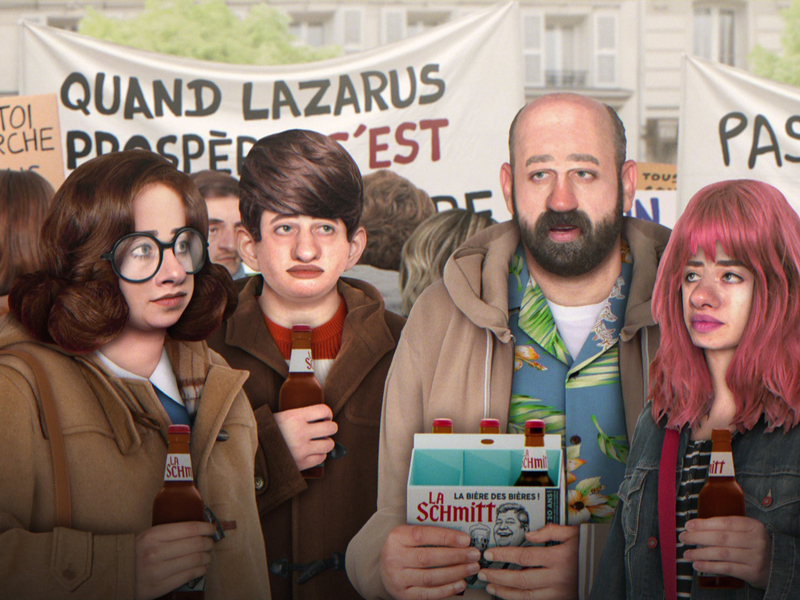
When Saying Yes Finally Breaks Something
Blaise
MOVIE REVIEW
Blaise
 -
- 

Genre: Drama, Coming-of-age
Year Released: 2026
Runtime: 1h 22m
Director(s): Jean-Paul Guigue, Dimitri Planchon
Writer(s): Dimitri Planchon
Cast: Nina Blanc-Francard, Léa Drucker, Jacques Gamblin
Where to Watch: shown at the 2026 Cannes Film Festival
RAVING REVIEW: BLAISE doesn’t start with a big moment or a clear turning point. It starts with someone who’s gotten so used to saying yes that it barely registers anymore. That pattern isn’t framed as a flaw right away; it’s just how he is, keeping things easy, keeping things quiet. The shift comes later, and when it does, it doesn’t feel like growth at first. It feels like a disruption.
What makes this story work is its refusal to treat this as a grand, cinematic shift. Blaise isn’t framed as someone destined for rebellion. He’s just a kid who has spent his entire life agreeing, blending in, and avoiding friction. When that pattern finally breaks, it turns chaotic and comes out messy, impulsive, and a little reckless, which feels far more honest than the usual coming-of-age transformation.
Nina Blanc-Francard carries that shift with a voice performance that stays grounded even as the character begins to spiral outward. There’s no sudden reinvention here, no transition into a new identity. Instead, every decision Blaise makes feels like it’s still tethered to the version of himself he’s trying to escape. That internal conflict never disappears, and the film is stronger for letting it sit rather than resolving it.
Around him, the family dynamic adds a different kind of instability. Léa Drucker’s Carole is chasing validation in a way that mirrors Blaise, but from a completely different angle. Her attempts to reshape how others see her don’t come across as manipulative or shallow. They feel desperate in a quieter, more controlled way. There’s a sense that she’s constantly recalibrating herself depending on who’s in front of her, which creates a subtle but consistent tension in every interaction.
Jacques Gamblin brings a different experience as Jacques, someone who seems more focused on external respect than internal reflection. His presence doesn’t dominate scenes, but it doesn’t need to. There’s a rigidity to the character that contrasts sharply with Blaise’s internal uncertainty and Carole’s constant adjustments. That contrast helps define the film's emotional space without ever becoming overly confrontational.
What’s especially effective is how the film lets these three arcs run alongside each other without forcing them into direct collision points. There are overlaps, moments where their struggles brush against one another, but BLAISE resists the urge to stage everything as a dramatic confrontation. Instead, it allows the disconnect between them to speak for itself, which ends up feeling more revealing than any single argument could.
The pacing follows that same philosophy. At 82 minutes, it never overstays its welcome, but it also doesn’t rush through its ideas. Scenes are given just enough room to breathe, even when they feel slightly uncomfortable or unresolved. That willingness to sit in those moments works in the film’s favor most of the time.
The film maintains a strong sense of identity. It doesn’t rely on dramatic twists or heightened storytelling to make its point. Instead, it builds meaning through behavior, through the way characters speak to each other, and through the choices they avoid as much as the ones they make. That approach gives the story a natural rhythm that feels consistent from beginning to end.
The relationship that pushes Blaise toward change is handled with a similar level of restraint. It isn’t framed as a sweeping, life-altering romance. It’s more direct, more uncertain, and at times a little impulsive. That choice keeps the film leveled, even as Blaise starts making decisions that feel increasingly out of character. The connection works less as a fully developed relationship and more as a catalyst, which fits the film’s focus on internal change rather than external resolution.
By the time the story reaches its conclusion, it doesn’t offer a clean sense of closure, and that feels intentional. The film isn’t interested in tying everything together or presenting growth as something that can be neatly defined. Instead, it leaves its characters in a place that suggests movement rather than completion. There’s a sense that something has shifted, even if it’s not entirely clear what that shift will lead to.
BLAISE works because it trusts its characters enough to let them exist without forcing them into simple arcs or conclusions. It understands that change rarely looks clean in the moment, and it builds its story around that idea rather than trying to reshape it into something more conventional. It doesn’t hit every note perfectly, and there are areas where it could push further, but the foundation is strong enough that those gaps don’t undermine the overall experience.
There’s no attempt to redefine the genre or deliver something overly stylized. Instead, BLAISE finds its impact in smaller, more personal moments, the kind that don’t announce themselves but stay with you anyway. And yes, I intentionally avoided talking about the film's defining characteristic, because there’s something remarkably powerful here, the film itself, the story, the characters' interactions, all carry the film in a way that you wouldn’t normally associate with this style. I want people to go into it without judging it based on that.
Please visit https://linktr.ee/overlyhonestr for more reviews.
You can follow me on Letterboxd, Instagram, Twitter, and YouTube. My social media accounts can also be found on most platforms by searching for 'Overly Honest Reviews'.
I’m always happy to hear from my readers; please don't hesitate to say hello or send me any questions about movies.
[photo courtesy of KG PRODUCTIONS, BEST FRIEND FOREVER, THE PR FACTORY]
DISCLAIMER:
At Overly Honest Movie Reviews, we value honesty and transparency. Occasionally, we receive complimentary items for review, including DVDs, Blu-rays, CDs, Vinyl Records, Books, and more. We assure you that these arrangements do not influence our reviews, as we are committed to providing unbiased and sincere evaluations. We aim to help you make informed entertainment choices regardless of our relationship with distributors or producers.
Amazon Affiliate Links:
Additionally, this site contains Amazon affiliate links. If you purchase through these links, we may receive a commission. This affiliate arrangement does not affect our commitment to honest reviews and helps support our site. We appreciate your trust and support as you navigate these links.
