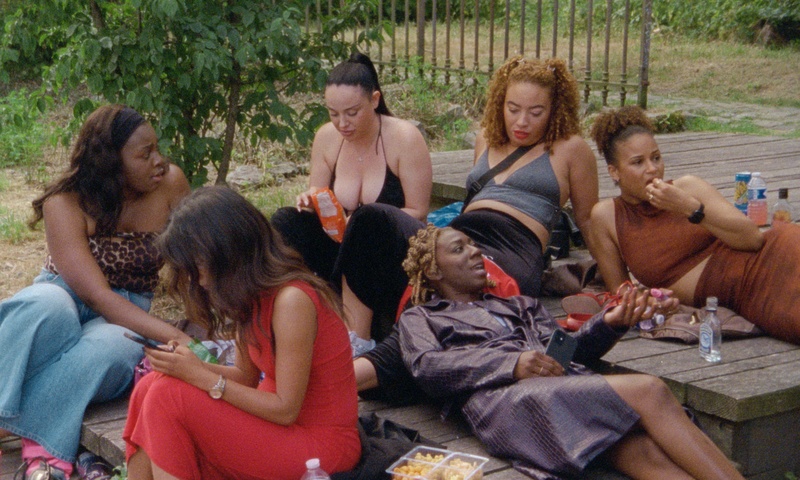
A Sharp Portrait of Survival and Self-Destruction
Shana
MOVIE REVIEW
Shana
 -
- 

Genre: Drama
Year Released: 2026
Runtime: 1h 20m
Director(s): Lila Pinell
Writer(s): Lila Pinell
Cast: Eva Huault, Noémie Lvovsky, Inès Gherib, Anaïs Monah, Sékouba Doucouré, Bettina de Van
Where to Watch: shown at the 2026 Cannes Film Festival
RAVING REVIEW: There’s a frantic kind of momentum running through SHANA that almost feels self-destructive. The film rarely pauses long enough for its lead to process what’s happening around her before another responsibility, argument, humiliation, or emotional collision arrives to knock her sideways again. That constant motion becomes the film’s identity. The film's writer/director, Lila Pinell, doesn’t frame Shana as somebody searching for herself. She frames her as somebody trying to stay upright while life keeps changing direction beneath her feet.
What makes that approach work is how little the movie romanticizes instability. A lesser version of this story could’ve easily turned its protagonist into a quirky symbol of chaos, defined solely by eccentricity and impulsive charm. SHANA avoids that trap almost entirely. Even when the film leans into dark humor or heightened coincidence, there’s always a bruised reality underneath it. The bad decisions carry consequences. The toxic relationships leave damage. Family tensions linger long after conversations end.
Eva Huault gives the kind of performance that holds all those twists together. She has an immediacy that makes the film feel less scripted, even during moments where the narrative deliberately drifts into something more mythic. Huault never plays Shana as a victim, but she also never hides how trapped the character feels, unable to escape. There’s stubbornness in her, but also fear, denial, anger, and exhaustion. Pinell allows all of those contradictions to coexist without sanding them down into something cleaner or easier to explain.
The relationship between Pinell and Huault becomes even more fascinating once you understand the history behind the project. Pinell first filmed Huault as a child during a documentary shoot years earlier, and that familiarity bleeds into the movie’s texture in ways that feel impossible to fake. SHANA doesn’t approach it from a distance. The film feels attuned to her behavior, her physicality, her sense of humor, and even the way she occupies silence. That intimacy gives the movie a looseness that keeps it alive even when the structure occasionally threatens to spiral outward.
What’s especially striking is how comfortably the film shifts between realism and something unknown. The inherited ring could’ve become a heavy-handed metaphor or an overexplained supernatural device, but Pinell uses it more like an emotional amplifier. It sits in the background of the film like a question nobody can answer. Is Shana cursed? Is she sabotaging herself? Is the ring meaningful, or is it simply giving her something to attach her fears to? The movie never locks itself into one interpretation, which keeps the tension alive throughout.
That ambiguity also allows SHANA to explore identity and inheritance without turning into a lecture. The film’s conversations around Jewish identity, generational shame, assimilation, and cultural erasure emerge naturally through character interactions rather than exposition dumps. One of the film’s smartest choices is refusing to simplify those moments into moral binaries. Family members say hurtful things. Contradictory emotions sit side by side. People inherit damage as much as tradition. The film understands how complicated those legacies can become when survival, fear, and assimilation start intertwining over generations.
SHANA can also be funny in ways that catch you off guard. Not sitcom funny, and not ironic in the detached style that many contemporary dramedies default to. The humor comes from personality clashes, escalating discomfort, and the absurdity of trying to maintain dignity while everything around you keeps collapsing. There’s a humanity to those moments that prevents the film from becoming emotionally suffocating.
Noémie Lvovsky brings a presence that helps stabilize parts of the film that intentionally flirt with chaos. Her scenes with Huault carry years of history, even when very little is explicitly stated. You can feel affection, frustration, disappointment, and familiarity all tangled together in the same exchanges. Pinell seems far more interested in emotional residue than dramatic speeches, and those quieter tensions often land harder because of it.
The decision to shoot on 16mm gives the movie an unpredictable texture that suits the story well. The grain softens some of the harsher notes without embellishing the environment into artificial melancholy. Paris feels lived-in here. Not postcard Paris, not hyper-stylized Paris, but a city where different social classes and cultural worlds constantly overlap in uneasy ways. Pinell frequently keeps the camera close to faces and bodies, which creates a sense of claustrophobia while also making the rare moments of openness feel more liberating.
The film’s biggest strength may also become its biggest hurdle for some viewers. SHANA refuses conventional pacing. Scenes sometimes crash into one another abruptly. Narratives seem to disappear and re-emerge later in altered form. Conflicts are deliberately left unresolved because the film is more interested in ongoing behavioral patterns than in catharsis. That gives the movie personality, but it can also create stretches where the momentum threatens to become shapeless.
The film rarely loses its sentimental honesty. That matters because SHANA is ultimately less concerned with plot mechanics than emotional accumulation. By the time the film reaches its closing, the weight of everything Shana has been carrying becomes clearer. Not just toxic relationships or financial pressure, but inherited expectations, buried shame, fear of isolation, and the exhausting performance of appearing functional while quietly unraveling underneath.
Huault’s performance stays with you, and the way Pinell frames survival as something deeply chaotic and unfinished. SHANA never pretends liberation arrives. The film understands that freedom can feel terrifying when dysfunction is the only thing you’ve learned to navigate comfortably. That idea gives the movie a lingering ache that outlasts some of its rougher edges. SHANA carries an unusually personal pulse. It feels handcrafted rather than manufactured, volatile rather than optimized. Even when it stumbles, it does so while reaching for something. That alone makes it difficult to shake.
Please visit https://linktr.ee/overlyhonestr for more reviews.
You can follow me on Letterboxd, Instagram, Twitter, and YouTube. My social media accounts can also be found on most platforms by searching for 'Overly Honest Reviews'.
I’m always happy to hear from my readers; please don't hesitate to say hello or send me any questions about movies.
[photo courtesy of ECCE FILMS, EMMANUEL CHAUMET – CG CINÉMA, CHARLES GILLIBERT, FRANCE 2 CINEMA, LES FILMS DU LOSANGE, THEPRFACTORY]
DISCLAIMER:
At Overly Honest Movie Reviews, we value honesty and transparency. Occasionally, we receive complimentary items for review, including DVDs, Blu-rays, CDs, Vinyl Records, Books, and more. We assure you that these arrangements do not influence our reviews, as we are committed to providing unbiased and sincere evaluations. We aim to help you make informed entertainment choices regardless of our relationship with distributors or producers.
Amazon Affiliate Links:
Additionally, this site contains Amazon affiliate links. If you purchase through these links, we may receive a commission. This affiliate arrangement does not affect our commitment to honest reviews and helps support our site. We appreciate your trust and support as you navigate these links.
