One Screenwriter Against the Entire Production
Backstage Madness (Shermendelik karnavaly)
MOVIE REVIEW
Backstage Madness (Shermendelik karnavaly)
 -
- 


Genre: Comedy, Crime
Year Released: 2025, 2026
Runtime: 1h 19m
Director(s): Amanbek Azhymat
Writer(s): Amanbek Azhymat
Cast: Adyl Bolorbek, Kural Chokoev, Eldiyar Jarashev, Erbol Ruslanov, Bolot Tileberdiev
Where to Watch: shown at the 2026 Fantasia Film Festival
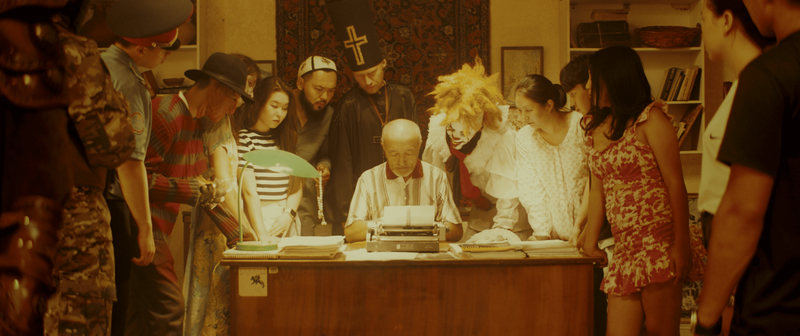
RAVING REVIEW: Every time the screenwriter presses a key, somebody else reaches over to rewrite the page. The producer wants more violence, the investors want deeper roles, the cast wants screen time, and artistic integrity has become the only part of the production nobody can afford. Amanbek Azhymat turns that battle into BACKSTAGE MADNESS, a Kyrgyz comedy that begins with a frustrated writer and gradually mutates into the ungovernable movie forming inside his head. Even after watching this, I still don’t know what to think.
Bolot Tileberdiev plays the unnamed screenwriter as someone whose patience has been worn down without extinguishing his belief in the importance of his work. He sits behind an old typewriter, dreaming of beauty and something worthy of an audience. His producer has a different understanding of cinema. Stories need crime, action, sex, recognizable faces, and enough parts to satisfy everyone connected to the money. The writer’s resistance is treated sympathetically, though Azhymat has enough honesty to recognize the vanity hiding inside his artistic convictions.
The arrangement gives the movie a strong foundation. Every new demand further corrupts the screenplay, forcing another character, genre, or complication into a project already collapsing under its own weight. The producer doesn’t see interference. He sees problem-solving. Investors must remain happy, friends expect favors, and audiences supposedly need constant stimulation. The screenwriter hears each suggestion as another piece of himself being removed.
Azhymat doesn’t present the imagined movie as a separate story. It changes while we watch, absorbing whichever demand or frustration has most recently entered the room. Gangsters, lovers, criminals, abused spouses, armed mail carriers, dubious businesspeople, and assorted opportunists spill into overlapping stories held together by money, violence, and a mysterious briefcase. Characters return in altered roles, and one genre barges into another before either has had time to establish its rules.
That lack of discipline is responsible for much of the fun and nearly all of the frustration that the viewer experiences. BACKSTAGE MADNESS is funniest when a completely unreasonable conclusion follows a reasonable moment. A small casting favor can rearrange an entire plot, while a demand for more excitement leads to an eruption of gunfire or punishment. The escalation captures how collaboration can turn into surrender, one harmless adjustment at a time.
Azhymat uses fictional stories to attack the culture surrounding their creation, including corruption, financial dependency, fragile masculinity, and the ease with which exploitation can be renamed opportunity. Women are subjected to some of the most extreme reversals in the screenwriter’s increasingly violent imagination. Men who expect obedience are met with retaliation so excessive that the encounters become farcical revenge fantasies. The humor isn’t subtle, and the repeated punishment can flatten the social observation beneath it. Even so, the reversals give the movie a pointed experience. Azhymat isn’t reproducing patriarchal power without comment; he’s letting his fictional world revolt against it with whatever object happens to be nearby.
Azhymat and Zhanysh Dadabaev’s editing may be the film’s most important element. The cuts create connections between the writer’s irritation, the producer’s demands, and the consequences unfolding inside. A glance in the office can become an act of violence within the screenplay, while an argument about casting might suddenly produce a new character. The movement between creation and execution makes the entire feature feel like a thought process gaining dangerous independence.
The momentum becomes less reliable once escalation turns into the expected response. After enough shootouts, beatings, misunderstandings, and abrupt genre changes, surprise gives way to accumulation. Some characters remain little more than costumes attached to a joke, which is understandable within the movie’s design but limits how much interest their individual stories can generate. Its Tarantino influence is evident in the posturing, sudden violence, shifting loyalties, and the pleasure taken in letting conversations drift toward confrontation. Azhymat doesn’t merely imitate that style. He also pokes at the kind of filmmaker who mistakes bloodshed, nonlinear storytelling, and eccentric criminals for automatic originality.
Kural Chokoev gives the producer enough charm to prevent him from becoming just a villain. His demands are ridiculous, but they also come from a practical reality the screenwriter would prefer not to confront. A movie without money remains a stack of pages, and a producer incapable of compromise may never produce anything. Chokoev plays him as a man accustomed to treating creative objections as temporary obstacles rather than deeply held beliefs.
Tileberdiev answers that with dignity instead of matching its volume. His screenwriter can appear stubborn, self-important, and disconnected from the realities of production, though the performance keeps returning to the pain beneath those qualities. He isn’t only losing control of a screenplay. He’s watching younger people decide that the values guiding his life are inconvenient leftovers from another era. His typewriter becomes a final territory where he can pretend the choices remain his.
That gives the movie more warmth than its violence and crude humor initially suggest. Beneath the blood, jokes, criminal schemes, and chaotic casting sits a sincere concern for anyone who has watched a personal idea become communal property. Collaboration may improve a project, but it can also reduce an artist to the person responsible for typing everyone else’s instructions. Azhymat never provides a boundary between necessary compromise and creative betrayal because the film industry rarely offers one.
BACKSTAGE MADNESS occasionally becomes the overloaded production it’s making fun of. Too many concepts compete for attention, jokes are pushed past their breaking point, and the anthology structure can feel like several short films fighting over the same running time. Restraint might have sharpened the commentary, although excessive behavior is also the movie’s chosen language. Asking it to behave would risk removing the frustration that gave birth to it.
It’s argumentative, ridiculous, angry, playful, and willing to embarrass itself as it chases an idea. The screenwriter may never create the work he first imagined, but the wreckage tells us more about filmmaking than his untouched version probably could. By the time everyone has added a role, rewritten a scene, and demanded something easier to sell, the disorder has become the most honest part of the production.
Please visit https://linktr.ee/overlyhonestr for more reviews.
You can follow me on Letterboxd, Instagram, Twitter, and YouTube. My social media accounts can also be found on most platforms by searching for 'Overly Honest Reviews'.
I’m always happy to hear from my readers; please don't hesitate to say hello or send me any questions about movies.
DISCLAIMER:
At Overly Honest Movie Reviews, we value honesty and transparency. Occasionally, we receive complimentary items for review, including DVDs, Blu-rays, CDs, Vinyl Records, Books, and more. We assure you that these arrangements do not influence our reviews, as we are committed to providing unbiased and sincere evaluations. We aim to help you make informed entertainment choices regardless of our relationship with distributors or producers.
Amazon Affiliate Links:
Additionally, this site contains Amazon affiliate links. If you purchase through these links, we may receive a commission. This affiliate arrangement does not affect our commitment to honest reviews and helps support our site. We appreciate your trust and support as you navigate these links.
