The Extraordinary Potential of Independent Filmmaking
The Mirror That Consumes You
MOVIE REVIEW
The Mirror That Consumes You
 -


Genre: Experimental, Drama, Horror, Neo-Noir, Short Film
Year: 2026
Runtime: 12m
Director: Gabriella Leonardi
Writer: Gabriella Leonardi
Cast: Gabriella Leonardi, Sheridan Smith
Where to Watch: available now; watch and subscribe here: www.youtube.com
RAVING REVIEW: Sure, money can buy expensive cameras, sets, top-tier lighting, hours with professional editors, and more, but it can't buy imagination and passion. Gabriella Leonardi makes that clear with THE MIRROR THAT CONSUMES YOU, a stunning experimental short that welcomes the arrival of a filmmaker with an incredible amount of imagination. Made with a non-existent production budget, this twelve-minute exploration of beauty norms, identity, ambition, and psychological distress accomplishes what many big-budget productions struggle to do. It has personality, purpose, and a distinctive creative identity. And my god, the visuals! I can't express how impressive the imagery is! If this is what Leonardi and her collaborators can accomplish with virtually no financial resources, I'm incredibly excited to see what they do next.
The story follows an aspiring actress approaching thirty as she questions her appearance, her ambitions, and whether she'll ever meet the expectations placed on her. Leonardi plays “Thing,” who lives in a world where mirrors and screens constantly remind her of everything she believes she's supposed to be. Her desire to pursue acting has become entwined with anxieties about her appearance, creating an uncomfortable relationship between who she is and who she thinks others want to see. Rather than treating this as a conventional narrative about someone struggling with confidence, Leonardi uses experimental filmmaking to convey the psychological experience of living under those pressures. The experience clearly connects to films like THE SUBSTANCE, not as an imitation, but as a parallel in telling a similar story.
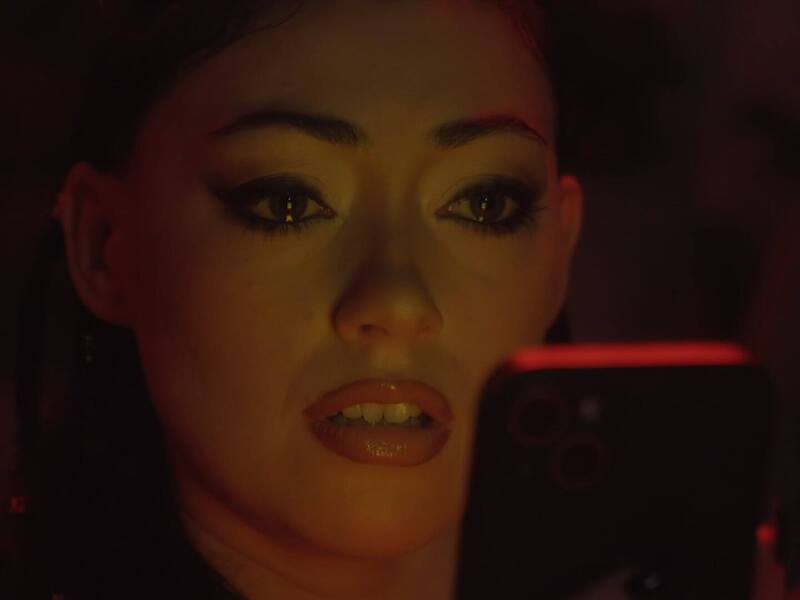
THE MIRROR THAT CONSUMES YOU uses bright lighting, bold colors, reflections, and distorted imagery to communicate feelings that aren't always easy to explain through dialogue. The aesthetic is gorgeous, but the beauty has a purpose beyond simply making the film look good. These images represent a character whose understanding of herself has become increasingly unstable, where appearance can feel more important than identity. This approach lets the film express itself rather than relying on conversations about body image and self-worth.
Cinematographer Ash Connaughton deserves recognition for helping bring that identity to life. The film uses a digital shooting format and a narrower 4:3 aspect ratio, a combination that gives it an almost oppressive quality. That framing fits the boundaries of self-perception, especially when mirrors and screens already play such important roles in the narrative. I love seeing experimental productions embrace color and composition with this much confidence, especially when the imagery is so closely tied to the underlying story.
Leonardi's use of lighting is among the film's most powerful elements. In her director's statement, she says the color red represents body dysmorphia as a character in its own right, turning something almost invisible into a visual presence. That's an incredibly interesting way to approach a condition that can dominate someone's self-perception without always being evident to those around them. By giving that psychological battle a visual identity, Leonardi makes the character's experience more tangible while keeping her storytelling abstract. The use of such striking imagery to represent something associated with emotional suffering also creates a disturbing contradiction. The result is an aesthetic that's beautiful to look at while addressing a subject that can be so painful.
The artistic approach is closely connected to Leonardi's background as a poet, and I think that relationship is essential to understanding the film's personality. Her transition into filmmaking feels like an extension of her poetry rather than a departure from it. Poetry communicates through rhythm, association, impact, and the emotion of carefully selected words. Experimental cinema can accomplish something comparable through scenes, editing, sound, and movement. THE MIRROR THAT CONSUMES YOU brings those disciplines together in a way that makes Leonardi's background an important part of the finished film.
The spoken-word poetry adds to THE MIRROR THAT CONSUMES YOU, bringing Leonardi's writing directly into the film rather than leaving its influences strictly to the visuals. Hearing these thoughts expressed adds intimacy, especially in a story concerned with self-image, insecurity, and the exhausting pressure to meet other people's expectations. The combination of spoken words and experimental imagery gives the film a personality that separates it from psychological drama. It's another reason this debut feels so personal and such an exciting introduction.
I also appreciate that Leonardi isn't treating this as just a question of learning to love yourself. The pressures surrounding appearance are connected to her career aspirations, her age, and the constant awareness that an audience might judge her according to standards she doesn’t get to control. For an actress, those concerns carry deep implications. The entertainment industry has long scrutinized women's appearances, attached expectations to youth, and treated attractiveness as something that can determine a person's worth. Approaching thirty shouldn't feel like a terrifying expiration date, yet the pressure to stay young and “attractive” remains so embedded in the culture of performance and celebrity.
The film also speaks to an issue that extends far beyond acting. Social media has made this an ordinary part of everyday life, with filters, editing, and carefully curated shots creating standards that have little to do with reality. People aren’t just comparing themselves to celebrities; they compare themselves to perfected versions of friends, strangers, and even themselves. When an image can be altered endlessly, dissatisfaction can become a cycle of adjustments and comparisons. Leonardi's focus on mirrors and screens ties it all together, emphasizing how the technology we use to show ourselves to the world can shape how we understand our own look.
Body dysmorphic disorder is a serious mental health condition rather than some interchangeable term for insecurity, and I appreciate that Leonardi approaches the subject through uncertainty instead of presenting answers to everything. In her director's statement, she raises questions about body dysmorphia, eating disorders, and the influence of an ever-growing appearance-obsessed world. Those questions aren't mutually exclusive, and the experience doesn't need a single explanation to make sense. The Body Dysmorphic Disorder Foundation estimates that approximately one in fifty adults lives with the condition, although stigma and shame may contribute to a drastic underreporting.
Leonardi's involvement as writer, director, producer, and lead actor adds another dimension to the project. Wearing so many hats in one production, particularly as a first-time director, involves considerable creative responsibility. It also gives her direct control over how her ideas are expressed. Thing is a character whose anxieties stem from her own, and Leonardi explains that the story draws on her lived experience. She isn't dramatizing the subject from a distance. She approaches it through experiences that have shaped her perspective, using filmmaking to translate those concerns into something others can recognize and discuss.
Sheridan Smith's participation is an intriguing addition to the production. She portrays the Doctor, and she joined through a connection with Leonardi, whose work she had followed and supported. According to Leonardi, Smith agreed to participate without payment, an extraordinary gesture for an independent production relying on the generosity of its collaborators. I love seeing established performers support emerging filmmakers this way!
Leonardi describes the film as having literally no budget, with performers and crew members volunteering their skill sets to bring the project to life. What impresses me is the commitment of people who believed enough in the idea to contribute their time and expertise. The finished production reflects a creative team working toward a shared goal, and I'd love to see what that same enthusiasm could accomplish with the financial support these artists deserve.
THE MIRROR THAT CONSUMES YOU represents the beginning of Damaged Soul Productions, the company Leonardi founded to develop work across film, television, and poetry. That makes this debut even more interesting because it isn't simply an isolated short created to experiment with directing.
Leonardi's has already demonstrated an interest in combining the psychological with expressive visual storytelling, but that doesn't mean her future projects need to follow the same direction. Her writing background, interest in character-driven storytelling, and willingness to experiment give her endless creative directions to pursue. Damaged Soul Productions' next project, PHOSPHENES, is planned as a twenty-five-minute proof of concept for a potential feature. I can't wait to see how Leonardi handles a longer runtime and a new story, especially after establishing such a confident creative foundation with her first directing effort. There’s a difference between being artsy, just to be artsy, and being artsy with a message. I’ve truly been blown away by the potential here.
This offers an encouraging lesson for filmmakers without access to traditional industry resources. Independent cinema has always benefited from people willing to experiment, collaborate, and challenge assumptions about what makes a worthy production. Leonardi shows that understanding a project matters as much as experience and money. The results aren't impressive because the budget was nonexistent. They're impressive because the people involved brought creativity and endless passion to a message they cared about.
I keep coming back to the visuals because they represent exactly the kind of filmmaking I love discovering in smaller productions. Too often, discussions about low-budget filmmaking focus almost exclusively on what the creators couldn't afford. THE MIRROR THAT CONSUMES YOU shifts that conversation toward what imagination, collaboration, artistic determination, tinfoil, and a spray bottle can accomplish. Its neon-lit imagery, symbolic use of color, and psychological subject matter create a memorable, purposeful aesthetic. For a twelve-minute short to inspire this much enthusiasm about the filmmaker's future is an achievement worth celebrating.
More than anything, I'm thrilled by the promise Gabriella Leonardi and this incredibly talented team represent. THE MIRROR THAT CONSUMES YOU tackles a difficult topic with imagination, personal conviction, and an artistic identity that makes it stand apart. Its creation reminds us that extraordinary ideas aren't reserved for filmmakers with enormous budgets or endless established industry connections. Leonardi has taken her first step behind the camera, and she's already given me a reason to pay attention to whatever comes next. If this is the beginning, I want a front-row seat for the rest of the journey.
Please visit https://linktr.ee/overlyhonestr for more reviews.
Follow me on Letterboxd, Instagram, Twitter, and YouTube. You can also find my social media accounts on most platforms by searching for 'Overly Honest Reviews'.
I’m always happy to hear from my readers; please don't hesitate to say hello or send me any movie questions.
[photo courtesy of DAMAGED SOUL PRODUCTIONS]
DISCLAIMER:
At Overly Honest Movie Reviews, we value honesty and transparency. Occasionally, we receive complimentary items for review, including DVDs, Blu-rays, CDs, Vinyl Records, Books, and more. We assure you these arrangements do not influence our reviews, as we are committed to unbiased, sincere evaluations. We aim to help you make informed entertainment choices regardless of our relationship with distributors or producers.
Amazon Affiliate Links:
This site also contains Amazon affiliate links. If you purchase through these links, we may receive a commission. This affiliate arrangement does not affect our commitment to honest reviews and helps support our site. We appreciate your trust and support as you navigate these links.
