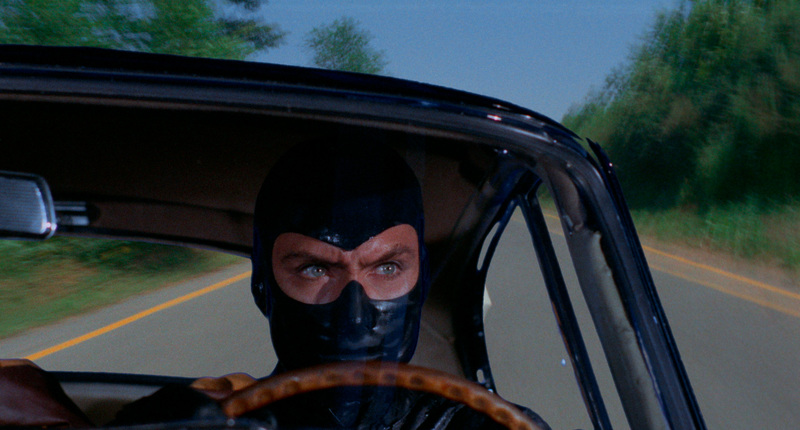
Anti-Establishment Energy Wrapped in Sleaze
Read Time:5 Minute, 51 Second
MOVIE REVIEW
Danger: Diabolik
 –
– 

Genre: Crime, Comic-Book Adaptation, Thriller
Year Released: 1968, Eureka Entertainment 4K 2026
Runtime: 1h 40m
Director(s): Mario Bava
Writer(s): Angela Giussani, Luciana Giussani, Dino Maiuri, Brian Degas, Tudor Gates, Mario Bava
Cast: John Phillip Law, Marisa Mell, Michel Piccoli, Adolfo Celi, Terry-Thomas
Where to Watch: available now, order your copy here: www.eurekavideo.co.uk
RAVING REVIEW: DANGER: DIABOLIK doesn’t ease into the experience, and it shouldn’t. It never adjusts its approach, which is exactly why it works. There’s no attempt to ground the story, no effort to build a relatable entry point, and no concern for traditional pacing. It’s built on a single idea, style over everything, and instead of trying to balance it out, it pushes as far as it can go, and then goes a step further.
The structure reflects that choice. This isn’t a film that builds tension in the ways you would expect. It doesn’t escalate toward a final confrontation or develop its stakes in layers. Instead, it moves from one heist to the next, each one designed to top the last in scale and presentation. The result feels less like a continuous narrative and more like a sequence of set pieces connected by a shared tone. That could easily feel disjointed, but here it creates a rhythm that stays consistent from beginning to end.
What makes that approach really work is the film's complete commitment to its character. Diabolik isn’t written as an antihero in the modern sense; there’s no attempt to soften him or justify his actions. He’s a criminal, and the film treats that as a given rather than a problem to solve. He doesn’t struggle, he doesn’t doubt, and he doesn’t lose control of a situation. Everything around him is something to manipulate, not survive. That lack of vulnerability changes how the film operates. Instead of watching someone overcome obstacles, you’re watching someone eliminate them before they matter.
John Phillip Law leans into that by keeping the performance restrained. There’s no excess in how he plays the role, which works in contrast to everything happening around him. The character doesn’t need to project personality in the usual way because the film builds his presence through control. Every movement feels deliberate, every decision feels pre-planned, and that consistency carries more weight than any attempt at emotional depth would have.
Eva Kant is just as locked in. There’s no imbalance between them, no attempt to create friction or conflict for the sake of drama. They operate on the same wavelength from the start, and the film never disrupts that. It removes a layer of unpredictability while keeping the momentum intact. Nothing is pulling the narrative sideways; everything stays focused on forward movement.
From a visual perspective, the film never lets up. The sets are artificial, the colors are exaggerated, and the compositions are precise to the point where they stop feeling natural. That’s the intention. Nothing is meant to blend into reality. Every frame feels constructed, and that construction becomes part of the experience. The film isn’t trying to convince you that this world exists.
That emphasis on construction isn’t just aesthetic because it changes how the film interacts. Instead of pulling you into the world, it keeps you aware of the design behind it. Backgrounds feel staged, environments feel controlled, the world feels off, and even movement within scenes feels choreographed rather than organic. That distance creates a different kind of engagement. You’re not reacting to realism; you’re responding to composition, color, cadence, and control in a way. It turns the film into something closer to a visual exercise, where the impact comes from how each element is arranged rather than what it represents.
It also reinforces how detached the characters are from their surroundings. Diabolik and Eva don’t operate under the same rules as the rest of the world; they move through spaces built specifically for them. Nothing pushes back against them in a meaningful way because the world itself feels shaped to accommodate their control. That consistency between character and setting keeps the film from feeling scattered, even when the structure is loose. That approach connects directly to its comic book roots. The way scenes are structured, the way movement is framed, even the way space is used, everything feels segmented, like individual panels arranged in sequence. The film doesn’t try to smooth that out into something more cinematic. It leans into it, letting each moment function almost independently before moving on to the next.
That decision defines how the film holds together. Instead of building a traditional arc, it maintains a consistent tone and lets that carry the experience. There’s no shift in direction, no attempt to deepen the story halfway through, and no moment where it tries to become something it isn’t. It stays exactly where it starts. That also means there are clear limitations. There’s no real character development, no real progression, and no sense that anything is changing beneath the surface. The stakes never expand beyond the immediate moment, and once a sequence is over, the film moves on without looking back. If you’re expecting growth or resolution in a conventional sense, it’s not here.
But that’s part of the design. The film isn’t interested in transformation; it’s interested in consistency. It builds a specific experience and commits to it, even if that means leaving certain elements underdeveloped. There’s no hesitation in that choice, and that confidence is what keeps it engaging.
Please visit https://linktr.ee/overlyhonestr for more reviews.
You can follow me on Letterboxd, Instagram, Twitter, and YouTube. My social media accounts can also be found on most platforms by searching for 'Overly Honest Reviews'.
I’m always happy to hear from my readers; please don't hesitate to say hello or send me any questions about movies.
[photo courtesy of EUREKA ENTERTAINMENT]
DISCLAIMER:
At Overly Honest Movie Reviews, we value honesty and transparency. Occasionally, we receive complimentary items for review, including DVDs, Blu-rays, CDs, Vinyl Records, Books, and more. We assure you that these arrangements do not influence our reviews, as we are committed to providing unbiased and sincere evaluations. We aim to help you make informed entertainment choices regardless of our relationship with distributors or producers.
Amazon Affiliate Links:
Additionally, this site contains Amazon affiliate links. If you purchase through these links, we may receive a commission. This affiliate arrangement does not affect our commitment to honest reviews and helps support our site. We appreciate your trust and support as you navigate these links.


Happy
0 %

Sad
0 %

Excited
0 %

Sleepy
0 %

Angry
0 %

Surprise
0 %
 0
0
 0
0


Average Rating