Where Craft Becomes Community
Read Time:5 Minute, 46 Second
MOVIE REVIEW
Fabric
 –
– 

Genre: Documentary Short
Year Released: 2026
Runtime: 23m
Director: Anabelle Marshall
Where to Watch: shown at the 2026 Raindance Film Festival
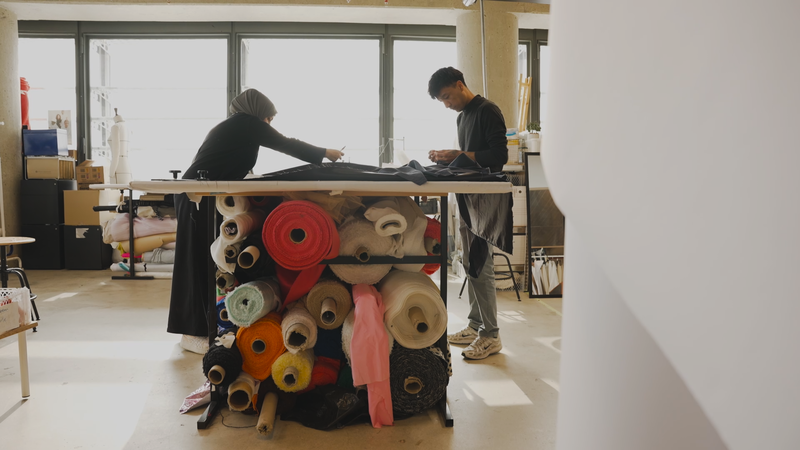
RAVING REVIEW: The most memorable parts of FABRIC aren’t the runway images, though those have their own appeal. The film is at its strongest when it watches hands at work. Measuring, cutting, stitching, adjusting, correcting, because they all become more than technical gestures. They’re evidence of people building their lives through precision, patience, and skill in a world that too often talks about refugees as a problem to be managed rather than as people with talent, ambition, and futures worth investing in.
Anabelle Marshall’s short documentary centers on Espero Atelier, a Paris-based social enterprise that trains refugees and people from marginalized communities in haute couture tailoring. Led by co-founder Maya Persaud, the workshop offers professional training and a path into one of France’s most mythologized industries. The film follows members of the Espero team as they prepare a collection for presentation at the Musée d’Orsay on the eve of Haute Couture Week, placing their work inside a space usually associated with prestige, legacy, and gatekeeping. FABRIC isn’t simply asking for compassion. It’s showing people who belong in the room because their work earns its place there.
The documentary’s strength is its refusal to reduce its subjects to hardship. Their experiences of displacement matter, and the film doesn’t pretend otherwise, but Marshall doesn’t use trauma as the only route to connection. Suad Ahmed Ziad, Sumaiya Ahmadi, Ibrahim Barry, and others are presented as makers, colleagues, and creative people with specific strengths. Their pasts are part of the story, not the whole story. That distinction gives FABRIC a sense of dignity that too many well-meaning documentaries miss.
Persaud emerges as a guiding presence, though Marshall avoids turning the film into a founder profile at the expense of the artisans. Persaud’s background in fashion gives credibility within an industry that can be brutally exclusive, and her belief in practical opportunity gives the film a clear moral stance. Support isn’t treated as charity. It’s infrastructure. Give people training, mentorship, language, community, and access, and the conversation changes from rescue to contribution.
That feels especially valuable because FABRIC arrives at a time when migration is routinely flattened into political shorthand. The film doesn’t argue by shouting over that noise. It answers with evidence of daily life. A workshop, a teacher, a seam, a fitting, a room where people are learning how to make something with care. Marshall’s approach is soft-spoken, but the softness isn’t weakness. It’s a choice to let the work and the people carry the argument without pushing every moment toward a prepackaged emotional reaction.
The appearance of figures like Catherine Brickhill and Sylvain Amic helps widen the documentary’s frame. Brickhill’s connection to major fashion houses and Amic’s role at the Musée d’Orsay give the project a bridge between grassroots training and cultural recognition. The film understands that symbolism can matter when it’s attached to material opportunity. Seeing refugee artisans connected to couture and displayed in a museum space carries a pointed meaning, especially in a country where fashion is bound to national identity.
The runway brings grace and ceremony, but the workshop footage gives the documentary its personality. The camera seems most interested in concentration. The look of someone absorbed in a task, the small corrections that separate an idea from a finished garment, and the way confidence appears gradually through practice.
At 23 minutes, FABRIC moves with purpose and never overstays its welcome, but some of the individual stories could use more breathing room. A few subjects are introduced with enough detail to spark curiosity, then the film has to keep moving toward the showcase. That’s understandable for a short documentary with several people, a major event, and a broader social mission to cover. However, it leaves the impression that a longer version could reveal more about the day-to-day challenges of integration, the demands of couture training, and what happens after the runway fades. There’s also room for a slightly more textured look at the fashion industry itself. FABRIC celebrates the atelier’s role in opening doors. That celebration feels earned, but the film only lightly touches the tension between luxury fashion’s public beauty and its barriers to entry. More attention to that contrast might have given the documentary an extra layer. The people onscreen are helping sustain a tradition that hasn’t always made space for them, and the film gestures toward that irony without exploring it as deeply as it could.
What’s here is sincere, intelligent, beautiful, and moving. Marshall recognizes that belonging isn’t an abstract idea. It can be taught, practiced, hired, mentored, and displayed. It can take shape in a garment made by someone who was never supposed to be welcomed into that world. FABRIC finds its strength in the gap between how refugees are often discussed and what they’re actually doing when given the chance to work, learn, and create.
These artisans aren’t symbols floating through an issue. They’re people doing hard work, gaining confidence, and shaping a place for themselves through discipline and craft. FABRIC may be modest in scope, but its perspective is generous. It looks at couture from the inside out and finds, beneath the beauty of the finished pieces, a stronger story about survival becoming skill and skill becoming a future.
Please visit https://linktr.ee/overlyhonestr for more reviews.
You can follow me on Letterboxd, Instagram, Twitter, and YouTube. My social media accounts can also be found on most platforms by searching for 'Overly Honest Reviews'.
I’m always happy to hear from my readers; please don't hesitate to say hello or send me any questions about movies.
[photo courtesy of TINY CIRCUS PRODUCTIONS]
DISCLAIMER:
At Overly Honest Movie Reviews, we value honesty and transparency. Occasionally, we receive complimentary items for review, including DVDs, Blu-rays, CDs, Vinyl Records, Books, and more. We assure you that these arrangements do not influence our reviews, as we are committed to providing unbiased and sincere evaluations. We aim to help you make informed entertainment choices regardless of our relationship with distributors or producers.
Amazon Affiliate Links:
Additionally, this site contains Amazon affiliate links. If you purchase through these links, we may receive a commission. This affiliate arrangement does not affect our commitment to honest reviews and helps support our site. We appreciate your trust and support as you navigate these links.


Happy
100 %

Sad
0 %

Excited
0 %

Sleepy
0 %

Angry
0 %

Surprise
0 %
 0
0
 0
0



Very in depth article, thank you!
Thank you! It was such a wonderful experience!
As an immigrant myself I really appreciate this documentary. There’s a lot of hidden talent in immigrants that Maya Persaud recognizes and brought to life for the world to enjoy. Thanks
I agree, it was so nice to see the focus where it was!
This commentary has brought to light an amazing/gifted group of people who are shining stars in the world of fashion!! Maya Persaud is to be praised for finding and bringing all this awesome talent together to create beauty into the world of fadhion!!