A Film That Understands the First Year Never Really Ends
Read Time:5 Minute, 22 Second
MOVIE REVIEW
Removal of the Eye
 –
– 


Genre: Comedy, Drama
Year Released: 2024, 2026
Runtime: 1h 33m
Director(s): Artemis Shaw, Prashanth Kamalakanthan
Writer(s): Artemis Shaw, Prashanth Kamalakanthan
Cast: Artemis Shaw, Prashanth Kamalakanthan, Katerina Shaw, Niko Kamalakanthan, Tayarisha Poe
Where to Watch: New York Premiere on February 4, 2026 (Nitehawk Williamsburg), February 5 (Nitehawk Prospect Park), and February 6 (Roxy Cinema), with a Los Angeles Premiere set for February 12 at 2220 Arts, presented by Mezzanine. More dates to follow, check here www.linktr.ee/removie
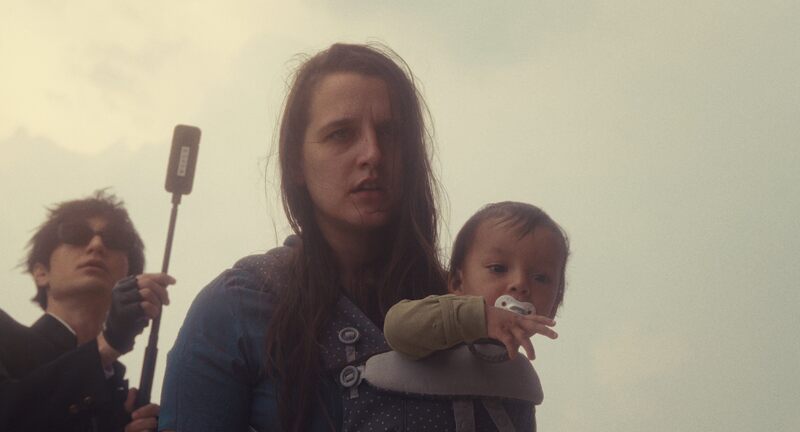
RAVING REVIEW: What happens to a sense of self when every hour of the day becomes organized around keeping another human alive? REMOVAL OF THE EYE begins from that muted panic, not as a conceptual exercise, but as lived reality, captured in real time by filmmakers Artemis Shaw and Prashanth Kamalakanthan as they document the first year of parenthood without the comfort of distance or hindsight. This isn’t a film about learning lessons or arriving with an understanding of clarity. It’s about survival, and the fragile hope that meaning will emerge once the exhaustion lifts.
Shaw and Kamalakanthan play Kallia and Ram, versions of themselves navigating halted careers, creative frustration, and a sleepless infant whose needs to swallow every available resource. Their lives shrink to the size of their Manhattan apartment, an enclosed space that quickly becomes both sanctuary and trap. The film’s tension doesn’t stem from a single crisis, but from the accumulation of missed sleep, unresolved resentment, unspoken fear, and the creeping sense that something has gone wrong, even if no one can articulate what that is.
The titular “eye” enters the story less as a supernatural threat and more as an emotional accelerant. Kallia’s Greek mother, played by Shaw’s real-life mother Katerina Shaw, believes the family has been cursed, and begins quietly attempting to cleanse it. What could be explored as cultural satire instead becomes far more unsettling. The superstition gains power not because the film treats it as fact, but because it offers a structure for anxiety when modern parenting language fails. When sleep consultants, research, and rational reassurance no longer provide relief, belief steps in to fill the void.
What REMOVAL OF THE EYE understands, and expresses with painful clarity, is that parenthood doesn’t simply add responsibility; it destabilizes identity—Kallia’s academic ambitions stall. Ram’s creative pursuits retreat into literal closets. Their relationship isn’t threatened by betrayal or cruelty, but by neglect born of depletion. They are not bad partners or careless parents. They are people running on empty, forced to make decisions while exhausted.
The film’s improvisational approach and stripped-down production are structural necessities. Shot over three months with no professional crew, the film bends to the baby’s schedule, not the other way around. That reality seeps into every frame. Scenes end abruptly. Conversations spiral and stall. Moments of tenderness are undercut by interruption. The film refuses the false measure of convenience, because parenthood itself offers none.
Visually, Kamalakanthan’s cinematography operates on two overlapping conceptual tracks. The first attempts to approximate an infant’s experience of the world, fragmented, distorted, overwhelmed by light and motion. The second reflects Katerina’s impaired visual perception due to her neurological condition. These perspectives don’t just justify the film’s lo-fi textures; they deepen its emotion. Everyone in this household is struggling to see clearly, literally and figuratively, and no single perspective offers authority.
Katerina Shaw’s presence is one of the film’s most affecting elements. Her character is never reduced to a symbol of old-world belief or intrusion. Instead, she becomes a reminder that caregiving doesn’t move in one direction. Aging parents require attention even as new children demand it, and the frameworks for managing that overlap are often incompatible. The film resists judgment here. Katerina’s beliefs are treated as coping mechanisms, shaped by history, displacement, and loss.
The humor in REMOVAL OF THE EYE emerges from recognition. Anyone who has lived through the first year of parenthood will recognize the absurdity of debating philosophical principles at three in the morning, or treating minor mishaps as existential threats. Laughter becomes a release valve, not a goal. Anxiety doesn’t disappear once identified. Conflict doesn’t resolve through conversation alone. REMOVAL OF THE EYE refuses to offer solutions it doesn’t believe in.
In the end, REMOVAL OF THE EYE is a film about the cost of care. Not just the physical labor, but the toll of loving while fearing failure. It’s rough around the edges, sometimes frustrating in its refusal to reassure, but sincere in its commitment to truth. Shaw and Kamalakanthan don’t present themselves as authorities on parenthood, and in doing so, they’ve made a film that feels less like a statement and more like a document, a record of a moment when life contracted, and identities fractured. REMOVAL OF THE EYE doesn’t claim that things will be okay. It simply acknowledges how hard it is to believe that they will be, and sometimes, that’s enough.
Please visit https://linktr.ee/overlyhonestr for more reviews.
You can follow me on Letterboxd, Instagram, Twitter, and YouTube. My social media accounts can also be found on most platforms by searching for 'Overly Honest Reviews'.
I’m always happy to hear from my readers; please don't hesitate to say hello or send me any questions about movies.
[photo courtesy of PARORI PRODUCTIONS]
DISCLAIMER:
At Overly Honest Movie Reviews, we value honesty and transparency. Occasionally, we receive complimentary items for review, including DVDs, Blu-rays, CDs, Vinyl Records, Books, and more. We assure you that these arrangements do not influence our reviews, as we are committed to providing unbiased and sincere evaluations. We aim to help you make informed entertainment choices regardless of our relationship with distributors or producers.
Amazon Affiliate Links:
Additionally, this site contains Amazon affiliate links. If you purchase through these links, we may receive a commission. This affiliate arrangement does not affect our commitment to honest reviews and helps support our site. We appreciate your trust and support as you navigate these links.


Happy
0 %

Sad
0 %

Excited
0 %

Sleepy
0 %

Angry
0 %

Surprise
0 %
 0
0
 0
0

Average Rating