Honor Costs More Than Blood
Read Time:6 Minute, 6 Second
MOVIE REVIEW
Blood Of Revenge [Limited Edition] (Meiji kyokyakuden – sandaime shumei)
 –
– 


Genre: Action, Crime, Drama
Year Released: 1965, Radiance Blu-ray 2026
Runtime: 1h 30m
Director(s): Tai Kato
Writer(s): Gohei Kamiya, Akira Murao, Norifumi Suzuki
Cast: Koji Tsuruta, Sumiko Fuji, Tetsuro Tanba, Masahiko Tsugawa
Where to Watch: available January 27, 2026. Pre-order your copy here: www.radiancefilms.co.uk, www.mvdshop.com, or www.amazon.com
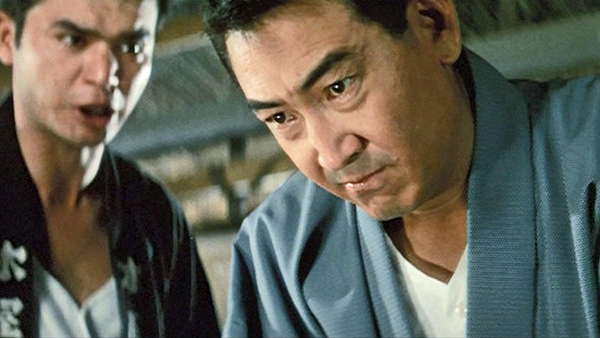
RAVING REVIEW: What does it take for an “honorable” man to admit he’s in a rigged game? BLOOD OF REVENGE drops you into Osaka with a premise that sounds familiar on paper—rival gangs, business dealings, and public respectability used as camouflage. Director Tai Kato treats that setup less like a springboard for nonstop action and more like a vise. The story’s fuel isn’t gunfire or body counts, it’s procedure: who controls labor, who controls construction, who gets to claim authenticity, and who’s forced to swallow insults because retaliation would ignite the entire city. That focus makes the movie feel more advanced than a lot of genre counterparts that sprint straight to the payoff, and it gives the drama room to breathe even when you can already sense where it’s headed.
Kato’s calling card here is control. He composes scenes like he’s laying down rules: where people stand tells you who’s cornered, who’s pretending to be something they’re not, and who’s daring someone else to blink first. When the film locks onto Koji Tsuruta, it becomes a showcase for what he did better than almost anyone in this lane—playing a man who communicates power through refusal. He refuses to beg. He refuses to turn every conflict into a brawl just to prove he can win one. That restraint is the point, and it’s also the trap. The more Tsuruta’s Kikuchi tries to keep the conflict “clean,” the more the story shows how impossible that is when the opposition isn’t interested in shared rules. He’s basically negotiating with people who benefit from chaos, then acting surprised when they keep choosing chaos.
That’s where BLOOD OF REVENGE earns most of its credibility. It understands that honor isn’t just a personal code—it’s a social performance. It’s a way to keep a crew aligned, to maintain a business front, to protect elders, to keep younger hotheads from embarrassing the organization. The film keeps pressing on that pressure point: what happens when your identity is built on being the steady one, the dependable one, the “chivalrous” one, and then the world around you starts treating that as weakness? Kato doesn’t romanticize the answer. He lets the consequences build, and when violence finally becomes unavoidable, it doesn’t feel cathartic. It feels like an admission that the system won.
The romantic angle is also deeper than it first appears. Sumiko Fuji (credited in some materials as Junko Fuji) isn’t there just to level the movie. She’s there to echo the same theme from a different corner: people getting squeezed by expectations, contracts, and ownership—formal or implied. Her presence adds a bruised tenderness to the film, but it’s not sentimental comfort. It’s another reminder that even private feelings can have public consequences in this world. The relationship gives Tsuruta’s character humanity, yet it also makes his predicament harsher because “doing the right thing” now carries concrete collateral damage. It’s personal, and the film never lets him forget it.
If there’s a drawback, it’s that the movie sometimes leans so hard into arguing—meetings, threats, counter-threats, status disputes—that the narrative can feel like it’s circling the same dilemma in slightly different ways. You can see that as intentional, because that’s how these power structures operate: repetition, ritual, intimidation dressed up as negotiation. Still, there are stretches where you may wish the film varied its approach more, not by speeding everything up, but by finding more ways to show the pressure without always stating it. A little more visual storytelling in the midsection—moments where we watch plans quietly take shape rather than hearing them hashed out—could’ve honed the momentum without changing the film’s temperament.
Even with that, Kato’s direction keeps pulling you forward because he understands escalation as an emotional process. The turning points don’t land because the plot says, “Now it’s time.” They land because you can see the patience draining out of the room. That’s also why the eventual bloodletting hits harder than it would in a more trigger-happy film. The film earns its brutality. It also earns its melancholy because it never pretends that vengeance restores anything. It just changes who has to carry the weight.
Radiance’s limited edition presentation leans into context and craft: a new HD transfer, uncompressed audio, a Tai Kato short from 1943 (Lice Are Scary), a Mark Schilling visual essay focused on Fuji, a new subtitle translation, and a booklet with new writing by Earl Jackson alongside archival material. The extras point you back toward what makes it distinct—Kato’s eye, the era’s star power, and the way this story sits inside a tradition of ninkyo dramas where moral posture is both armor and liability.
BLOOD OF REVENGE is the kind of film you respect even when it doesn’t sweep you off your feet. Its best scenes are genuinely striking, its lead performance is rock-solid, and its view of “honor” is clear-eyed enough to feel relevant. If you want a yakuza drama that treats violence as the last resort of people who ran out of options—and treats that outcome as tragedy, not triumph—this one delivers.
Please visit https://linktr.ee/overlyhonestr for more reviews.
You can follow me on Letterboxd, Instagram, Twitter, and YouTube. My social media accounts can also be found on most platforms by searching for 'Overly Honest Reviews'.
I’m always happy to hear from my readers; please don't hesitate to say hello or send me any questions about movies.
[photo courtesy of RADIANCE FILMS, MVD ENTERTAINMENT]
DISCLAIMER:
At Overly Honest Movie Reviews, we value honesty and transparency. Occasionally, we receive complimentary items for review, including DVDs, Blu-rays, CDs, Vinyl Records, Books, and more. We assure you that these arrangements do not influence our reviews, as we are committed to providing unbiased and sincere evaluations. We aim to help you make informed entertainment choices regardless of our relationship with distributors or producers.
Amazon Affiliate Links:
Additionally, this site contains Amazon affiliate links. If you purchase through these links, we may receive a commission. This affiliate arrangement does not affect our commitment to honest reviews and helps support our site. We appreciate your trust and support in navigating these links.


Happy
0 %

Sad
0 %

Excited
100 %

Sleepy
0 %

Angry
0 %

Surprise
0 %
 1
1
 0
0


Average Rating