The Danger of Believing Your Own Narrative
Read Time:6 Minute, 8 Second
MOVIE REVIEWS
Corey Feldman vs. the World
 –
– 

Genre: Documentary
Year Released: 2025, 2026
Runtime: 1h 38m
Director(s): Marcie Hume
Where to Watch: available on Apple TV, YouTube, and Google Play, and the film will begin a special engagement with the Alamo Drafthouse theatre chain on March 6, 2026, and will see its New Zealand premiere with the famed Hollywood Avondale theater in Auckland on March 5
RAVING REVIEW: COREY FELDMAN VS. THE WORLD doesn’t force your hand in deciding who Corey Feldman is and what his legacy ultimately will be. It doesn’t ease you in, doesn’t soften the edges of its focus, and doesn’t check in to see if you’re comfortable. It places you inside a reality and leaves you there long enough for patterns to form on their own. That patience is its most defining quality, and also the reason it hits as hard as it does.
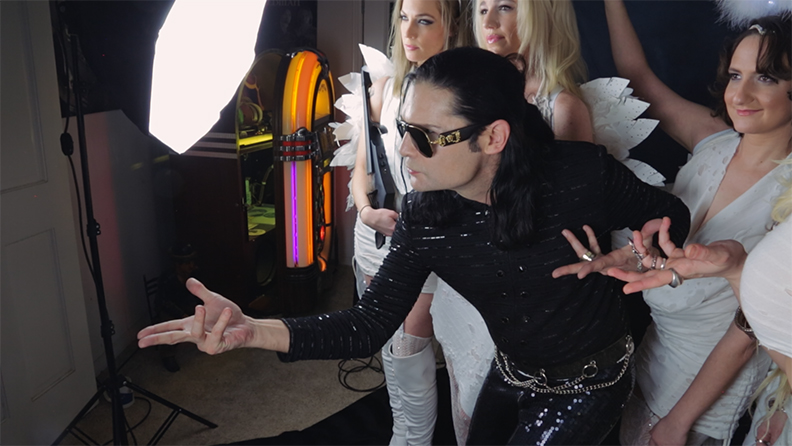
The film follows Corey Feldman during a prolonged attempt at cultural reclamation, centered on a touring music project, Corey's Angels, and a tightly controlled inner circle. On the surface, it looks like a comeback attempt built on belief, perseverance, and misunderstood genius. If you spend enough time watching, though, that framing starts to collapse. What replaces it isn’t a twist or revelation, but accumulation. Repeated moments of deflection. Repeated reframing of criticism as persecution. Repeated instances where power is exercised without self-awareness. In my personal opinion, it wouldn’t shock me to see Feldman try to run as the heir apparent for President in 2028 (kind of joking…)
Director Marcie Hume’s approach is crucial here. This is a vérité documentary in the truest sense. There are no talking heads stepping in to explain what you’re seeing. No editorial voice reaches out to tell you what matters. The camera stays present, even when it would be easier to cut away (except for the multiple times Feldman motions for it to be cut). Early on, the film is often funny. Uncomfortably funny, but funny nonetheless. Feldman’s language, presentation, and unwavering confidence create moments that feel absurd, hard not to laugh at. The film doesn’t encourage that laughter, but it doesn’t interrupt it either. It trusts the audience to recognize when humor stops being harmless. Over time, the tone shifts not because the film changes tactics, but because the implications of what’s being observed grow.
As the tour destabilizes, voices from within Feldman’s circle begin to speak out. Former collaborators describe environments defined by control, emotional manipulation, and imbalance. Non-disclosure agreements become tools of silence rather than protection. Loyalty is treated as proof of morality, while dissent is treated as evidence of evil intent. The film doesn’t rush these moments. It allows testimony to coexist alongside Feldman’s own worldview, leaving the contradiction unresolved.
COREY FELDMAN VS. THE WORLD never pretends there’s a simple moral lane to drive in. Feldman’s history of childhood abuse is acknowledged, not as a footnote, but as a foundational truth that informs who he is. At the same time, the film refuses to let that history excuse the harm described by others. It asks the audience to hold both realities at once, even when it feels uncomfortable.
What makes the documentary especially effective is how clearly it shows the mechanics of self-mythmaking. Feldman frames himself as a righteous figure under constant attack, surrounded by enemies who don’t understand his mission. Any challenge to his authority is recast as a moral failure. Any attempt at accountability is labeled betrayal. Over time, this belief system leaves no room for reflection, only reinforcement. (again, sound familiar?)
The women featured in the film are essential to its emotional focus. Their accounts aren’t treated as counterpoints or obstacles. They’re presented as lived experiences that complicate the story Feldman tells about himself. Watching those experiences brushed aside, reframed, or dismissed in real time is where the documentary becomes genuinely unsettling. The imbalance of power isn’t theoretical; it’s visible in everyday interactions.
Hume’s decision to stay observational rather than confrontational is what gives the film its credibility. She doesn’t interrupt, correct, or challenge Feldman on camera. Instead, she lets his worldview speak for itself. Over nearly a decade of footage, that worldview hardens. By the latter sections of the film, Feldman’s inability to process criticism without spiritualizing it becomes impossible to ignore.
There’s a point where the documentary stops being about a failed tour or a misunderstood artist and becomes something more sobering. It turns into a study of how fame can freeze a person in place, how trauma can be weaponized against accountability, and how control can masquerade as protection. None of this is stated outright. It’s felt. The editing is deliberate, the pacing patient. Scenes are allowed to linger even when discomfort builds. That choice forces the viewer to sit with the material rather than consume it passively. This isn’t a documentary designed for background viewing; it demands attention and emotional labor.
By the final moments, the laughter that was there early on is gone. What remains is something closer to grief. Not just for Feldman, but for the people caught in his pull, and for the version of him that might have existed if self-reflection had been possible. The film never suggests redemption or resolution. It ends where it began, inside a closed system. COREY FELDMAN VS. THE WORLD is entertaining conventionally, but it’s fearless in its restraint. It doesn’t chase the scandal. It doesn’t sanitize the complexity. It trusts reality to be stranger, sadder, and more revealing than any imposed narrative could be. This is a difficult film to watch and an even harder one to dismiss. It lingers because it doesn’t tell you what to think. It shows you how power behaves when it’s never questioned, and then steps aside.
Please visit https://linktr.ee/overlyhonestr for more reviews.
You can follow me on Letterboxd, Instagram, Twitter, and YouTube. My social media accounts can also be found on most platforms by searching for 'Overly Honest Reviews'.
I’m always happy to hear from my readers; please don't hesitate to say hello or send me any questions about movies.
[photo courtesy of SUBJECTIVE FILMS, COOL AND HAPPY STUDIO]
DISCLAIMER:
At Overly Honest Movie Reviews, we value honesty and transparency. Occasionally, we receive complimentary items for review, including DVDs, Blu-rays, CDs, Vinyl Records, Books, and more. We assure you that these arrangements do not influence our reviews, as we are committed to providing unbiased and sincere evaluations. We aim to help you make informed entertainment choices regardless of our relationship with distributors or producers.
Amazon Affiliate Links:
Additionally, this site contains Amazon affiliate links. If you purchase through these links, we may receive a commission. This affiliate arrangement does not affect our commitment to honest reviews and helps support our site. We appreciate your trust and support as you navigate these links.


Happy
0 %

Sad
0 %

Excited
100 %

Sleepy
0 %

Angry
0 %

Surprise
0 %
 2
2
 0
0



Average Rating