The Lingering Echo of One Tragic Night
Read Time:5 Minute, 42 Second
MOVIE REVIEW
Let Dan Go
 –
– 


Genre: Drama, Short
Year Released: 2026
Runtime: 17m
Director(s): Arielle Carroll
Writer(s): Timothy J. Cox
Cast: Timothy J. Cox, Ashlee Lawhorn, Daniel Griesheimer
Where to Watch: TBD (film festivals)
RAVING REVIEW: LET DAN GO focuses on something many stories about grief overlook, examining the conversations that happen years after a loss, when the initial shock has faded, but the questions remain. Directed by Arielle Carroll and written by Timothy J. Cox, the film focuses on the aftermath of loss rather than the event itself, creating a reflective drama about two people trying to understand what it means to move forward.
The premise is simple but loaded with emotion. Years after a fatal car accident claimed the life of a young man named Dan, his father Harry reconnects with Dan’s girlfriend Abby. Their meeting is meant to celebrate Dan’s life, but the encounter also forces them to confront unresolved grief that has quietly shaped their lives ever since.
LET DAN GO works so well, thanks in large part to its commitment to intimacy. Rather than expanding the story across multiple locations or elaborate narrative threads, the film narrows its focus almost entirely to a conversation between two people who share the same loss but carry it in different ways. That choice turns the short into something closer to a chamber piece, where the strength and power of dialogue come from performance rather than plot mechanics.
Timothy J. Cox anchors the film as Harry, a father who has spent years learning how to live with a grief that never disappears. Cox approaches the role with restraint, allowing small gestures and pauses to communicate what Harry struggles to express. His performance suggests a man who has spent years quietly replaying the same memories, trying to make sense of something that will never make sense to him.
Opposite him, Ashlee Lawhorn brings a different energy to Abby. Where Harry’s grief has settled into something subdued and reflective, Abby carries a more visible vulnerability. The character still feels connected to Dan in a way that makes the conversation both comforting and painful. Lawhorn’s performance captures that duality well, showing someone who wants to honor the past while also trying to build a future that isn’t defined entirely by tragedy.
Daniel Griesheimer appears as Dan in the film’s opening segment, which functions as a brief prologue before the central conversation begins. This section establishes the emotional stakes without lingering too long on the event itself. Instead of sensationalizing the tragedy, the film treats it as a memory that continues to ripple through the lives of the people left behind.
Once the story transitions to Harry and Abby’s meeting, LET DAN GO settles into its true focus, looking at the slow, careful unpacking of grief through dialogue. Their conversation touches on shared memories, regrets, and the lingering question of whether it is ever truly possible to let someone go.
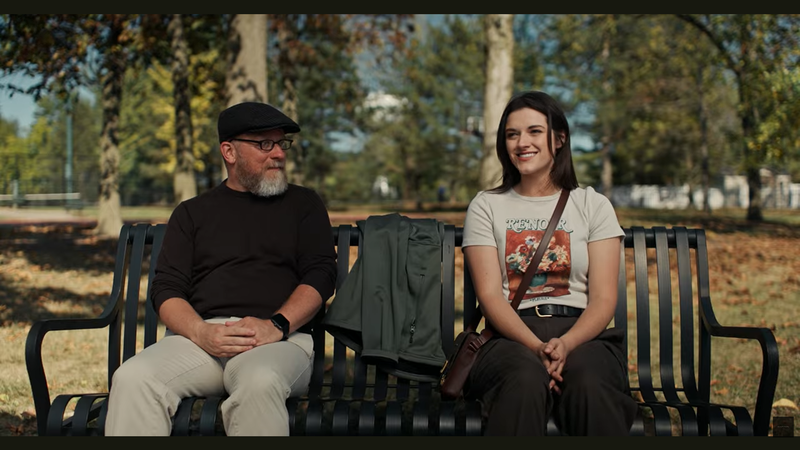
The park setting plays a surprisingly important role in the film’s atmosphere. The environment gives the conversation room to breathe, creating a natural backdrop that reinforces the film’s understated tone. Background sounds and passing moments of life continue around them, reminding the audience that the world moves forward even when personal grief feels frozen in time.
Director Arielle Carroll shows a strong instinct for pacing in these scenes. Rather than rushing the dialogue or pushing the emotion too aggressively, the film allows silence and hesitation to become part of the storytelling. That approach helps the characters feel like real people rather than vehicles for thematic statements.
Short films often struggle with time limitations, especially when dealing with emotionally complex material. LET DAN GO largely avoids that pitfall by structuring the story around a single encounter. The narrative doesn’t attempt to resolve every aspect of the characters’ grief. Instead, it captures one moment where understanding begins to take shape. The film's core strength lies in the authenticity of its performances. Cox and Lawhorn share a chemistry that makes their exchange feel more than scripted. Their dialogue carries the tone of two people who have spent years circling the same questions, finally allowing themselves to speak about them.
LET DAN GO refused to frame grief as something that has to be conquered or resolved. The film recognizes that loss changes people in ways that never disappear. Harry and Abby aren’t searching for closure in the traditional sense. Instead, they’re trying to understand how the memory of someone they loved can remain present without preventing them from continuing with their lives. That perspective gives the film a maturity. Rather than delivering a dramatic revelation or a perfect resolution, LET DAN GO ends on a note that feels reflective and open. The conversation doesn’t erase the pain they carry, but it allows them to acknowledge it together. For a short film, that honesty goes a long way.
Arielle Carroll’s direction demonstrates a clear understanding of how small-scale storytelling can deliver meaningful impact when the focus remains on character and performance. Timothy J. Cox’s script also shows an appreciation for the complexity of grief, resisting the temptation to simplify the emotions involved. LET DAN GO succeeds because it recognizes that healing often begins with something as simple as a conversation. Two people on a park bench (anyone get the reference?), sharing memories and confronting the silence left behind by someone who is gone, become a powerful reminder that letting go does not mean forgetting. Sometimes it means learning to carry their memory differently.
Please visit https://linktr.ee/overlyhonestr for more reviews.
You can follow me on Letterboxd, Instagram, Twitter, and YouTube. My social media accounts can also be found on most platforms by searching for 'Overly Honest Reviews'.
I’m always happy to hear from my readers; please don't hesitate to say hello or send me any questions about movies.
[photo courtesy of ALYSM FILMS]
DISCLAIMER:
At Overly Honest Movie Reviews, we value honesty and transparency. Occasionally, we receive complimentary items for review, including DVDs, Blu-rays, CDs, Vinyl Records, Books, and more. We assure you that these arrangements do not influence our reviews, as we are committed to providing unbiased and sincere evaluations. We aim to help you make informed entertainment choices regardless of our relationship with distributors or producers.
Amazon Affiliate Links:
Additionally, this site contains Amazon affiliate links. If you purchase through these links, we may receive a commission. This affiliate arrangement does not affect our commitment to honest reviews and helps support our site. We appreciate your trust and support as you navigate these links.


Happy
0 %

Sad
0 %

Excited
0 %

Sleepy
0 %

Angry
0 %

Surprise
0 %
 0
0
 0
0


Average Rating